
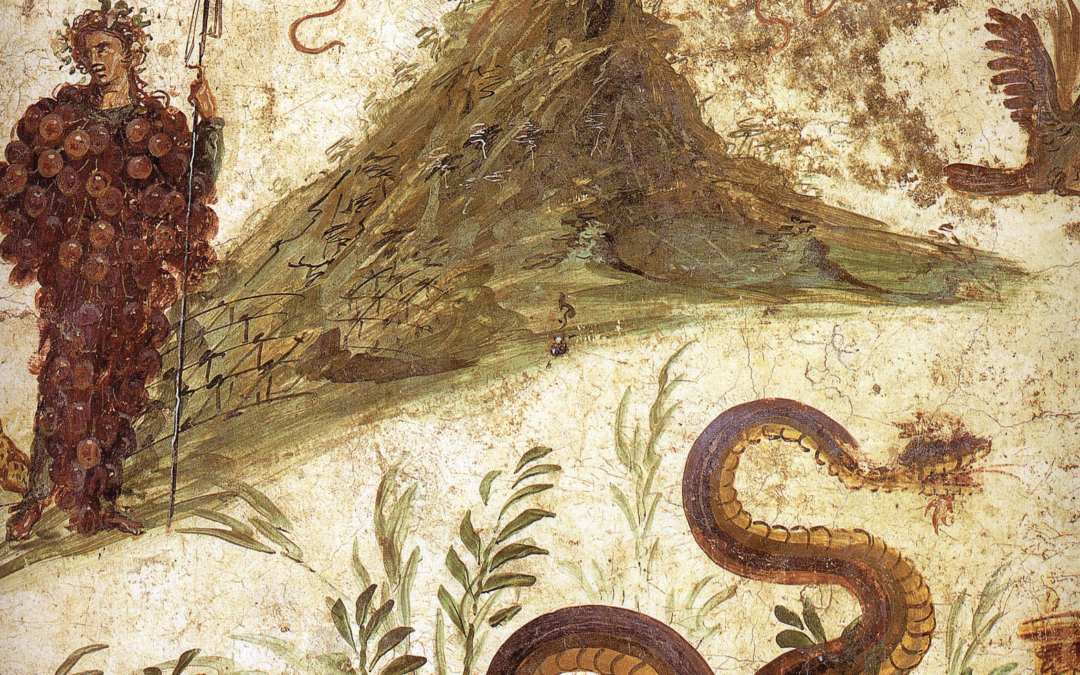

An ancient Roman depiction of the genius loci, the spirit of place, as a serpent from Pompeii in the first century BCE. From Marisa Panetta (ed.), Pompeji: Geschichte, Kunst, und Leben in her versunkenen Stadt, Stuttgart: Belser Verlag, 2005, p. 111.
Alexander Pope, the eighteenth-century English poet, giving advice on garden and landscape design, wrote, “Consult the genius of the place in all; That tells the waters or to rise, or fall.” These lines have been understood to recommend considering the context of the location when designing as a primary principle in landscape architecture. The poet was invoking a religious idea from ancient Rome, the idea of the genius loci, or the spirit or god of the place.
In the ancient world, the land was considered to be inhabited by spiritual entities that had to be propitiated with prayer and sacrifice before any kind of work could be attempted on the land. Each grove of trees, each spring, each creek or river, and every hill or mountain had its own spiritual beings, which were variously known as fauns, nymphs, dryads, satyrs, lares, and gods. Proceeding to fell trees, plow ground, or sow without their approval was to court disaster.
No respectable Roman would fail to honor the genii locorum in any agricultural operation. Cato the Elder, in his farming manual, De Re Rustica, stated that it was the sacred duty of a farmer to sacrifice a pig to the god of the grove before cutting down a single tree! The care of the local spirit population was as essential to proper agriculture as good plowing techniques and sowing the right seed at the right time.
Such an approach is a far cry from the merely aesthetic sense meant by our poet, Pope. This philosophy entails a deep spiritual relationship with the intelligences of the land and brings a reverence, not without perhaps a bit of fear of incurring the wrath of the land spirits, to the relationship between the farmers and the land they tend.
This idea of the natural world as haunted by spiritual entities didn’t begin to fade until the Protestant Reformation supplanted the animistic sentiment of the peasantry with the empty theology of a remote God. Later, as the Industrial Revolution largely depopulated the countryside, the widespread adoption of the materialistic worldview after the Enlightenment finally banished the fairy faith in all but the most remote corners of the world.
The Roman poet Virgil, author of the poetic agricultural manual known as The Georgics, which is rich in the rural spiritual lore of the ancient Roman farmers, addressed all the gods and goddesses who preside over the farmer’s life at the beginning of the First Georgic: Ceres, goddess of grain and agriculture; Pan, keeper of the flocks, the fauns, presences of the fields, the dryads, and the spirits of the oak trees; Neptune, who created horses; Minerva, who created the olive tree; Liber/Dionysus, giver of the vine; and Sylvanus, god of the forest. He praises,
You gods and goddesses who, with such kindness,
Watch over our fields and vineyards and who nurture
The fruits that seed themselves without our labor
And all the crops with rain that falls from heaven.
How Do We Communicate With Spirits Of The Land Today?
So, what does “consulting the genius of the place” mean to us? To me, it means first, on a practical level, just as Virgil recommends in the First Georgic:
And yet, if the field is unknown and new to us,
Before our plow breaks open the soil at all,
It’s necessary to study the ways of the winds
And the changing ways of the skies, and also to
Know the history of planting in that ground,
What crops will prosper there and what will not
In one place grain grows best, in another vines….
So, on the material level, consulting the genius loci could mean to take into careful account the ecological conditions of the land, sun, drainage, soil type, slope, local weather, what crops grow well in your area, and other such considerations, the kind of things that the science of agronomy concerns itself with. This is necessary knowledge, and I myself spent years reading every agronomy book I could get my hands on.
But it’s not enough to only heed the material conditions of the land. Consulting the actual spirits who inhabit your land pays on a practical level because they are real, even if you can’t see them. I know I’m heading into crackpot territory here, perhaps, but this is my experience. When you take the spirits into account, things just start to go better — crops are healthier, animals thrive, you have fewer problems with pests, weather may be more favorable, and you may even suffer fewer accidents and breakdowns.
The genii locorum — the fey, the gods, and the angels — are forces with whom we can form relationships to our benefit and to that of the world.
I’m not saying you’re not going to have problems if you neglect basic agronomy — far from it. You must put in the physical work for the magic to work. Careful agricultural technique also honors the spirits of the land. One must work the soil at the right time, when moisture and other conditions are right, and plant at the right season. All of these practices please the land spirits.
Prayerfully reaching out to the Source in whatever name one finds most appealing whenever we begin any major agricultural operation is an excellent practice. You could use the Homeric Hymn or Orphic Hymn to Gaia or Demeter if you are of a classical bent, and pour out a libation of wine or olive oil before you plow or work ground. Asking the Creator to bless the seeds you are about to plant and honoring the phases of the Moon, the rising of the Sun, the planets, and the stars are all good ways to spiritually connect with the spirits of nature and the spirits of the land. I always make sure to start and end my prayers by acknowledging the Source, the One, from whom all things come, but that’s just my way.
A more specific way to connect with the genii locorum is to find a power spot in nature near you — a hollow tree, a spring, a cave, a large oak tree, a hill, something that seems like a gateway. On two farms I have lived on, I have found large oak trees growing next to springs and have gone occasionally to leave offerings and ask favors from the genius there. I meditate briefly and go on my way.
So how to proceed in practice? I’ve mentioned some practical steps in passing above, which I will repeat here, along with some others that I haven’t mentioned, that I consider helpful to those who are interested in entering into a closer relationship with the spirits of the land:
- Leaving out libations. These are offerings of a drink (often wine, but it could be juice or milk) poured out for specific entities. It was a long-standing custom to leave bread and milk out at night for the fairies in much of the Celtic world.
- Leaving food offerings outside, on an altar, or at a sacred spring.
- Performing prayers and blessings any time any significant projects are undertaken on the land, like felling a tree, plowing, or otherwise working ground, planting crops, harvesting, and so on.
- Marking the turning of the year and seasons, like the solstices, equinoxes, and cross-quarter days, with prayers relevant to the occasion.
- Finding power spots in nature where you can sense the presence of land beings and enter into communication with them. A pendulum can be helpful for this, by dowsing for yes or no answers, or indicating flows of subtle energy.
- Practicing geomancy (particularly if you are a bit thick about receiving messages from the nature communication, like I am), which is a method of divination that basically involves making a series of marks in the dirt or sand and deriving answers ranging from either a yes or no to a whole astrological chart from them.
Just getting outside, into nature, night or day, and speaking from your heart in prayer, song, or silence to the power there, with as much or as little ceremony as you are comfortable with, will change your life more than you can imagine. And with repeated practice comes a deeper relationship with the land and its visible and invisible inhabitants.
The genii locorum — the fey, the gods, and the angels — execute the creative force of the divine here in the world of manifestation, administering the world of nature accordingly. They are forces with whom we can interact and form relationships to our benefit and to that of the world and the human community.
Reprinted with permission from The Cunning Farmer: Agrarian Magical Practices, Mythology & Folklore by Todd Elliott. Inner Traditions, 2026.
Todd Elliott is a practicing farmer, Druid, Reiki master, and astrological magician who lives and works on a ridgetop farm in Kentucky, ethically raising crops and livestock with his family, while preserving these endangered traditions.
Find holistic Energy Healing And Medicine in the Spirit of Change online Alternative Health Directory.
RELATED ARTICLES:
Farming Without Disturbing Soil Could Cut Agriculture’s Climate Impact By 30% – New Research
Transforming Food And Health In Native Communities Through Vertical Farming
Recent Comments