
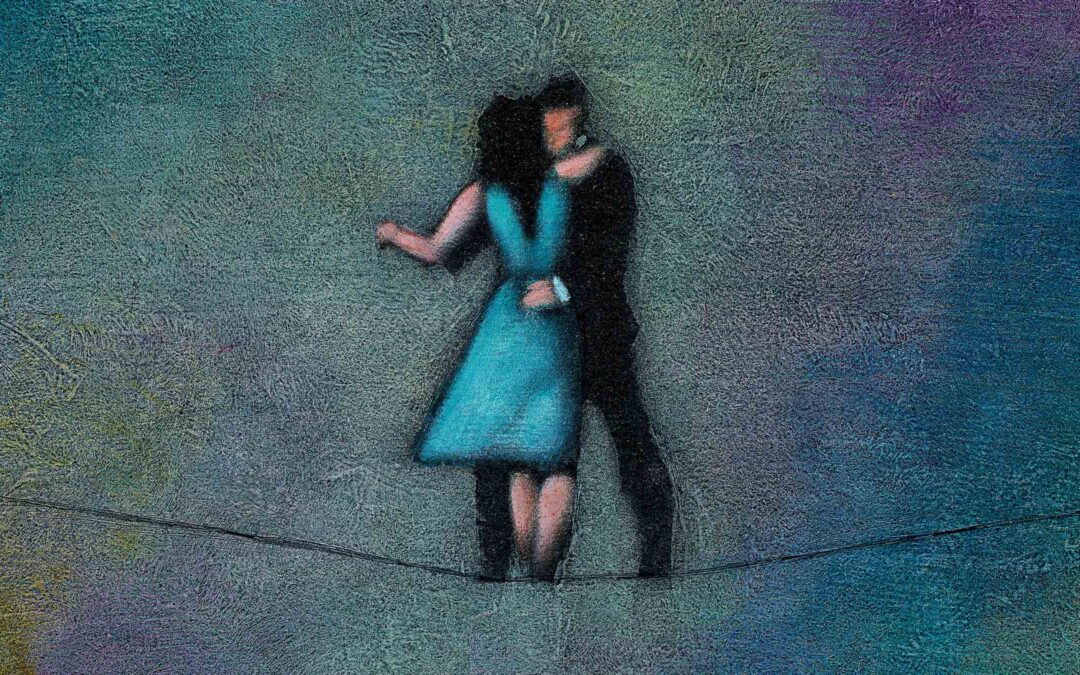
In 1974, Philippe Petit walked a wire strung between the Twin Towers in New York City. For forty minutes, he walked, knelt, lay down, even danced—1,300 feet above the street.
What made this possible wasn’t just courage. It was training. Petit had practiced balance his entire life, then spent months preparing for this specific crossing—learning the tension of this particular wire, how wind moved at that altitude, how his body responded to fear. What he was really mastering was a kind of middle way: not leaning too far in either direction, not tightening or loosening his body too much, staying responsive to each shifting condition. By the time he stepped out over the void, he was ready.
In intimate partnership, we walk a similar wire. The tension between autonomy and connection is our own high-altitude balancing act—and unlike Petit, most of us step onto the wire without ever having trained.
The Buddha taught the middle way: the path between extremes. Not too tight, not too loose. Not grasping, not pushing away. Petit lived this principle physically; in relationship, we live it emotionally. In a relationship, this is not an abstract teaching. The wire we’re walking is strung between two of our deepest human needs. On one side: autonomy—solitude, independence, self-determination. On the other: connection—intimacy, togetherness, the knowledge that you matter to another person. We feel pulled between them, clinging to independence and space one moment and to closeness the next, trying to stop the wobble instead of learning to ride it.
The Buddha had a word for this: dukkha. The stress that comes from trying to make the unstable secure, from demanding that what’s inherently uncertain become reliable.
Seen through the lens of dukkha, relationship isn’t a problem to solve. It’s a training in balance—exactly the kind Petit undertook—learning to feel the wobble without collapsing into either extreme.
A few years ago, my partner, devon, and I finished a three-year meditation retreat. We’d been practicing intensively for forty-four months, mostly in silence, mostly together. The meditation deepened us. It also made us forget how to be separate people.
We could see we’d become entangled and stuck. We tried to fix it. Nothing worked.
Not long after, we went into separate six-week retreats. During those weeks alone, I came up with what seemed like a perfect solution: I would become a monk within the marriage. Devon could handle all our affairs. I’d meditate, study, teach. We’d both be so happy.
When I told her this plan, she looked at me like I’d lost my mind. “That’s not going to work,” she said.
But I couldn’t let it go. For weeks we were stuck, rehashing the same positions—me trying to sell her on my vision, her explaining, again and again, why it was absurd.
Finally, we started using the practices we teach—check-ins, meditation, honest conversation. Very slowly, something else became clear. My plan wasn’t a way forward. It was a way out.
Neither of us yet knew how to stay inside the tension without one of us disappearing. What we began to understand, slowly and imperfectly, was that the relationship wasn’t going to give us relief from this tension. It was going to ask us to become more capable of living inside it.
The work was simple but not easy: notice the urge to pull away or close the distance, and stay with what is actually happening. Sometimes that meant tolerating solitude, sometimes tolerating closeness, but almost always it meant tolerating uncertainty.
The middle way isn’t a destination. It’s a discipline of constant rebalancing—moment-by-moment recalibration. Petit didn’t find one perfect posture; he responded to each shift as it came. Relationship asks the same.
The first discipline is to learn to see your own lean toward autonomy or connection. Everyone has both of these needs, and each of us tends to favor one more than the other. The only question from a practice standpoint, however, is which one you’re protecting in this moment. When conflict arises, where do you go? Do you withdraw into yourself, or pursue your partner for resolution? Neither is wrong. The problem begins when we make one of us wrong. When one of us is leaning toward connection and the other toward solitude, the unskillful move is to turn that difference into blame—you’re too clingy or you’re too distant. The practice is to see what you’re doing while you’re doing it and to respect your partner’s opposite movement without trying to correct it.
One essential discipline is this: When conflict arises, keep 50 percent of your attention on your own body and heart. Not just on what your partner is doing wrong, but on what is happening inside you. What are you defending? What are you afraid of? This isn’t self-absorption. It’s the only way not to fall off the wire.
But the deeper practice goes beyond technique. When I truly honor devon’s need for connection, I don’t lose myself—I discover my own capacity for intimacy. When she honors my need for autonomy, she doesn’t lose me—she discovers her own capacity for solitude. We find that what we thought were separate needs are actually braided together.
Philippe Petit didn’t achieve perfect balance once and keep it forever. He maintained his balance through thousands of micro-adjustments—shifting his weight, reading the wind, responding to each wobble.
Partnership is like that. The wire doesn’t go away, the wind keeps blowing, and autonomy and connection will always pull in opposite directions. This is not a failure of love—it’s the form love takes when it’s practiced in real time. We stay upright in relationship not because the wire becomes stable, but because we become steadier. Partnership becomes the training ground where we learn to walk the middle way.
The question isn’t whether you’ll wobble. You will. The question is whether you’re willing to keep training, together, on a wire that was never meant to become solid ground.
A Practice: The Balance Check
Find three minutes of quiet. Sit comfortably and close your eyes.
Notice where you are right now on the autonomy–connection spectrum. Are you leaning heavily into independence? Notice the fear underneath—perhaps of being swallowed, of losing yourself. Are you leaning heavily into togetherness? Notice that fear too—perhaps of being alone, of being left.
Don’t try to fix anything. Just see it clearly.
Notice what arises. Fear? Relief? Resistance? Let it be. If you’d like, write down your observations.
The post Walking the High Wire of Love appeared first on Lion’s Roar.
Recent Comments