
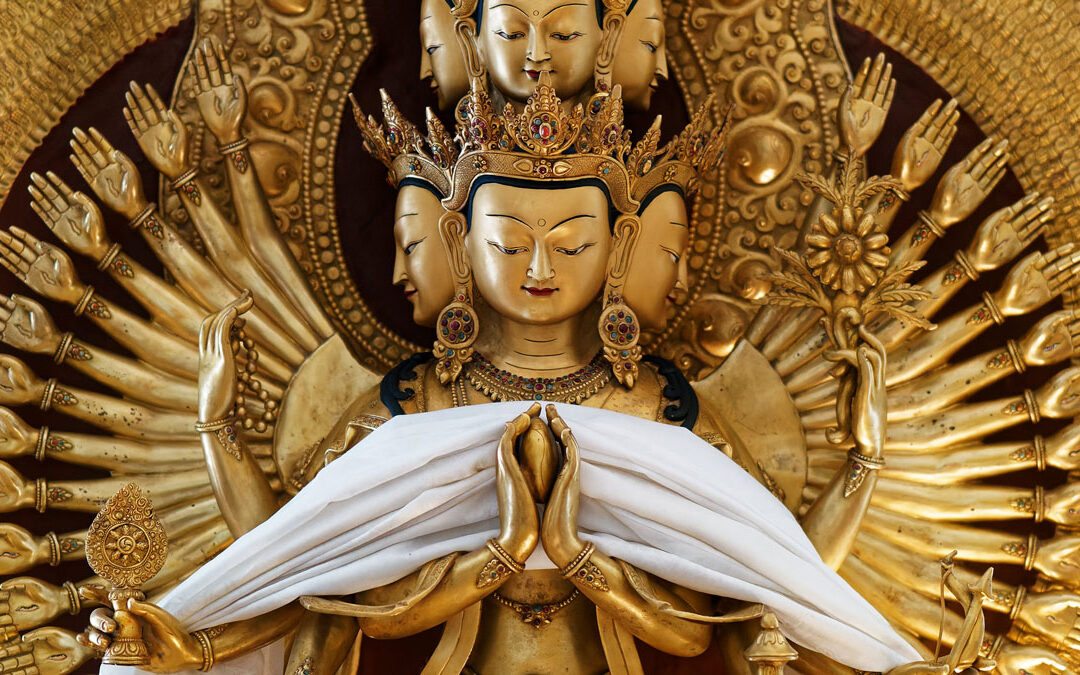
There is a story about Chenrezig, the bodhisattva of compassion, who vowed to liberate all beings from suffering. When he looked out at the world and saw the immensity of suffering — the endless cycles of pain, violence, fear, and cruelty — he shattered into pieces. The weight of witnessing this suffering broke him. Amitabha Buddha reassembled Chenrezig, giving him a thousand arms and eleven heads so he could better reach and see those who suffer. The story tells us Chenrezig cried in despair at the world’s suffering. His tears formed a lake, and from that lake a lotus bloomed, giving birth to Tara, the female Buddha, always ready to spring into action to help suffering beings.
“What is this rage teaching me? How can I sit with it without looking the other way?”
I am a Latina mother of two young children. In recent months, our community groups have experienced an increase in posts about ICE sightings. I now carry my passport everywhere I go. I’ve made copies of my naturalization papers and have shown my husband where to find the originals. I find myself rehearsing scenarios: What if I’m stopped on my way to school pickup? What will happen to my children if they are with me when I get stopped? I’m terrified that I will be detained and put in a detention center, never to be found.
These fears are the daily reality for hundreds of thousands of people across the United States. Whether it becomes a headline or not, we are all witnesses to what is and has been unfolding. Social media streams videos in real-time: children being separated from caregivers and sent to detention centers in other states, people being yelled at, shoved, assaulted, shot, and killed. The violence is happening in front of us. The constant flood of information saturates us, leading to desensitization. We freeze. We become numb. Our numbness becomes another form of turning away.
Chenrezig’s story teaches us something crucial: breaking open in the face of suffering is not a failure of practice, but part of the practice itself. When we truly witness the pain of the world, we will shatter, but from that shattering, we can be rebuilt. We can rebuild with a greater capacity to help, seeing our common humanity and opening to the suffering of all beings. We can free ourselves from an individualistic experience and move toward a communal one. By taking the bodhisattva vow, we hold the potential to heal from trauma. We learn to see our overwhelm and heartbreak are not obstacles, but a path forward.
The bodhisattva vow is central to Mahayana Buddhism. Like Chenrezig, when we take this vow we commit to reaching enlightenment for the sake of all sentient beings. We make a fundamental commitment to altruism, promising to face others’ suffering as central to our practice. This means we must honestly examine where our compassion actually extends. When we say, “all beings,” who are we including and who are we leaving out? Are we drawing lines that conveniently exclude those whose suffering would require us to act?
The bodhisattva vow is not a comfortable commitment. It asks us to truly witness, to let what we’re seeing land in our hearts and bodies, and to respond. This invites a continuous unfolding of being broken open, remaining present, and returning — again and again — to our own suffering and the suffering of all beings. It is an invitation to examine our practice honestly. Are we using the dharma to cultivate genuine wisdom and compassion, or are we using it to justify our own comfort and inaction?
We cannot control what is happening. We cannot single-handedly stop ICE raids or empty detention centers. But we can refuse to be desensitized. We can refuse to look away. We can show up in our communities by sharing resources, supporting those at risk, bearing witness, and speaking out. We can let our hearts break open rather than numbing them closed.
Our practice calls us to examine ourselves constantly, to check our intentions and motivations, and to make sure we’re not kidding ourselves about what we’re actually doing versus what we think we’re doing. The suffering is here, now, in front of us. The question for Buddhist practitioners is not whether we see this suffering — we do. The question is: what does our practice ask of us when we witness harm on this scale?
As Buddhists, we can fall into the trap of hiding behind our practice. We tell ourselves that “going beyond dualistic thinking” means not taking sides; that “equanimity” means remaining unmoved by injustice; that caring deeply about systemic violence is just another attachment. This isn’t wisdom — it’s spiritual bypassing. The Middle Way is not indifference. Equanimity is not the same as numbness. These concepts, when misunderstood, become excuses to avoid the discomfort of responding to injustice.
Buddhist practitioners in the West have become adept at using dharma concepts — non-duality, equanimity, karma, emptiness— as shields against the discomfort of responding to actual suffering. We say “all beings” while looking away from those whose suffering would require us to act, take risks, and break open. But the dharma, when practiced honestly rather than performed comfortably, breaks us open exactly where we’re trying to stay closed. Like Chenrezig shattering after seeing the suffering of all beings, genuine practice doesn’t lead to detachment. It leads to heartbreak, and even rage.
The question I keep asking myself is: What is this rage teaching me? How can I sit with it without looking the other way? What is this really calling me to do?
Vajrayana Buddhism teaches that our negative emotions can be transformed into fuel for enlightenment, often referred to as transforming poison into medicine. Rather than attempting to eliminate negative emotions, this approach involves using awareness to transmute them, turning destructive impulses into wisdom and compassion.
We are taught that everything can be taken as an opportunity to practice, that everything can be brought into the path. This is no different.
This article was created in collaboration with Buddhist Justice Reporter, founded by Buddhist POC in response to the police torture and killing of George Floyd, inspired by the anti-lynching journalistic work of Ida B. Wells-Barnett.
The post Using Heartbreak as Practice appeared first on Lion’s Roar.
Recent Comments