
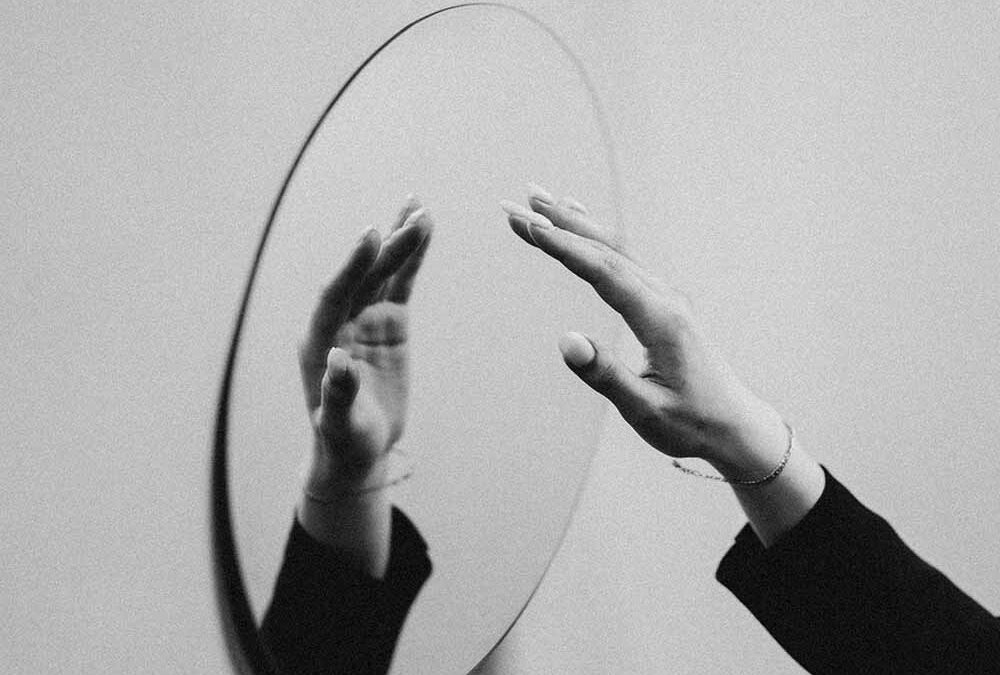
At age eleven, I went to a massive, marvelous playground. Part of it was labyrinthine and low-ceilinged, and it was almost meditative to crawl around in there, my eyes on the floor. At one point, though, I realized I was about to bang into another little girl. I shrank back, and she did too. My mind was forming a split-second opinion about her and her shyness when I realized she was me. It was my own reflection.
This moment of seeing myself without recognition gave me a funny feeling, as if I were Alice in Wonderland slipping through the looking glass. Suddenly, with a new view, I locked eyes with myself in the mirror. Who was I really? It was the first time I ever questioned my identity or what constitutes a self.
In the quiet heart of the playground, I got a glimmer of a truth I’d later encounter in Buddhism: I have no self as I normally think of it, no self that’s solid, separate, and unchanging. This felt unsettling then, also like freedom.
Usually, we go about our lives focused on our small self with its clear, confining borders of my body, my likes and dislikes, my opinions, my things, my accomplishments. Yet, as Bradley Donaldson explains (page 44), this me is just “piles of conditions” that have come together and will inevitably fall apart. If we cling to a definition of ourselves that’s based on these changeable factors, we’re signing ourselves up for suffering. After all, we can’t construct a separate, enduring self based these unstable, insubstantial factors. No matter how hard we try, it will never work.
Conventionally, no-self is seen as an existential threat. But occasionally we come upon some other thing or situation that allows us to see that no-self is actually a relief. We don’t have to constantly compare ourselves to others, questioning whether we’re better than them, worse than them, or equal to them. We don’t have to listen to our inner critic who’s always driving us to be more or different. That’s because, as Alisa Dennis puts it, “there’s no permanent, deficient self to condemn.”
Our true nature is buddhanature, which Dennis defines as our “inherent clarity and warmth that was never lost, only covered over.” It’s our intrinsic wholeness.
Being authentically ourselves is not just for our own benefit. When we show up authentically, we create space for others to do the same, and in that space, says Jo Confino (page 52), a new, meaningful connection can emerge between us. We recognize our mutual interbeing—I am because you are, you are because I am. And we take care of each other.
“When we strip everything back, our deepest aspiration is not fame, wealth, or the fulfilment of desire,” Confino continues, “but something far simpler and more profound: to love and be loved.”
Of course, it’s only human to keep losing touch with our true nature—to remember and forget, remember and forget. So, although what I learned in the playground did not stay with me, the truth of no-self occasionally flickers into my awareness, and those are always the moments when I’m most loving and at ease in the world.
Discovering our authentic self is a practice and a lifelong journey. May the teachings in this issue’s special section “Discover Your True Self” help you on your path.
The post Through the Looking Glass appeared first on Lion’s Roar.
Recent Comments