
Guest post by Trupti Rathi
“Yoga does not just change the way we see things, it transforms the person who sees.” — B.K.S. Iyengar
In nine years of running a yoga studio, I have seen the same pattern repeat itself more times than I can count.
Someone joins in January. They come three times a week for the first month. They are motivated, consistent, genuinely enjoying it. Then, somewhere between week six and week ten, attendance starts slipping. By month three, they have quietly stopped coming.
When I have had the chance to ask why, the answers are almost always the same. And almost always, the real reason is not what people think it is.
It is not about time, motivation, or flexibility
The most common reasons people give for quitting are: “I got too busy,” “I lost motivation,” or “I am just not flexible enough.” These feel true, but they are symptoms, not causes.
The actual reason most people quit in the early months comes down to one of three things — and once you can see which one applies to you, the path forward becomes much clearer.
Reason 1: They are measuring the wrong things
Most beginners start yoga with a visual idea of what it should look like — someone folding effortlessly in half, balancing on one leg, holding a perfect downward dog. When their body does not match that image in week two, they interpret it as failure.
The problem is not their body. It is the measuring stick.
Yoga is not a performance. Progress in yoga looks like this:
- Sleeping better after two weeks of practice
- Your lower back not being as tight in the mornings
- Feeling less reactive during a stressful day at work
- Holding a pose for five breaths instead of two
None of these look impressive in a photo. All of them are real progress. If you only track the visible stuff, you will miss most of what yoga is actually doing for you.
Reason 2: They picked the wrong class for where they are
Not all yoga classes are built the same, and not all “beginner-friendly” labels mean what you think they do.
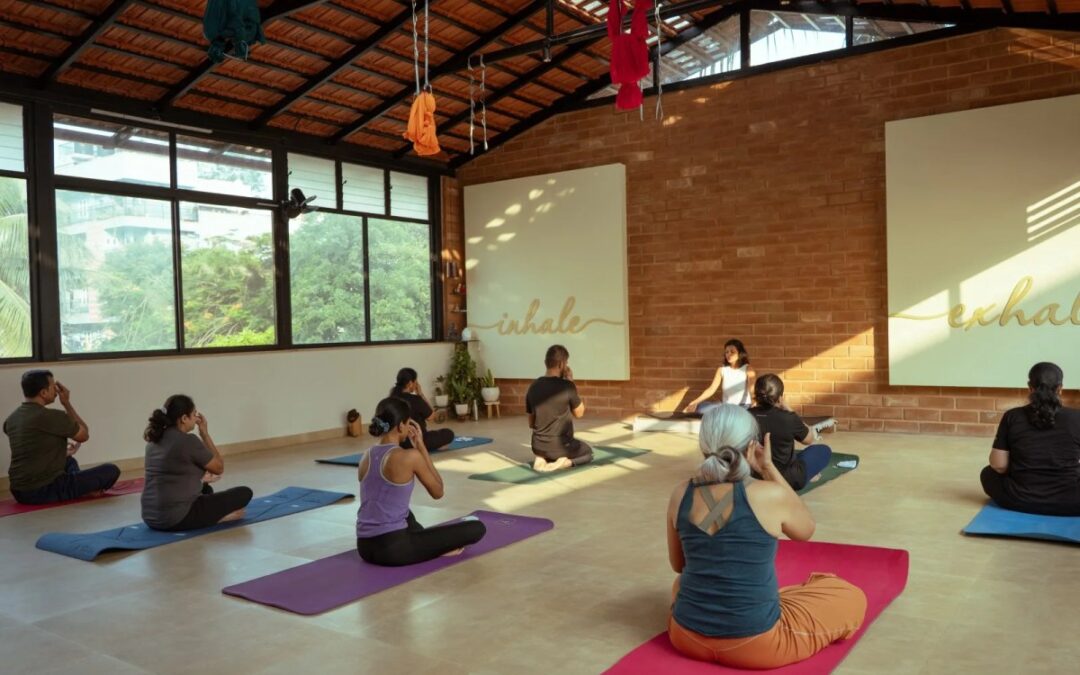
A fast-paced Vinyasa class with 25 students and minimal individual correction is a very different experience from a structured Hatha class with 10 students where the teacher walks the room. Both might be called “open to all levels.”
If your first months of yoga feel confusing or physically frustrating, you have not failed. You may simply be in the wrong class.
What to look for in an early-stage class:
- Small batch sizes (8-12 students) so you actually get attention
- A teacher who gives individual corrections, not just general instructions
- A class where you finish feeling better than when you walked in, not defeated
Reason 3: They are waiting to feel ready before being consistent
This is the most subtle reason and the most persistent. It sounds like: “I will go back to class once my schedule settles down.” Or: “I want to practice at home a bit more before I return.”
The schedule never settles. The home practice rarely materialises. And the longer the gap, the harder it feels to walk back in.
Consistency in yoga does not come from being ready. It comes from showing up before you feel ready. The practice is the preparation.
The most durable students I have taught are not the ones who came in most motivated. They are the ones who came back after missing two weeks and said nothing more dramatic than: “Okay, I’m back.”
What actually helps people stick with yoga
Based on what I have seen work over years of teaching:
- Commit to two classes a week, not five. Overcommitting early leads to burnout. Two consistent classes a week for three months will do more than five sporadic ones.
- Find a teacher, not just a studio. A teacher who knows your name and remembers your shoulder issue is worth more than a thousand online videos.
- Track the non-visible progress. After each session, write one thing that felt better than last week. Do this for 90 days.
- Give it 90 days before you judge it. The first month is mostly your nervous system adjusting. Real change shows up in months two and three.
The practice is patient. You just need to meet it halfway.
Yoga does not require perfection, flexibility, or ideal timing. It requires only that you keep coming back.
If you quit in the first three months, you are not a failure. You are someone who has not yet found the right entry point. Change the class, adjust the expectation, lower the frequency if needed — but do not walk away entirely. The version of yourself that sticks with yoga for a year is worth the patience it takes to get there.
About the Author: Trupti Rathi is the founder and principal yoga teacher at Absolute Yoga, a studio in Kalyan Nagar, Bangalore, established in 2016. With over a decade of teaching experience across in-studio, online, and aerial yoga, she works with students at every stage of their practice. More at www.absoluteyoga.in.
Recent Comments