
“Love isn’t a state of perfect caring. It is an active noun like struggle.”
—Fred Rogers
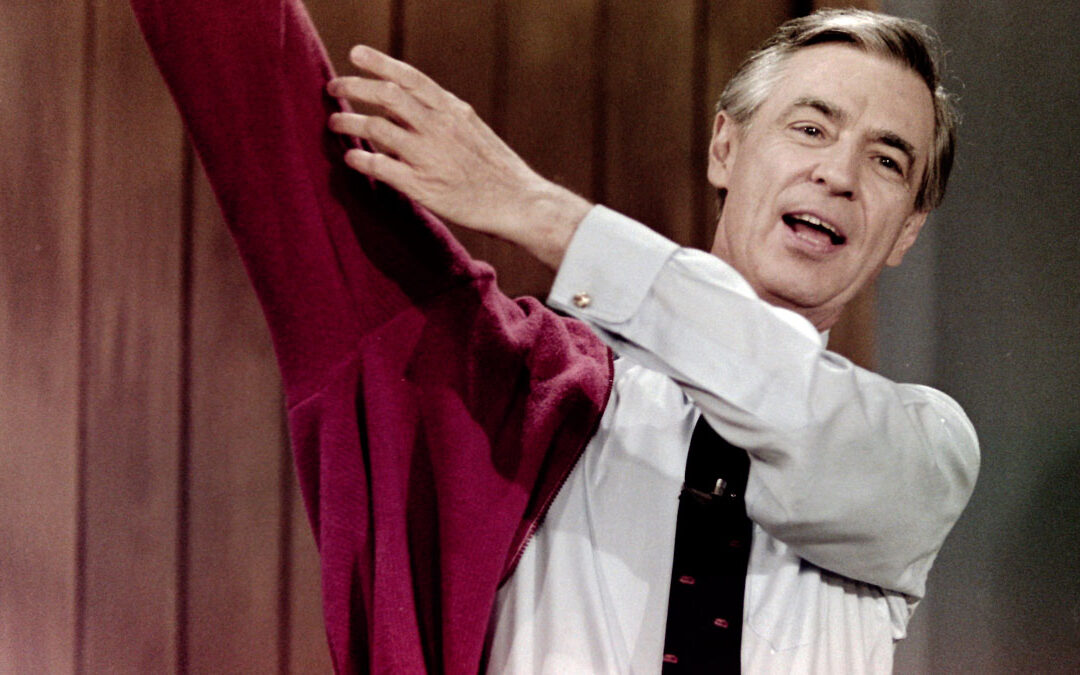
This year, August 31st marks twenty-five years since the last episode of Mister Rogers’ Neighborhood aired. Growing up outside of the United States, I wasn’t exposed to Mister Rogers’ Neighborhood as a child. I first registered who Fred Rogers was when I saw Tom Hanks play him in the 2019 film A Beautiful Day in the Neighborhood, through which I began to understand how much of an impact he had in American households, offering a daily dose of goodness through the television.
I watched the 2018 documentary film about his life, Won’t You Be My Neighbor?, for the first time only recently. I was moved watching him interact with children in real time, not as an actor or puppeteer, but simply talking to a child, looking at each one as if they were the most important person he could possibly be speaking to.
“He was asking us to be there for our neighbors, to reach out in small ways to whoever happens to be in front of us, and ultimately make them part of our neighborhood.”
In one scene, a ten-year-old boy named Jeff Erlanger, who was in a wheelchair after spinal surgery, sat across from Rogers. He asked him quite directly about his wheelchair, why he used it, and what it was like. There was no discomfort in the way he approached him. The message was the same one he offered children over and over again: you don’t need to change anything about yourself to be loved. Then the two of them sang “It’s You I Like” together. I found it so sweet and moving to watch, thinking about what it must be like for a child to have somebody look at them that way, as if they were completely accepted just as they were.
As I watched, the word that kept coming to mind was metta. Metta is usually translated as loving-kindness, a kind of unconditional friendliness and goodwill toward ourselves and others. Every time he looks straight into the camera and speaks to the children watching at home, it’s as if he’s actually seeing you with eyes of unconditional love and acceptance. He reminds us that you don’t have to accomplish something, look a certain way, get the right grades, or become somebody special before you are loved. There’s something innately good and lovable about you already.
Rogers was famously criticized by some conservative commentators for this, accused of helping raise a generation of entitled children who thought they were wonderful without having to earn it, but that’s not how I see it. Rogers was an ordained Presbyterian minister and a deeply spiritual person. He wasn’t trying to pump up children’s egos. He was speaking, I think, from a belief in the inherent sacredness — or basic goodness — of every being.
I try to do some version of this in my own work. Whatever a person comes to me with, whether a physical, mental, or emotional struggle, I try to see beyond what I sometimes think of as the externality of the person. I try to see something core in them that is good and whole, beyond all the quirks and neuroses of personality. When I can do that, something changes in the relationship, but it’s something I have to remind myself of. It isn’t simply a state I inhabit all the time.
When I first encountered Rogers through the Tom Hanks film, my reaction was that he seemed like a yogi, someone who simply embodied love and compassion. It looked effortless, as though that was just who he was. In reality, things were more complicated, as the documentary explained. Rogers had been a frequently ill child who was bullied. His beloved puppet, Daniel Striped Tiger, became a kind of alter ego, a way for him to express his own fear, insecurity, and vulnerability.
As Thich Nhat Hanh’s famous teaching goes, “No mud, no lotus.” The mud of Rogers’ own suffering seems to have become part of what allowed something very beautiful to grow. He could have become bitter or angry from what he experienced as a child. Instead, he seemed determined not to inflict that same pain on somebody else.
That doesn’t mean it all came naturally. Rogers swam a mile most mornings. He weighed himself every day, having been called “fat Freddy” by his childhood bullies. He studied at seminary. He had routines and disciplines. When he stopped making the show for a period, his wife recalled that he seemed to lose something of his sense of purpose.
People who knew Rogers’ television persona often wondered the same thing I found myself wondering when I first encountered him: Is this guy actually real? Is he like this when the camera is off? By all accounts, the answer was yes. “Mr. Rogers” wasn’t simply a character he played on television — it was how he tried to live.
One of the most powerful scenes from the show came in 1969, when Rogers invited François Clemmons, a Black cast member who played Officer Clemmons, to sit beside him and cool his feet in the same small wading pool. This was at a time when segregated swimming pools were still very much part of American life. Afterwards, Rogers dried Clemmons’ feet. It was, in its own way, quite subversive. He wasn’t particularly subtle about what he wanted to say.
Yet Clemmons was also gay, but Rogers asked him to keep that private because he feared the controversy could cost the program its audience. Though it was likely to protect a show he thought could do a lot of good, there were limits to what even Fred Rogers was willing to take on in that moment, and there was a real cost to Clemmons in being asked to remain closeted.
Rogers wasn’t some godlike person beyond human struggle. He was a human being trying, within the constraints of his time and his own limitations, to approach the world from a place of compassion, faith, and love.
He was also, in some ways, an activist. He just had a very different way of doing it. You see that in his famous 1969 Senate testimony defending funding for public television. He had prepared a speech, but didn’t really use it. He simply talked about what he was trying to do for children and why he believed it mattered. The senator listening to him was visibly disarmed and finally told him, in effect, that he’d earned the twenty million dollars he was asking Congress to preserve. There was great conviction in Fred Rogers’ quietness.
The last new episode of Mister Rogers’ Neighborhood aired only eleven days before September 11, 2001. About a year later, his producers persuaded a reluctant Rogers to return to the studio to record messages for parents. He wasn’t sure he had anything adequate to say. My sense was that the scale of what had happened shook him. The message he eventually gave was one of hope. He invoked the idea of tikkun olam, from the Jewish faith, which he rendered as a call for all of us, whatever our particular work, to become “repairers of creation.”
Rogers himself would not have called any of this metta. He would perhaps have understood what he was offering through the language of grace and God’s unconditional love, which isn’t quite the same claim metta makes. In the Christian understanding, you are worthy of God’s love because you are a child of God. Metta begins somewhere different, as a practice. We deliberately cultivate goodwill toward ourselves, then toward people we love, and gradually extend it outward toward more and more beings.
My own roots are in the Hindu philosophy of Advaita Vedanta, and that may be why these different ways of speaking about love don’t feel so far apart to me. Advaita points toward a reality in which the separation between “me” and “you” is ultimately not as solid as we imagine it. The practice of metta can soften those boundaries, too. As the heart opens to wider and wider circles of beings, the world begins to feel less divided into us and them. For me, these traditions point toward something universally recognizable: a love that excludes no one.
I think that’s part of why many people find themselves crying watching Mr. Rogers all these years later, myself included. There’s a grief in watching the world Rogers created in his neighborhood — a kind of grief for what could be. I wish we could have that kind of world, I found myself thinking.
He wasn’t asking us to fix the whole world — he was asking us to be there for our neighbors, to reach out in small ways to whoever happens to be in front of us, and ultimately make them part of our neighborhood. We don’t have to solve everything. Tending to our own little corner of the world matters. The quality of attention is part of what metta looks like when it leaves the cushion.
Fred Rogers kept repeating a version of the same thing throughout his life: I like you as you are. Reach out to your neighbor, he taught us. Respond to the needs of whoever shows up in front of you. Slow down enough to actually see them. Twenty-five years after his last episode aired, his message still feels like a practice worth learning.
The post The Metta of Mister Rogers appeared first on Lion’s Roar.
Recent Comments