
“Until you make the unconscious conscious, it will direct your life, and you will call it fate.” ~Carl Jung
“You’re just like your mother.” I came across those words in a post recently, followed by a response that made me pause: “Actually, I’m my mother’s revenge. I’m the voice she didn’t have and the boundary she couldn’t set.”
It stayed with me, not because I felt any desire for revenge against anyone, but because something was resonating. I couldn’t quite put my finger on why, so I went back to something I had written five years ago.
In 2021, Tiny Buddha published an article about an aspect of my childhood that I had rarely spoken about: how overwhelmed my mum could become when she was alone with my brother and me, which could often spill over into snapping or shouting at us with intense anger.
I learned to think ten steps ahead, choose my words carefully, and anticipate what might set things off.
I also wrote about my mother with compassion. She had her own history, including an abusive alcoholic father, and while she was certainly not alcoholic, I could see how patterns can seep through generations without anyone consciously choosing to pass them on.
When children grow up seeing one parent as the perpetrator and the other as the victim, as my mother had, they can make strong decisions about what they will never tolerate and what they will never become. But sometimes those protective responses become patterns of their own, carrying elements of the original dynamic forward rather than truly breaking the cycle.
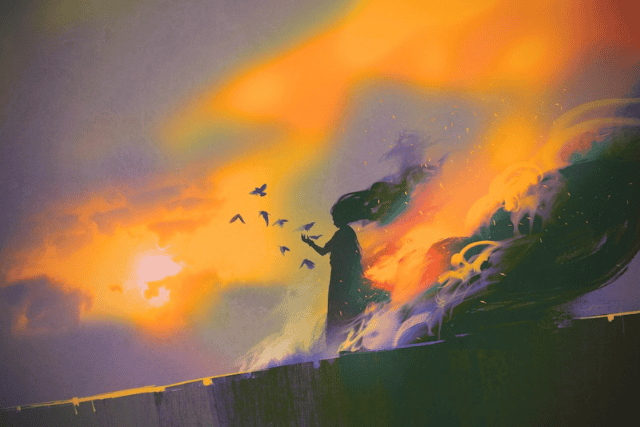
I had always had a fire in me. As a teenager, I wielded my voice as captain of my swim team in our chants. One parent apparently once asked my mother, laughing, “Do you feed her raw meat?”
The problem wasn’t that I had a fire. The problem was that, when I was overwhelmed, I had no idea how to hold it.
Having become a mother myself, I’ve caught myself occasionally slipping into the same kind of chuntering state I remembered from my own childhood. That was a red flag. I didn’t want my children learning to monitor my emotional state in the way I had learned to monitor my mum’s.
So I worked on it. At one point, I came up with a simple exercise with the kids. At the end of each day, they could give me a tick or a cross on a chart I kept on the fridge, depending on whether they felt I had communicated respectfully with them.
It was humbling and one of the most useful parenting exercises I ever did. I wasn’t trying to become perfectly regulated. I was trying to notice when I was getting it wrong, repair it, and keep learning.
But I had spent so much of my childhood experiencing fire as something dangerous that, when my own children were young, I didn’t know what else to do other than swallow it.
This was particularly true because the kids were sensitive to conflict, especially loud voices. I therefore became very conscious of keeping the peace, choosing my words carefully, and containing my reactions.
That was an important stage, but it wasn’t the destination. Because swallowing our fire is not the same thing as regulating it.
Over time, and with practice, I found another voice. I learned that I could disagree without attacking, set a boundary without turning it into a battle, say no without needing the other person to agree with me, and be forceful while still being respectful.
I see this particularly in parenting. When my teens push boundaries, I sometimes feel frustrated. In the past, I might have swallowed that frustration to keep the peace or let it build until it came out in a less constructive way. Now I pause and focus on what I need to communicate. I can be clear and firm about what’s needed without making it a battle.
I didn’t lose my fire; I learned how to hold it. And that is why the sentence about being “my mother’s revenge” landed differently for me than it might have once.
I could recognize echoes of her behavior in myself, especially when frustration built up, but I came to understand that I didn’t have to repeat her patterns. I inherited her fire, but I could decide what to do with it.
My mother’s fire had a story behind it too. I think much of it came from a determination that said, “That won’t be me.”
Her own childhood had shown her how vulnerable women could be to the men in their lives. She remembered witnessing her father hit her mother. She also knew her mother’s first husband had abandoned her, leaving one day and never returning, before eventually sending divorce papers.
I think Mum carried a deep determination that she wouldn’t allow herself, or her daughter, to be taken advantage of in the same way.
It was a recurring theme: don’t be naive, don’t let yourself be taken in, don’t give someone the opportunity to hurt you.
My mum also positioned me for something else from an early age. She’d often comment, “Shona’s not afraid of anything,” or “She’s fiercely independent.” That was a voice that gave me courage. Ironically, like a moth drawn to a flame, I became drawn to many of the circumstances and situations I had been warned against my whole life.
Yet I was more afraid of being on my own than I should have been, and I put too much trust in people and situations for far longer than I should have. The truth is, I have been burned on more fronts than I could have imagined when I was young.
But I’m strangely grateful for that now. Not grateful for the pain itself, obviously, or for the people or circumstances that caused it. Grateful for what I discovered on the other side.
I discovered that I don’t have to spend my life trying not to be burned, nor stay until I’m totally frazzled. I can lean into what happens, feel it, learn, adjust, leave when I need to, and come out still knowing who I am.
But I didn’t arrive at that understanding overnight. I had to learn to sit with the discomfort of someone being unhappy with me without immediately trying to fix it. I had to learn that I could be really uncomfortable and still be okay.
It hasn’t always been graceful. Sometimes I’ve fallen back into old habits when I haven’t known how best to respond to conflict. But I’ve learned that I can pause, take time to find words that feel right, or talk things through with someone I trust. I can use the tools available to me to help navigate a difficult conversation rather than reacting from the first wave of emotion.
Each time I hold a boundary, survive the discomfort, and discover that I haven’t lost myself in the process, I build a little more trust in my own ability to cope.
Perhaps that is the difference between my mother’s fire and mine. Her fire was fueled by the determination that that won’t be me. Mine has increasingly become fuelled by the knowledge that even if it is me, I will be okay.
Both things can be true. She hurt me in ways she probably never understood, and she loved me in ways I will always remember. Her own story shaped her, and her story shaped me, but it doesn’t end there.
What I understand more deeply now is that breaking the chain isn’t necessarily about becoming nothing like the people who came before us. Sometimes it is about taking what they gave us, separating the wound from the wisdom, and deciding what gets carried forward.
So perhaps I am my mother’s revenge after all. Not revenge against her, not revenge against any one person, but revenge against the silence. The silence that kept painful experiences hidden and that can keep us from speaking up, setting boundaries, or doing things differently.
I look at genealogy charts, and I see names, dates, and who was born from whom and who married whom—little else. But in my bones and my heart, I feel the disappointment of bad relationships, the abuse that happened behind closed doors, the pregnancies lost, the choices made in secret, the abandonment, the upheaval, the grief, the compromises, and the things people endured because they could not see another way.
A family tree tells us who came before us, but it tells us almost nothing about what they carried.
I carry what my mother survived, what her mother survived, what our fathers survived, and all those who came before us. But I don’t have to carry it in the way they did.
My mother’s project was protection. My project became resilience. She taught me to be afraid of what might break me. Life taught me that I could bend without breaking, burn without being consumed, and find my way back to myself.
What did you inherit from your family that was never yours to carry, and what did they give you that you would never want to lose?

About Shona Keachie
Shona teaches by the power of example how to find our inner truth among the often-harried day-to-day practicalities of life. If you enjoyed this article, you may enjoy Normal Is Dysfunctional That Is the Growth Opportunity, Clear the Fog of Trauma to See the Magnificence of Your Being, and Your Childhood Is Not Your Fault but It Is Your Responsibility. To follow her blog, click here.
Get in the conversation! Click here to leave a comment on the site.
Recent Comments