
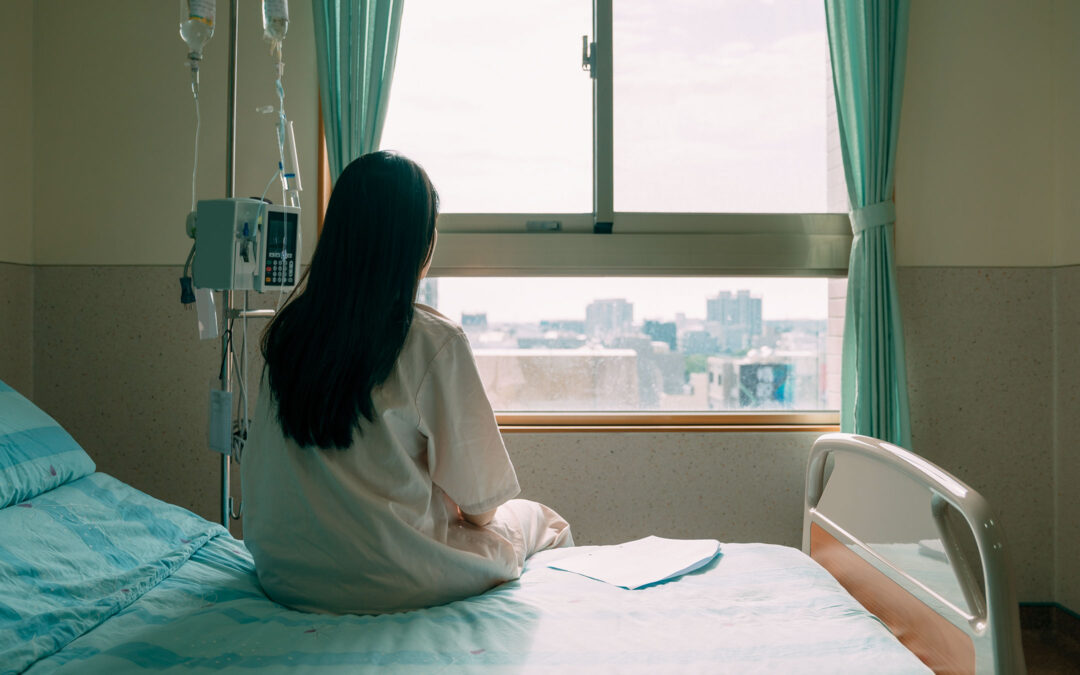
On a September day when I was in my forties, I lay in a Tokyo hospital, my joints aching and my skin burning hot. The routine of temperature-taking, breakfast, and doctors’ rounds hadn’t started yet, so the room was silent except for the beeping of monitors and an occasional rattling snore from the elderly woman in the next bed. Only a faint glow of daylight penetrated the privacy curtain.
I’d been admitted a week earlier, suffering from a severe headache and nausea, a fever of 103, and violent chills. My husband, David, and I had been on summer holiday with our children in Indonesia, so my doctors thought I might have contracted dengue fever or malaria. None of my symptoms had abated, and every day new ones were appearing: a jaundiced tinge to my skin, tiny red petechiae dots on my hands from subdermal bleeding, a pebbly rash on my knees, photophobia.
“I stared at the screen in the consultation room: In the lower left quadrant of a ghostly ovoid, a black orb was expanding, destroying my brain.”
On my tenth day in the hospital, one of my doctors, Dr. Kondo, rushed in. Flinging his arms wide like an umpire, he announced, “Final diagnosis! Endocarditis.” Endocarditis is a rare, life-threatening infection of the endocardium, or heart lining. Bacteria got into my bloodstream, attached to the endocardium—often on a heart valve—and formed a mass known as a vegetation. The vegetation on my mitral valve measured 20.3 millimeters.
“It is lucky,” Dr. Kondo said, “that you have not experienced a heart attack.” I’d need to stay for four more weeks to receive intravenous ceftriaxone and ciprofloxacin, antibiotics that might or might not work.
That might or might not work. I contracted into a knot of fear and bewilderment.
After Dr. Kondo left, I hobbled with my IV stand to the hallway computer to google endocarditis. As the information flashed onto the screen, my mind grew charged and staticky, my breathing ragged: Complications include congestive heart failure, severe organ damage, intracranial hemorrhage, stroke, neurological failure. Difficult to cure. Significant mortality.
I’d been working on a novel and in my research had been studying The Tibetan Book of the Dead, a guide to navigating transitional states called bardos. These include the intervals between death and rebirth, and birth and death, as well as periods when our ordinary reality is suspended, such as during sickness. Intended for both the dead and the living, the book’s teachings help us meet uncertainty, changes, and endings with greater equanimity.
Desperately ill, cut loose from the reality I knew, I began to see how my journey echoed the voyage through bardo described in The Tibetan Book of the Dead, forcing me to face the book’s lesson that nothing—including us—lasts forever.
The head doctor, Dr. Ando, had stopped by. His expression was both intrigued and perplexed, as if he were wondering how this extremely sick American woman had come to be under his care.
“Have you…been in Japan for quite a long time?” he asked.
When I told him I’d lived in Tokyo for almost a quarter of a century, he looked surprised. When I said I was a mother of two, a writer, and a literature professor, he looked astonished. I shared his amazement. In my diminished state, the person I’d described seemed like someone else. I’d taken leave of my life and was viewing it from afar, just as the dead are said to hover in bardo, loath to accept their new reality and gazing back at the existence to which they long to return.
Nights, I lay in bed listening to sirens shriek in the labyrinthine streets of the city and ventilators hiss. I prayed for heavy, narcotic slumber, but if I managed to drift off, it was into a realm of nightmares. I dreamed I was driving on a dark, winding road in torrential rain, and I lost control of the car and plunged off the edge; I dreamed that wild dogs were attacking me. I’d entered the bardoscape depicted in The Tibetan Book of the Dead, where “songs like wailings” are heard and “thick awesome darkness appear[s]…continually,” where you experience “apparitional illusions…of being pursued by various terrible beasts of prey.”
After a couple of days of antibiotic therapy, the vegetation on my mitral valve had shrunk by almost 40 percent. But an MRI and a CT scan showed that a piece of the vegetation had broken off and traveled through the bloodstream to the occipital lobe of my brain, causing a large abscess to form. Dr. Ando told me and David that this could lead to paralysis, “irreversible cognitive impairment,” or—he paused, searching for the right words—“even more critical complications.”
I was started on IV glycerol, but an MRI two days later revealed that the abscess had grown larger, leading to infarction, or obstruction of the blood supply, and death of the surrounding tissue. I stared at the screen in the consultation room: In the lower left quadrant of a ghostly ovoid, a black orb was expanding, destroying my brain.
The doctors were considering drastic, last-ditch measures. They might try drilling a burr hole in my skull to drain the abscess. If this failed, the only hope might be a craniotomy, where they would remove a piece of my skull bone to expose and evacuate the abscess.
Back in my room, David and I fell silent, alone together in the beeping, hissing night.
In the bardo of life-threatening illness, it seems that the earth beneath us has given way, and we’re whirling through space. Now, as the abscess in my brain grew, a long-forgotten memory came back to me, of another time when I was spinning in the void. Soon after David and I got married, we took a holiday to a volcanic island in Fiji. Every day it poured rain, so we spent our time diving to circumvent rainstorms on land. One morning we did a drift dive, the kind where you descend holding on to a rope until you get below the strongest part of the current, near the ocean floor. But we let go too soon, and, unable to see the bottom or the surface, we were lost together, buffeted in the endless blue.
My doctors initiated high-dose dexamethasone steroid therapy to try to decrease the swelling in my brain, and there was grave discussion of neurological complications and additional tests. But first, I would need to complete the remaining three weeks of antibiotics.
The days passed slowly. I slipped into a dream within a dream, drifting into a strangely calm bend in the dark river that had engulfed me. Gradually, my echocardiograms and CT scans showed decreasing mitral valve vegetation and brain swelling, and I started to feel a little less afraid. The abscess scarred over and the dexamethasone was tapered; a cerebral angiogram indicated that the infection hadn’t created aneurysms, so I wasn’t at risk for a stroke.
On a beautiful October morning, sunlight golden on the gingko trees, David came to take me home. I could hardly believe I was walking out of the room that I might very well have left on a gurney, covered by a sheet. My journey through bardo had lasted six weeks.
Several nurses helped us pack, exclaiming over and over, “Yokatta desu nee! Yoku ganbarimashita, nee!” It’s great, isn’t it! You really hung in there!
Over lunch at a neighborhood trattoria, David and I talked about everything that had happened. He told me that when the brain abscess was discovered, the doctors felt I wasn’t going to make it.
In bardo, The Tibetan Book of the Dead says, we’re in search of a lost harmony. I’d thought this meant that we seek to restore our former life, but now I saw it differently: We’re searching for the harmony lost when we forget that impermanence is the central truth of existence. Only when we accept that change is the essence of our beautiful, brief time here can we find the happiness we seek.
I looked around at the trees and flowers pulsing in an array of greens, oranges, pinks, and reds, at the shimmering turquoise sky, and felt immersed in the loveliness of this fleeting world. I’d lost ten pounds, my hair was thin, and I had track marks on my arms from the IV needles. But I was eating tomato-and-tuna pasta with my husband on a sunny fall day, conversation and laughter drifting from the tables around us, the ping of a baseball bat sounding from a nearby field.
The post The Bardo of Illness appeared first on Lion’s Roar.
Recent Comments