
When Nguyen Xuan Bao was born one hundred years ago in the ancient Vietnamese capital of Hue, his homeland was under French colonial rule. Despite the rise of a Eurocentric Catholic elite and the increasing constraints placed on Buddhist institutions and culture, Buddhism remained a deeply rooted tradition, allowing the teenager who would become the world-renowned teacher Thich Nhat Hanh to enter a Vietnamese Zen monastery at sixteen. He became a fully ordained monk nine years later while also delving deeply into modern thought at the University of Saigon.
Decades of brutality and violent turmoil unfolded in Vietnam as the young monk progressed into adulthood, from the Japanese occupation during World War II, to the French colonial war against the Communist-led Viet Minh that split the country in two, to the long war between South and North Vietnam that was eventually taken over—and lost—by the United States.
The progressive young Buddhist monk and poet became one of the country’s most important voices of peace, leading a courageous band of activists who risked, and sometimes lost, their lives as they sought an end to the war. He advocated an “Engaged Buddhism” that befit his chosen name: Hanh means “action.”
Like many true advocates for peace, Thich Nhat Hanh earned the enmity of both sides, and when he went to the U.S. to campaign for peace in 1966, the South Vietnamese government would not let him return home. His exile became one of Vietnam’s gifts to the world.
Taking residence in France, Thich Nhat Hanh, called Thay by his students (pronounced TIE, meaning “teacher”), went on to become known as “the father of mindfulness,” and his scores of books and extensive tours helped make mindfulness an everyday word. His advocacy of Engaged Buddhism inspired Buddhists everywhere to undertake political, social, and environmental activism as a core expression of their Buddhist vow to reduce suffering. Establishing a worldwide community of students headquartered at Plum Village monastery in France, he became arguably the most influential Buddhist teacher of our time.
Thich Nhat Hanh suffered a debilitating stroke in 2014, when he was eighty-eight. Four years later, he returned to his home monastery in Hue, Vietnam, where he died in 2022 at ninety-five. Like the ensos he famously calligraphed, his life came full circle.
Upon the death of someone so outsized, so deeply loved, one assumes that an overwhelming sense of loss or even despair would prevail among those close to him. But what has in fact unfolded in the world of Thich Nhat Hanh in the twelve years since he stopped teaching and the four years since his death, and how is his legacy being carried forward?
Before we explore that, it’s worthwhile to look in more detail at Thich Nhat Hanh’s extraordinary life, the wide-ranging work that shaped his path, and the distinctive contributions that continue to define his place in contemporary spirituality.
In the 1950s, not long after his full ordination, Thich Nhat Hanh became a prolific writer with a reputation as a gifted free-verse poet. He also became a campaigner for a reinvigorated Buddhism in his homeland. As he said of that time, “I was full of creative energy, an artist and a poet. More than anything else, I wanted to help renew Buddhism in my country, to make it relevant to the needs of the young people.” A book he wrote for lay Buddhists offered a view of integrating practice into daily life beyond just reciting prayers and offering incense.
When Vietnam was divided in two in 1954, however, Buddhism began to be suppressed by the Catholic-dominated government of South Vietnam, and Thich Nhat Hanh’s mission took new shape. As editor-in-chief of the official magazine of the newly formed National Buddhist Association, he sought to demonstrate the vibrancy of an engaged form of Buddhism, pointing back to the eleventh and twelfth centuries when Buddhism played a large role in shaping Vietnamese culture and governance.
With a group of friends, Thich Nhat Hanh carved out of the wilderness his first rural practice center. It was an experimental model for a modern Buddhist center where monastics and lay practitioners alike could embody an all-encompassing practice environment less hidebound and hierarchical than the traditional temples of Vietnam.
He found young allies for his work and gathered them into a group called the “Thirteen Cedars.” Among them was a young biology student who would later become Sister Chan Khong, a prominent Plum Village leader and teacher.
In 1961, Thay was invited to study at Princeton Theological Seminary and to continue his research in religious studies at Columbia. After three years, with a greater sense of American culture and Western ways, he returned to a Vietnam in even greater turmoil, now in the throes of full-scale war led by the U.S.
Soon he published a collection of poems, Palms Joined in Prayer for the White Dove to Appear, that was immediately popular but led to his denouncement on radio by both sides in the war. Despite increasing danger, he established a politically neutral relief organization of student volunteers to assist in villages harmed by war.
Then, in one of his most groundbreaking acts, he founded the Order of Interbeing. Based on the bodhisattva precepts of Mahayana Buddhism, it combined a commitment to mindfulness with engagement in social and political issues and nonattachment to views and dogma. His coining of the term “interbeing” to express the interconnectedness of all life, and his promotion of mindfulness as a practice of peace, would remain hallmarks of his work for the rest of his life.
In May 1966, he left Vietnam for a supposedly short sojourn overseas. It turned into a nineteen-country tour, whose popularity ensured he would be forbidden to return home. As he stepped upon the world stage, his combination of Buddha-like presence and fierce conviction made its mark. The New York Post and The New Yorker reported on his mission of peace; his poetry was featured in The New York Review of Books; he made his presence known at the Paris Peace Talks; and he made common cause with Martin Luther King Jr., ultimately persuading him to oppose the war.
The crucible of war shaped Thich Nhat Hanh. Reflecting on it fifty years later, he said that it taught him that in a “situation of utmost suffering like that, we practice in such a way that we preserve our hope and compassion.” He also recalled that at his most difficult moments, “With the practice of mindful breathing, I got out of the situation.”
Following his exile, this intimate understanding of the power of mindfulness made him the most vocal and prolific advocate of mindfulness as a practice for everybody: His groundbreaking 1975 book, The Miracle of Mindfulness, has sold millions of copies and has never gone out of print.
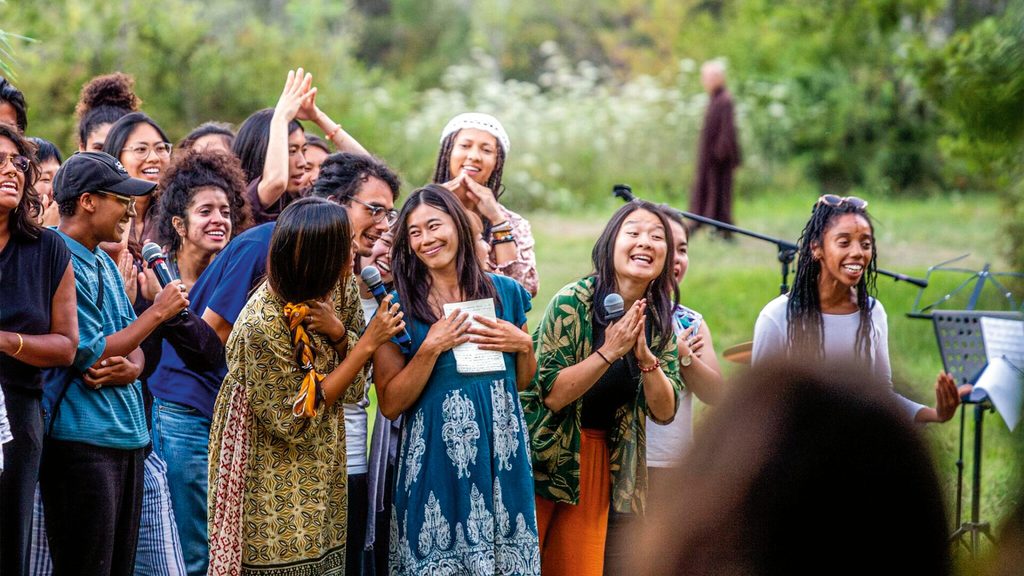
With countless local lay communities, eleven monastic centers with over seven hundred fully ordained monastics, and hundreds of thousands of adherents spread across seven continents, trying to get a sense of what’s going on in the diverse global world of Thich Nhat Hanh’s followers is like trying to wrap your arms around a sequoia. Yet in my conversations with his students, I could feel very strongly a common ethos, a presence in the community he left behind that shines through as powerfully as the master himself.
The first thing I learned from each person I spoke with is that Thich Nhat Hanh emphatically lived to create something that would last far beyond his lifetime. He carved a path that would make it possible for the teacher of the future to take the form of a community. When he and his early followers camped out at a dilapidated farm in the south of France in the early eighties, he saw to the planting of over a thousand plum trees, giving the name Plum Village to this monastery, retreat, and event center, and ultimately to the whole community he established. The community’s award-winning meditation app, which is both free and free of ads, is not called the Thich Nhat Hanh app. It’s called the Plum Village Mobile App. To interact with Thich Nhat Hanh’s world is to enter a village that’s not simply a place on the map. It’s an interconnected, living organism.
Mindfulness retreats remain the most intimate and powerful transmission of his dharma. In these retreats, says Sister Tue Nghiem, “The monastics and the lay sangha at Plum Village monasteries show people, show the world, a mindful way of living, a way of living in community that counteracts the individualism so prevalent today.”
Tue Nghiem, whose family fled Vietnam in 1980, grew up in California’s Central Valley and first met Thich Nhat Hanh when she was fifteen. Her brother, who had ordained with him, invited her to visit Plum Village. She spent over a year living there, and when she returned to California, it became clear that “immersion in that way of living” was the path her life needed to follow.
Meena Srinivasan is not a monastic, but for her, immersion in a full-time practice environment is also important. She and her family were the first to take up residence at Simplicity Hamlet, an emerging residential lay community located in the foothills of Deer Park, a Plum Village monastery in Escondido, California.
As a former public-school administrator and author of two books on mindfulness in education, Srinivasan played a key role in the establishment of the Thich Nhat Hanh School of Interbeing, which opened in August 2026 in a facility down the road from Deer Park. The school currently serves K–4 with the vision to eventually expand to PreK–12. “Manifesting this school has been a dream of our community for many years,” she says.
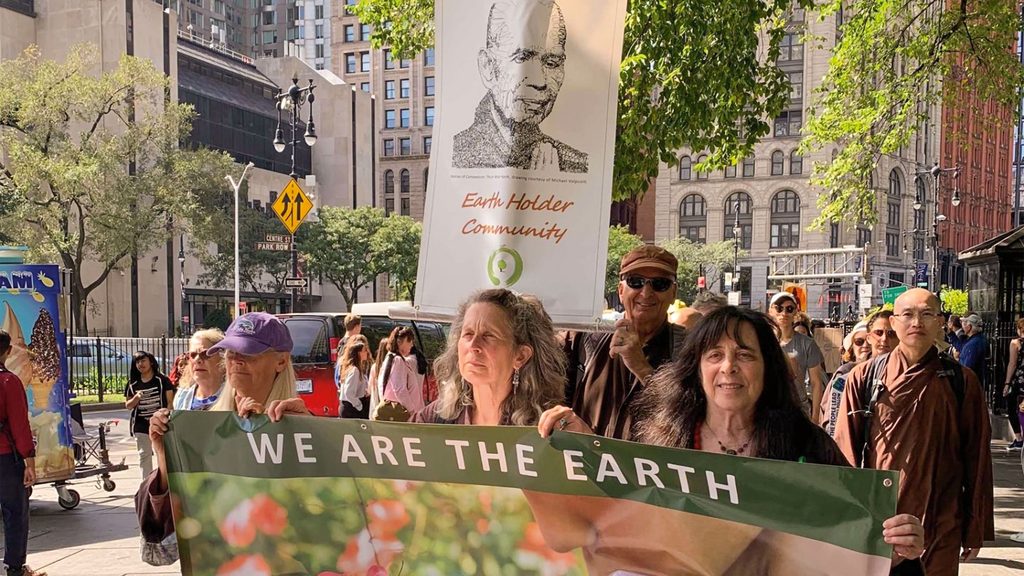
Srinivasan feels that Thich Nhat Hanh’s interweaving of monastic and lay practitioners is one of the most powerful parts of his legacy. Even though she’s a lay Buddhist, she’s a longtime member of the Order of Interbeing and fully empowered as a dharma teacher in the community. She loves that her son is able to live in a community immediately adjacent to the monastery and play tag and basketball with the monks. The joy that Srinivasan expresses is a central feature of the Plum Village environment.
Tue Nghiem says, “We have many practices to allow people to deeply dwell in the present moment and come into touch with the wonders and beauties all around us. It is only there that we can take care of our suffering, heal ourselves, truly experience joy, and understand our true nature.”
When I ask about Engaged Buddhism, Tue Nghiem offers the example of retreats for climate activists: “To truly deal with this crisis effectively, they need support for how to take care of themselves. That’s what Plum Village brings.”
Brother Phap Huu, who grew up in the Vietnamese diaspora in Canada, first visited Plum Village as a young boy with his father and sister. On his fourth visit there, his parents agreed to his becoming a monk, and he was ordained the next year at the age of thirteen. He served as a close attendant to Thich Nhat Hanh for over fifteen years.
“To look at suffering with mindfulness is engagement, so our engagement has never stopped,” he tells me. “Thay’s activism continued in the light of bringing the teachings into all walks of life. Like him, we want to transform people’s lives, so they can transform the work they do in the world.”
When I ask him about carrying on Thich Nhat Hanh’s role as the “father of mindfulness,” he laughs, letting me know that Thich Nhat Hanh wouldn’t have called himself that. “One time we were having tea, and he looked at me and said, ‘You and your brothers and sisters, you have to continue to renew Buddhism, to renew mindfulness.’ Mindfulness is not a thing we worship. It needs to be practiced, and we need to be present to adapt, to listen, to learn what is the suffering of our times, so mindfulness does not become appropriated as something that has lost its context but rather continuously emerges freshly.”
When I ask people who’s in charge and what teacher or teachers will lead the way now that Thich Nhat Hanh is gone, I consistently hear a nuanced answer. The monastics, especially the dharma teachers, play a vital role in both leadership and teaching, and a monastic element will always be a key part of Thich Nhat Hanh’s legacy. However, both teaching and leadership are collective, and both lay and monastic. According to Tue Nghiem, “Thay was clear that there would be no sole leader in the community. Even when he was alive, he was not the sole decision-maker. He was training every one of us to step up and to make the decisions to run the community collectively. For example, there are three hamlets at Plum Village in France. Each makes decisions collectively, and all three operate collectively.”
“While there are, of course, leaders who hold strong influence in the community,” she says, “the authority and final decision-making emerge from the collective body of fully ordained monastics.” It’s the same with the many Plum Village teachers whose talks and podcasts are easily accessed online. “There are many dharma teachers, but we don’t think of ourselves as having ‘students.’ They are practitioners, and we provide dharma guidance and inspiration for their practice. Teachers have their different skills and abilities, but none is the sole teacher.”
As Phap Huu explains it, “Thay’s legacy and his way of teaching was not to see himself as the only teacher and leader, but rather every person is a cell of the bigger buddha of collective awakening, a continuation of the many patriarchs and many teachers in the tradition of Buddhism. When he said the Buddha of the future will be the sangha, he meant both the Plum Village sangha and the greater sangha of all who practice genuine mindfulness, whether they are Buddhists or not.”
According to Brother Phap Linh, a monk and musician living at Plum Village, Thich Nhat Hanh frequently discussed three kinds of dharma: living, spoken, and written. “Thay was very focused,” he told me, “on the transmission of practice in the form of the living dharma, which is why he wanted to make sure he had monastic disciples to carry on the tradition, as well as lay dharma teachers and long-term practitioners—people who could embody the living dharma, especially in the form of a residential community.”
Matt Friberg recently became publisher of Parallax Press, the nonprofit publishing house Thich Nhat Hanh cofounded in 1986. Parallax publishes books “on mindful living and Engaged Buddhism,” and for Friberg, the living quality of this mission is front and center. It’s not simply about compiling and editing transcripts of old teachings. As they “try to determine what from Thay’s teachings to lift up,” he feels it’s important to “activate a fresh response to the big questions and crises that we face, keeping things applicable to this historical moment.” He emphasizes that a key thing he learned from Thich Nhat Hanh and the community is that “right view is vital for real change.” This first branch of the eightfold path, he tells me, is about “seeing beyond our dualistic notions of self and other, right and wrong, living things and inert matter—all the dichotomies we set up.”
Friberg’s emphasis on dissolving dualistic notions echoes what Thich Nhat Hanh meant by “interbeing,” a word whose living quality he preferred to the more philosophical term “interdependence.” The Order of Interbeing he started in 1966 in Vietnam now has more than a thousand members. To join requires a lifetime commitment to mindfulness and active social engagement.
The interconnected quality implied by “interbeing” emerges in the way Friberg talks about the relationship of lay to monastic practitioners and monastery/retreat center to the outside world. “Thay created,” he says, “a monastic community and a lay community that are not separate but integrated. The monastics offer an example of what a different way of living looks like, one whose first principle is not individualistic and competitive. Its outlook is about cooperation and interbeing and interconnection and what can concretely manifest out of that.
“That’s such a beautiful thing the Plum Village community does,” he continues. “When I go there for a few weeks, I move more slowly, have time to rest, and am plucked out of my normal busyness and dropped into another world. The time there nourishes a deep inspiration that practicing another kind of world is possible.”
At the same time, lay sangha members are far from passive recipients. “As laypeople,” Friberg says, “we’re more in touch with the changing nature of society, with the different kinds of voices and perspectives going on that may offer ways to express the dharma that—while connected to the deep roots—can reach people in innovative ways, where they live now.” He sees a natural reciprocity between the two communities. Just as the monastics connect laypeople to a deeper world, lay practitioners help connect the monastic community to the day-to-day sufferings of people out in the world.
Phap Linh shares an analogy with me that Thay used: “He said that an ancient plum tree has very deep, very old roots, reaching deep into the ground. Yet every spring, the flowers, blossoms, and leaves are completely new. They’re no less fresh than the blossoms on a young plum tree.
“To me that represents the DNA of what he’s transmitted to us,” says Phap Linh, “a methodology or blueprint, the thing behind the thing. It’s precisely this ability to stay very deeply connected to the lineage, to the tradition, to not underestimate the significance and the importance of that connectedness and that rootedness in tradition, to cultivate a deep kind of respectfulness to lineage and spiritual ancestry, while always having the ability to innovate.”
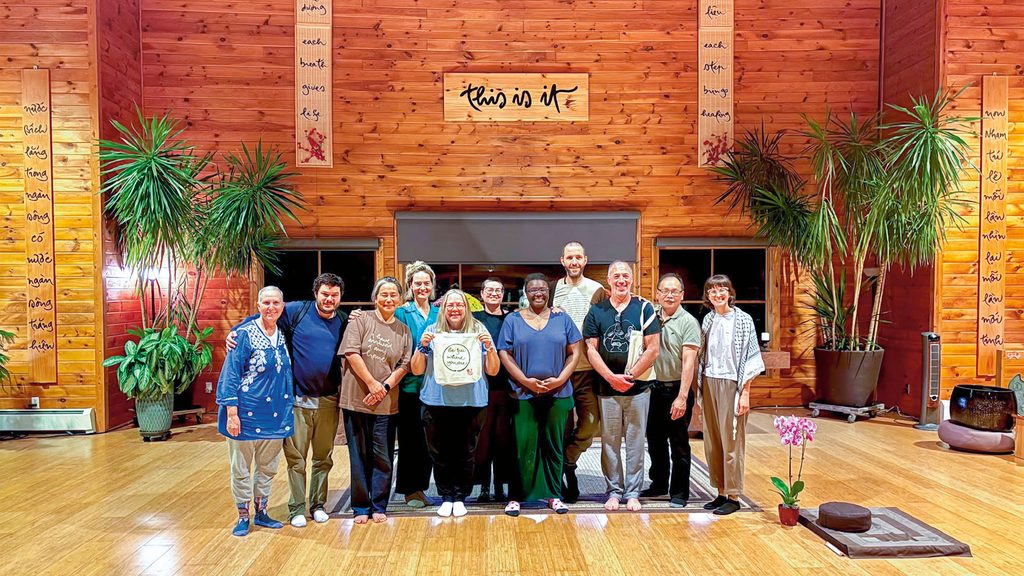
Phap Linh went on to say that the entire Plum Village community works to both nurture and care for the deep roots while also paying attention to the blossoms and the fruit—what’s happening now, who can be reached and helped in their unique way. In a related analogy Friberg shared with me, Thich Nhat Hanh talked about what he learned from the need to prune the trees at Plum Village. It feels hard to remove otherwise healthy branches that are not bearing fruit, but it’s necessary in order to allow “healthy development to take place.” The point is that even healthy-seeming traditions need to be reexamined in order to “answer the real needs of our time.”
Hisae Matsuda was born in Japan and moved with her family to England when she was very young. She first encountered Thay at a retreat near London when she was twenty-three and was “instantly convinced of the power and authenticity of the teachings.”
At the end of the retreat, she was encouraged to join a sangha to maintain her practice, but she was unable to make that work in her busy young life in London. Years later, she would reenter the Plum Village world, eventually becoming an editor at Parallax, which she continues to be. For six years, in fact, she was publisher, before passing the torch to Matt Friberg.
While Matsuda met Thich Nhat Hanh in her twenties, her first visit to Plum Village occurred three decades later, just after he’d left for Vietnam. Moved by the significance of his return to his root monastery, she decided to make a pilgrimage to Hue, where she ended up having a chance encounter with him as she accompanied another practitioner to the temple for walking meditation.
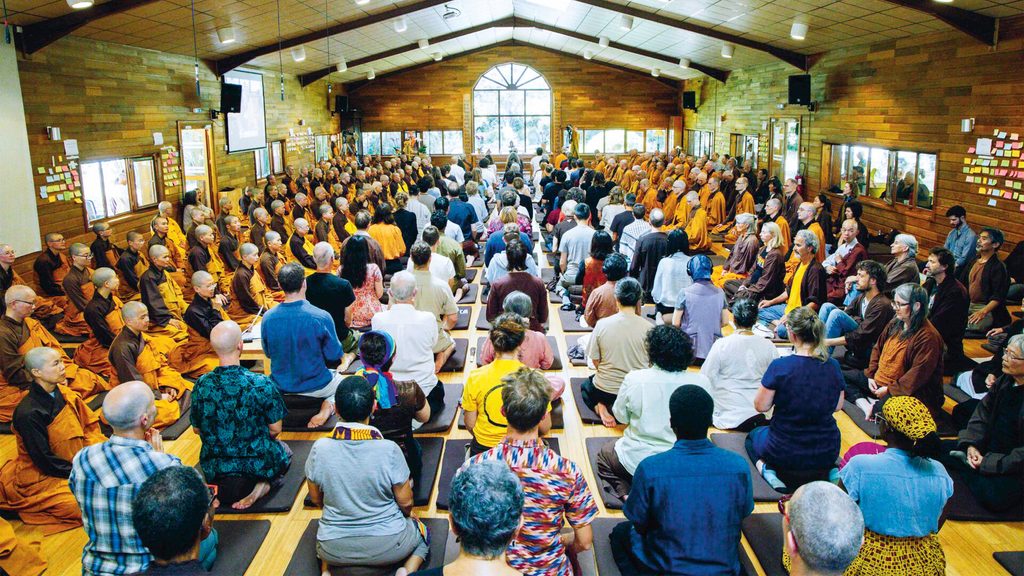
One of the elements that struck her strongly was how she “instantly felt at home” in the foreign monastery. She realized “that Thay had created a consistent atmosphere modeled on what he’d experienced at the place where he was a novice. All the temples in the Plum Village tradition have certain elements in common. In addition to the meditation hall, dining hall, and living quarters, they all have a lotus pond, walking meditation trails, and a bell tower emitting the sound of the mindfulness bell. It creates a kind of atmosphere that calls you home. I was very moved to see that in Hue.”
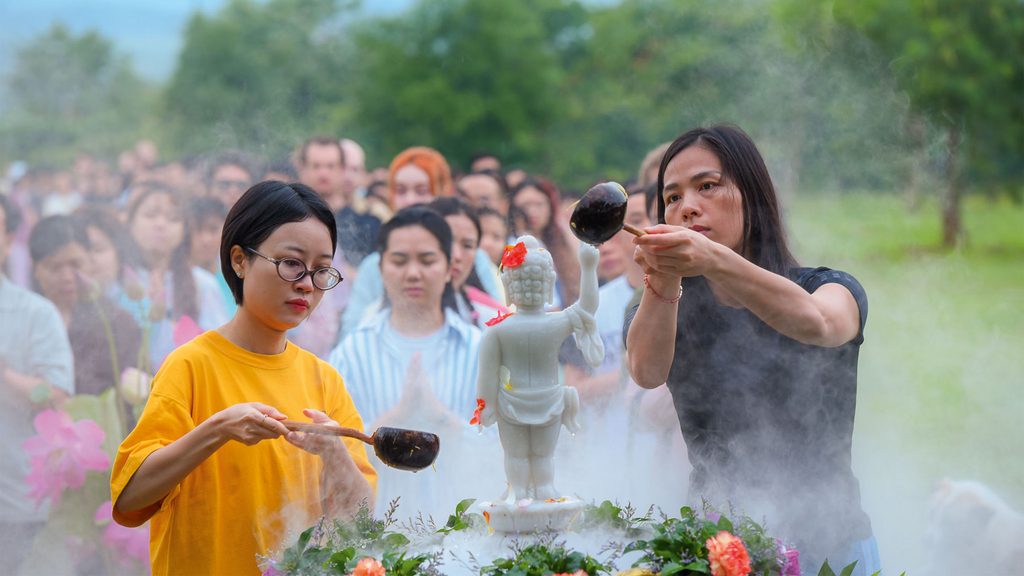
Matsuda speaks about the quality of the teaching and the consistency of the routine across all retreats. But she also emphasizes the community’s willingness to try new things and—when those experiments take root—to let them become new traditions. As Tue Nghiem tells me, “There are 84,000 dharma doors, so we are always finding new doors.”
Naturally, one of the doors of living dharma today is how it’s shared in the digital realm. Dissemination of the teachings and the experiences of students and teachers has long been an effective element in Thich Nhat Hanh’s world. In addition to Parallax Press, The Mindfulness Bell journal has existed since 1990, and the Plum Village website has been rebuilt and restocked.
A developer of the website and the Plum Village app, Maarten Hunink has been instrumental in creating one of the most innovative presentations of dharma in the digital realm: Living Gems. In a sense, it answers the question of where Thich Nhat Hanh may be found today.
With nearly four thousand recorded talks delivered by Thich Nhat Hanh in Vietnamese, English, and French in a variety of formats and settings, the community faced the monumental task of making this treasure trove accessible to the world. In addition to the technical hurdles of preserving and digitizing a vast number of deteriorating cassettes, VHS tapes, minidiscs, DVDs, and hard drives, it was necessary to make new transcripts and check the accuracy of existing transcripts. This work is being done by a team of more than one hundred volunteers, who have checked more than six hundred talks to date. Living Gems, which launched in March 2026, is a continuously developing, user-friendly archive of teachings from the Plum Village tradition.
One relatively simple way to deliver Thich Nhat Hanh to the world would have been to share videos on YouTube. In that case, however, the community would lose control over how the talks were experienced, with interruptions from ads and other distractions in the interface. With Thich Nhat Hanh’s attention to detail in curating the atmosphere surrounding the dharma, that approach seemed like a poor fit. According to Phap Linh, “We wanted something that was searchable, accessible, and offers a pleasant environment where you can cultivate concentration, presence, and insight.” It’s the digital equivalent of the ponds and plum trees, the bell towers and the walking paths that embody the spirit of Thich Nhat Hanh.
Maarten, who’s been working on this project since before it even had a name, told me that as preservation of the material progressed, there was a deep question of “What exactly are we going to develop? We were quite conscious that at the time, it was already possible to build a kind of chatbot that could enable you to talk to Thay or ask ‘him’ questions. But we made a very conscious decision not to create a ‘virtual Thay’ you could chat with, because it would never actually be Thay.”
Some people argued that the internet would create an AI Thay anyway, so they might as well do it themselves and retain more control. In the end, the conclusion was that context is everything. An AI Thay answering your questions lacks the context and specificity essential to dharma transmission, and it might hallucinate something wholly inaccurate.
“The only thing we want to deliver,” Maarten says, “is actual material from Thay that you can watch or listen to, while also understanding the context in which the material is delivered.” The focus became building a “well-tuned search engine that allows people to find whole talks on a subject but also the specific place within a talk that’s relevant to what they’re trying to explore or understand.” As an example, when I used Living Gems to search for “pruning trees,” it returned an astounding collection of relevant content.
As the quality of the searchability evolves over time, Maarten feels, it will offer something far more helpful, authentic, and profound than a chatbot. For Phap Linh, who’s a teacher and author, the powerful searchability makes Living Gems “an invaluable resource for those of us in the Plum Village editorial team to continue to create books, as well as curate ‘mini-curricula’ on particular subjects.” It also helps you to observe, he says, how Thich Nhat Hanh’s “pedagogy evolved over time.” And as new books and courses emerge from his work, his pedagogy continues to evolve.
In a broader sense, so does his very way of being. When people come to Plum Village retreats, Phap Huu notes, they “say it feels like Thay is still here, including in the way the community continues the art of retreating. The beauty of it is that his energy is still really present in the collective. And soon, in January 2027, we will launch the Online Monastery, for both live and archived teachings and courses from Plum Village teachers.”
Like the plum tree with its ancient roots, the tradition Thich Nhat Hanh inherited, renewed, and passed on will continue to produce new blossoms and fruits.
The post Thay’s Continuation appeared first on Lion’s Roar.
Recent Comments