

“Trauma creates change you don’t choose. Healing is about creating change you do choose.” ~Michelle Rosenthal”
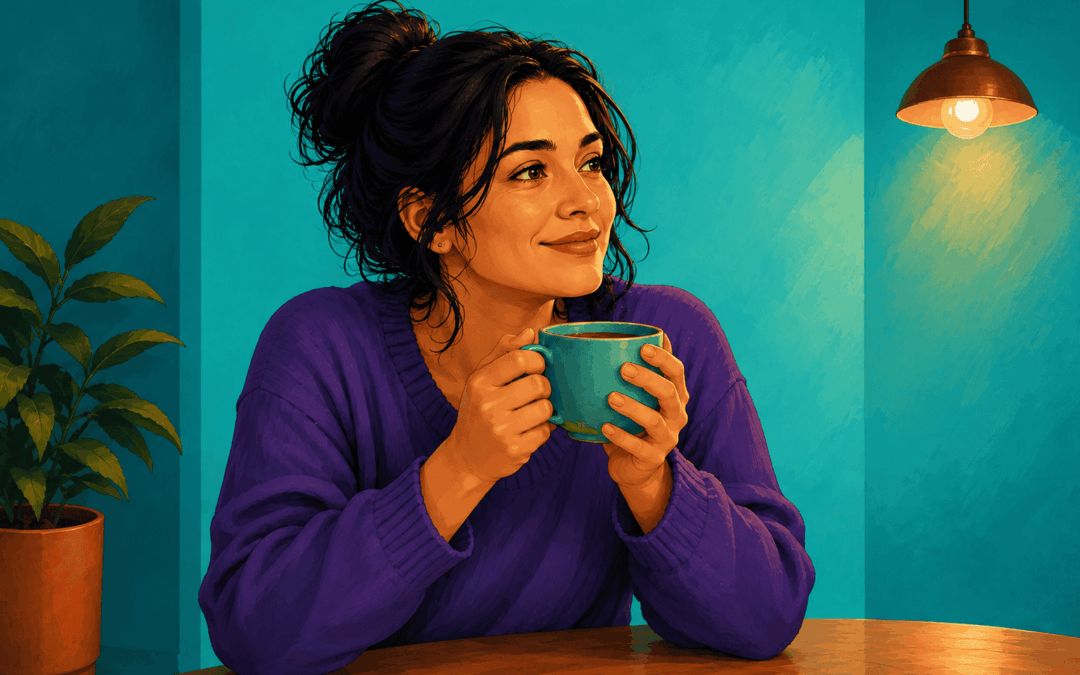
Today I am sitting in my favorite café in Venice Mall. I got my favorite seat, the one near the water.
I have spent countless hours here. I have cried here. Journaled here. Drawn here. Consoled myself here.
There was a time when this café felt like my only refuge from a life that felt too heavy to carry.
Today I am sitting in the same seat, drinking the same tea, looking at the same water. And for the first time, I realized something. I feel good.
Not numb. Not performing okayness while something heavier runs underneath. Actually, genuinely, quietly good.
Everything outside is almost exactly the same. But I am not.
A Few Months Ago, I Would Come Here To Escape
When I used to come here before, I wasn’t really coming for the tea. I was coming to breathe.
Going out was never simple. There were always questions from parents waiting for me.
Where are you going? Why? Who are you meeting? When will you return?
And underneath each question was something heavier—the implication that I needed to justify myself. That my choices required approval. That I should feel guilty for wanting to simply exist outside those four walls.
The exhausting part wasn’t the questions.
The exhausting part was believing I needed permission to live my own life.
The Home I Grew Up In
For most of my childhood, I believed I had good parents and a good upbringing.
I had to believe that. It was the only way to survive.
What I didn’t understand then was that I had learned to dissociate from the pain. To convince myself that the difficult moments were exceptions, not patterns. Children do this when the alternative is too frightening to hold.
My mother became an orphan as a toddler, raised by a cruel aunt who treated her like a maid. She repeated that behavior with me—not because she chose to consciously, but because unhealed wounds pass themselves on.
She mocked my clothes, my choices, and even my confidence. The same qualities she criticized at home were often appreciated outside, which left me deeply confused.
She turned my father against me and cast me as the family villain. She was my first bully. I didn’t understand her manipulations then, but my pillow would be wet from my tears every night in my teenage years. How could my own mother be so cruel to me?.
For most of my life I thought of myself as a difficult, bad person because that is what had been fed into my mind throughout my childhood. Even when people showed me love and acceptance, I couldn’t receive it. I believed that if they truly knew me, they wouldn’t like me either.
But what confused me most was that she wasn’t always like this. Sometimes she was warm, loving, caring. And so I told myself for years that this was simply a complicated love—the kind many families have.
Then one night, months into my healing journey, I was lying in bed crying after she had hurt me again. And I thought, “She can’t be this evil all the time. She must have loved me sometimes.”
And a childhood memory flashed before my eyes.
I had been sick. Home alone with her. She didn’t come to check my fever. Didn’t sit with me. Didn’t ask how I was. She quietly went about her own work, unbothered.
But the moment my father walked through the door, she transformed. Warm. Attentive. The picture of the most loving, caring mother.
And in those few seconds, the puzzle of my life finally unravelled.
I never had a mother. She was just acting like one when others were watching.
Everything became clear. The bullying, the mocking, the threats—all of it had happened when I was alone with her. The loving, caring, kind mother appeared only in the presence of others. That is why my childhood and adult self was always so confused. Sometimes I was showered with love; sometimes I was crushed by her cruelty.
I was her emotional punching bag.
It took me four nights of crying to process and accept this. But since that acceptance, something shifted. Her criticisms stopped landing the same way. The hold she had over me began to loosen—not because she changed, but because I finally understood what I had been responding to.
I detached from her emotionally. I accepted that I never had a mother and never will. This acceptance alone freed me from the years of hurting and trying to earn her love. I started mothering my own inner child instead—giving her all the love I had yearned for my mother to give me. And she started healing.
My father’s story was different but left its own marks.
He came from a genuinely humble background—a brilliant student who had to start working at fourteen, studying further through distance education despite being a topper. He struggled enormously and built a respectable life from almost nothing. But he was so terrified of lack that he installed that same terror in me.
He feared my love of art and creativity. If he caught me drawing, he behaved as if I had committed a crime. He gave me material comforts but used them as weapons of shame—reminding me constantly how hard he had worked, how lucky I was, how much I owed him simply for existing in the family he had built.
Art will not get you anywhere. Earning is hard. You need to study. You need to be practical.
He never directly stopped me from doing anything. But if I chose something he didn’t approve of—going out, dressing as I liked, taking my own decisions—the guilt-tripping was relentless. Quiet, persistent, exhausting. He feared for my future, my career, and tried to make every small decision for me.
He did love me. But he never realized how much fear, shame, and self-doubt he had installed in the process.
And that child received a very clear message: she was incapable. Unworthy. Undeserving.
The Beliefs I Carried Without Knowing
I wasn’t born believing I was incapable.
I wasn’t born feeling guilty for having needs.
I wasn’t born believing I needed permission to live my own life.
I wasn’t born feeling unworthy of love.
These beliefs were installed. They felt like facts because I received them before I had the language to question them.
I could see it clearly when I looked back at my career. I had been a star student in college yet got placed last with the lowest salary package. The belief that I was incapable, that creativity had no value, that I could not make it on my own—it showed up in every room I walked into. Not in what I said. In how I held myself. In what I believed I deserved.
That was not who I was. That was what I had been taught to believe about myself.
What Began to Change
Healing began with reading. With slowly recognizing patterns. With understanding that what I had experienced as a child had a name—and that name was not my fault.
I started talking to the child I had been. The quiet, invisible little girl who had learned to make herself small to stay safe. I told her—every night, patiently, repeatedly—that it was not her fault. That she was worthy. That she was loved.
She didn’t believe it immediately.
But I kept going.
When nothing in my life was working and I was tired of the cycle of shame and guilt, I collapsed inward. That collapse became the beginning. I started understanding my patterns. Slowly, I started standing up for myself—to my parents, to the old voices inside my own head.
They didn’t like it.
But I wasn’t their prisoner anymore.
And the strangest thing began to happen.
As I changed the relationship I had with myself, the hold my parents had on me began to loosen. I cook my own food now. I go out when I want. My father’s questions no longer send me into guilt and justification. My mother’s behavior—the same behavior—I can now observe without being swept away by it.
I have detached emotionally while living in the same house. I still do what needs to be done. But their behavior no longer defines how I feel about myself. I have started knowing my worth.
And I have never been more at peace with myself.
I No Longer Abandon Myself
This might be the biggest change of all. I am aware of my feelings now.
When I feel anxious, angry, or hurt, I listen.
Earlier I would override myself. Suppress myself. Ignore what my body was trying to tell me because I had learned that my feelings were an inconvenience.
Now I ask: What is this feeling trying to tell me?
Sometimes it is an old wound. Sometimes it is a boundary being crossed. Sometimes it is simply my body asking for rest.
When an old pattern surfaces—a familiar dynamic trying to pull me back into a smaller version of myself—I notice it. I name it. I remind myself that I am safe, that I have choices, that I am no longer someone who has to absorb what others cannot hold.
And I come back to myself.
The Freedom I Was Looking For
For years I thought freedom meant leaving. Leaving the house. Leaving the situation. Leaving the people who hurt me. Maybe one day I will.
But sitting in this café today, I realized something. Freedom arrived before I physically went anywhere.
Freedom arrived when I stopped believing the things that kept me trapped, when I stopped seeking permission, when I stopped abandoning myself, and when I started giving myself the love I had been waiting for others to give me.
The people around me may still try to guilt-trip me. They may still criticize me. They may still be uncomfortable with who I am becoming.
But their reactions are no longer my prison.
The Wildflower Was Always There
Healing didn’t turn me into someone new. It revealed who I was underneath the fear. Underneath the guilt. Underneath the shame. Underneath the conditioning.
The wildflower was always there. She was simply buried beneath years of absorbed beliefs that were never hers to carry.
And now she is blooming. On her own terms. In her own colors. In her own time.
Today I am sitting in the same café.
The same seat. The same tea. The same water.
A few months ago I sat here trying to escape my life.
Today I sit here grateful for it. Not because everything is perfect. But because I finally feel at home within myself.
And after everything I have been through, that feels like everything.
If you are healing from childhood wounds, difficult family dynamics, or years of self-doubt, I hope this reminds you that sometimes the biggest transformation happens while everything outside appears exactly the same.
Other times, changing the outside environment can be the first step toward healing and taking control of your life. Only you can decide what is safest for you.
Either way, keep going. One day you will look back and realize how far you have come.

About Sangeeta Kumari
Sangeeta writes about healing from childhood trauma, self-worth, emotional resilience, and the journey of becoming yourself after years of people-pleasing and self-doubt. Through personal stories and reflections, she explores nervous system healing, boundaries, solitude, creativity, and finding freedom from unhealthy family dynamics. She shares her writing on Substack at substack.com/@unveilthewildflower and on Instagram, where she documents her ongoing journey back to herself.
Get in the conversation! Click here to leave a comment on the site.
Recent Comments