
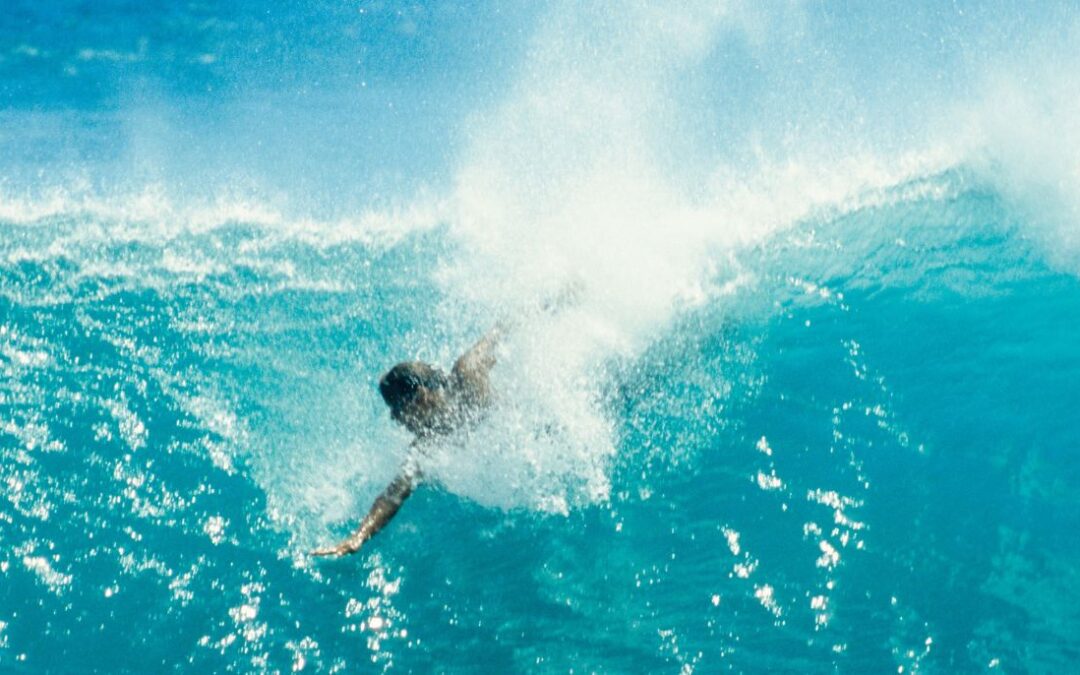
My friend Omar grew up surfing here in South Orange County. He’d sworn off surfboards long ago in favor of bodysurfing, a purer form of wave-riding, to his mind—nothing between you and the sea. I wanted to learn, and he took pity on this Toledo transplant.
After acquainting me with the physics of waves over a handful of surf checks, Omar thought I was ready. We were at the south end of California’s Crystal Cove State Park. The beach is overshadowed by cliffs where the waves break more consistently but are unnerving all the same. This was big water, endless and writhing.
We zipped into our wetsuits. Omar’s was new, made of ultraflexible geoprene, but mine was a garage sale artifact, made of stiff rubbery neoprene. When Omar laid eyes on it, he said, “Man, that wetsuit is old-school.”
Our fins went on last.
Omar high-stepped into the surf and dove under an oncoming wave. The wetsuit gave me a Tin Man walk. It made me think of my brother Ben, who can’t walk at all. Here I was, bristling at a little bodily restriction. I stopped at the tideline. Fear gripped me like the squeeze of the wetsuit, but I shuffled into the foamy surf.
I had to swim a good stretch to get out past the shorepound. Mild offshore winds teased in four-footers. My body, buoyant from the neoprene, rose and settled as they passed. Soon, my flippers didn’t tap the bottom anymore. The waves owned me now.
The Buddhist teacher Yongey Mingyur Rinpoche equates strong emotions like fear to waves that disturb the surface of the mind. They overpower us because we haven’t connected with the deeper ocean of calm that is always below.
“Acknowledge each wave but stay with the ocean,” instructs Mingyur Rinpoche in his book In Love with the World. “This will pass if [you] let it.”
But while the depths of the mind hold calm water, I was reminded out here of the ocean’s great unknownness. From my one experience diving, on assignment for the Los Angeles Times 150 miles off the coast of Southern Baja, the deep struck me as lonely, forbidding. I remember looking down from inside the shark cage, visibility over ninety feet that day, watching the cerulean blue gather a lavender blush before it gradated to a somber blue that dimmed and opened like the black maw of a great beast threatening to swallow me. More threatening even than the first great white that cruised past our cage.
If you’re not ready for it, this stillness, the emptiness, can be disturbing. But Mingyur Rinpoche teaches that our minds are boundless, with an innate capacity for “spacious awareness.” He compares the mind with “open skies and oceans—references meant to invoke immeasurable vastness.”
In spacious awareness, perhaps, I wouldn’t wonder “Why him and not me?” Why had Ben, my only sibling, been the one born with cerebral palsy, epilepsy, double scoliosis, only one eye, and intellectual disability? What caprice of the cosmos decided he should take on these burdens while leaving his big brother untouched, aside from survivor’s guilt for being the “normal” one, free to walk through the world while Ben lingers in a group home?
These questions haunt me more lately.
The waves were crashing down hard, putting me through the washing machine. I was already queasy from the violent whirls.
Off to my right, Omar floated on the surface, his face free of tension as he rested there, utterly unfettered by the rolling seas.
Every so often a set of swells came in—larger waves that had traveled over a long fetch, outlasting the wind and gathering their own kinetic energy. These were the waves Omar had taught me to watch for, the best ones for bodysurfing. But I found them brutal. They had a tendency to stomp me, push me down into a dark churn.
I learned to let the wetsuit bring me up instead of fighting the wave, though this didn’t allay the mounting dread whenever one of those swells came in, a wall of water lifting up above the smaller waves. I could hear a hiss as the blue mound rushed at me.
Our emotions and thoughts can be just as daunting as big swells. But Rinpoche assures us that all disturbances will crest and then break apart: “Waves arise, and clouds move by; when we are not stuck inside them, they lose their impact.”
Still, these ocean waves took their toll, wearing down my mind and body. After repeated beatings, I zombied out of the impact zone and collapsed on my towel. Omar was still out there, cozy as a harbor seal.
There’s a definite art to choosing the right wave. If it was breaking too much, Omar would punch through it to get out of its way. But if it was just starting to crest, he’d kick ahead of the wave, his timing and speed hitching him to all that energy, and he’d surf across the face in the direction of the break then eject over the shoulder.
I felt embarrassed for resting on the towel. The incoming waves represented punishment, oxygen deprivation. But was I not in a cherry surf spot my friend had handpicked for us? I stood, walking back into the waves.
The next swell caught me off guard. I started kicking just before it reached me, sure I was too late, too slow. But then came an enormous push, a lifting, as I was borne aloft. My head and upper torso stuck out of the face of the swell like I was the figurehead of a tall ship.
Weightlessness! And, with it, a sudden expansion: extreme presence, no beginning or end, no other. Suddenly all those recurring negative thoughts about my life, those beckoning little self-blows, seemed petty compared to this connection with nature’s immensity. It was as if the wave knew me not as a foreign object but as an essential droplet—for however long this moment lasted.
Maybe Ben already knows the feeling. His mind untainted by the corruptions of the world, he sits quietly in his porch chair for hours in a state of tranquility I can only aspire to.
I actually envy my brother at times. His visual impairment has heightened his other senses. He can taste a spring breeze as if it were something delicious.
He naps a lot due to his meds, but he hasn’t had a seizure in a while, and that’s major after a lifetime of such episodes. Awful to watch. He’d be seated on the floor or in a chair when suddenly his upper body would be thrown forward as if in a violent collision, air rushing out so fast he would snort then go rigid with his arms extended. I’d watch my brother turn to stone, not a sound or a breath from him. Finally, after what seemed like an eon, his body would release, and he’d be gulping air, weeping, moaning, rocking. But soon he’d laugh in big yips and shouts, so happy it was over. From terror to euphoria in sixty seconds.
“Big emotion leads to big skylike mind,” Rinpoche writes. But at such a price?
The beach ahead quickly enlarged, and I was tossed into the shallows. Gasping for air, I climbed out of the wash, struggling to take finned steps in the mucky tidal sand.
I rejoined Omar to wait for the next set, though nausea from swallowing saltwater threatened to make me heave. My energy was a waning dream. I’d just decided to head in when a swell rose behind us. I kicked with all I had left, sure I was too late, yet I was again swept up by an onrush, and I rode the wave straight into shore until it lowered me like an escalator as it collapsed.
Magnificent.
I’d let waves pass. I’d been thrown under. But now I knew it was possible to ride balanced between open sky above and ocean depths below—where the imputations of our personhood don’t override the luminosity of unborn mind. Where we acknowledge each wave, yet remain with the ocean.
The post Ride the Waves appeared first on Lion’s Roar.
Recent Comments