
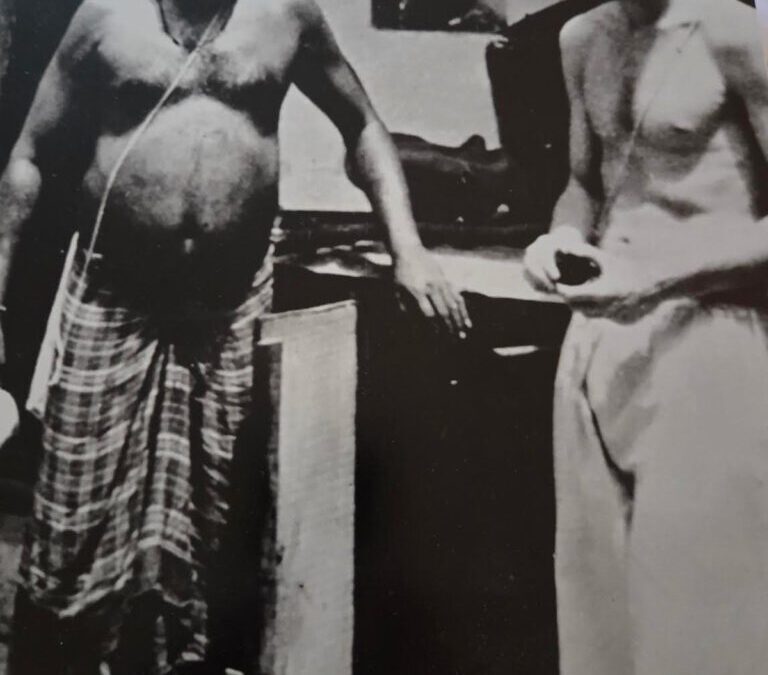
The first journal I ever kept was on my first trip to India. I did not think of it as a spiritual pilgrimage at first, even though my then-wife Iris and I had been inspired to go after reading Ram Dass’s Be Here Now, the 1970s underground bestseller. Iris wanted to find Ram Dass’s guru Neem Karoli Baba. For me, it was more of a Kiplingesque journey, visions of me as an intrepid explorer dancing in my head. Somewhere in the recesses of my mind I also thought I’d learn to play tabla, the classical drums of India, as I’d played Western drums since junior high school in blues, jazz, and rock bands, and still do.
In either case, I knew it would be life-changing and that I would want to take note – literally take notes – to record the adventure. After several years working as a newspaper reporter, on the run scribbling on little pads, I thought this would be second nature for me. I had also read a lot of Henry David Thoreau, the American transcendentalist, especially his 1854 book Walden, in which he assiduously listed what he bought and how much each item cost while living alone beside Walden Pond in Concord, Massachusetts. At the time I admired this style, which reminded me of what reporters do.
“The real goal is to bring the reader into the moment – to have them, as Ram Dass would say, ‘be here now.’”
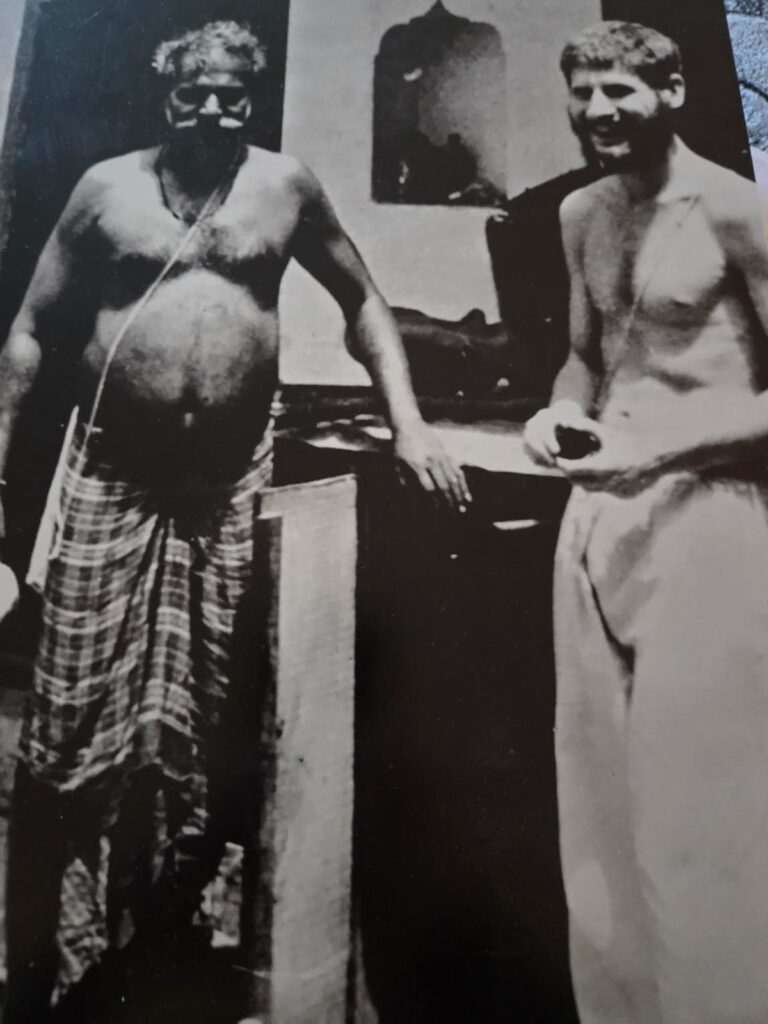
Iris never met that guru, but I found a different sort of guru: a master tabla musician who I met after a concert he gave in an open-air amphitheater at Benares Hindu University. In India, musicians are considered holy people, revered as divine channels. Music itself is viewed as sadhana (a spiritual discipline) and Nada Brahma (the divine essence of sound) rather than as solely entertainment. His name was Panchu Maharaj and I became his disciple. I called myself the “accidental shishya,” the Sanskrit word for disciple.
During the few weeks I stayed in his home, surrounded by a handful of his family, all performers of some sort, I sat alone in a room, with monkeys sitting on the balcony outside my room watching my attempts to practice the various simple rhythms, or tals in Hindi. I swore they were laughing at me. Throughout the days those tals followed me; dogs’ barks, wheels rumbling on cobblestone streets, people shouting – all of these noises remarkably fitting into the rhythms in my head.
My note-taking took a deeper turn than just detailing where I was, how much I spent, what year this statue or that temple was built. At first I wrote slowly, like Thoreau would have wanted me to, cataloging each day’s progress, each meal, each new rhythm I was learning. Then things slowed down, way down, until I felt more than I thought, experienced more than I intellectualized. Capturing this shift in words on a cheap grammar school-style composition booklet was above my skill set. I was not writing great prose. In fact, rereading it caused actual pain to my brain. But something was happening, something different from the writing I knew before, something as yet explainable.
I was reminded of what old school journalists told me: that journalism is the first draft of history. That made my scribbles a very rough draft of a first draft. These were field notes, simply abbreviated reminders of time and place, that someone with initiative could turn into writing good enough to be read by friends and others, even get published, without embarrassment.
That is exactly what happened. After leaving India, we spent six weeks on Menorca, one of the Balearic Islands off the coast of Spain. I read my diary notes, painful as it was, and spent weeks writing and polishing a profile of Panchu Maharaj that I eventually sold to East West Journal, the publication of the American macrobiotic movement in the mid 1970s. My freelance career had officially begun. It also marked my “aha moment” when I could envision the overlap of three interests: travel, writing and what I can now call my quest.
There were takeaways from this, lessons I learned as a reporter and peripatetic traveler, that are worth sharing when traveling the treacherous road of writing about your spiritual journey.
First among them is that every trip can and should have a spiritual component. Otherwise, why the heck are you going? “The journey of life is not a journey from one place to another, but a journey from ignorance to wisdom,” wrote Socrates.
As a cub reporter, I was not entitled to use the words “I,” “me,” or “mine.” Unless you were a columnist, it had to be third-person reportage. Yet great writing always has a point of view. How do you do that without using first person? Another old writer’s mantra: “Show, don’t tell.” In other words, show details of why this person or place or experience has blown your mind. It’s true that God is in the details. Describe the sunlight, the shade of green, the sounds of temple bell. Well chosen, they will reflect your own point of view.
This also helps alleviate those tired cliches that say nothing meaningful, words such as “amazing,” “incredible,” “awesome,” even “unforgettable.”
There is another risk to writing about a spiritual experience while traveling, or at any time. As I said, readers desire a point of view, especially when that experience has a highly subjective transformative effect on a person. Yet, without a balance between subjective and objective, a writer can run the risk of sounding preachy, or proselytizing. Converting people is not the goal, nor should it be. The reader will listen to your experience and decide on their own if they too want to try it.
The real goal is to bring the reader into the moment – to have them, as Ram Dass would say, “be here now.”
To help reach that level of writing, one exercise I have applied to every writing workshop I have ever led is to have participants write as many sentences as they can in 10 minutes, each sentence beginning with the words “Here and now I am…” and complete the sentences. This requires writers to report on their senses – sights, sounds, smells, feelings – to evoke that time and place.
These little strategies ground one’s experience in prose that may be prone to fantastical flights of revery.
Ram Dass used to remind us that even when you are basking in bliss, seeing divine light, conversing with Gods and Goddesses, don’t forget your social security number. It’s the same when writing about those experiences wherever you go in the world.
The post How to Write About a Spiritual Journey appeared first on Lion’s Roar.
Recent Comments