
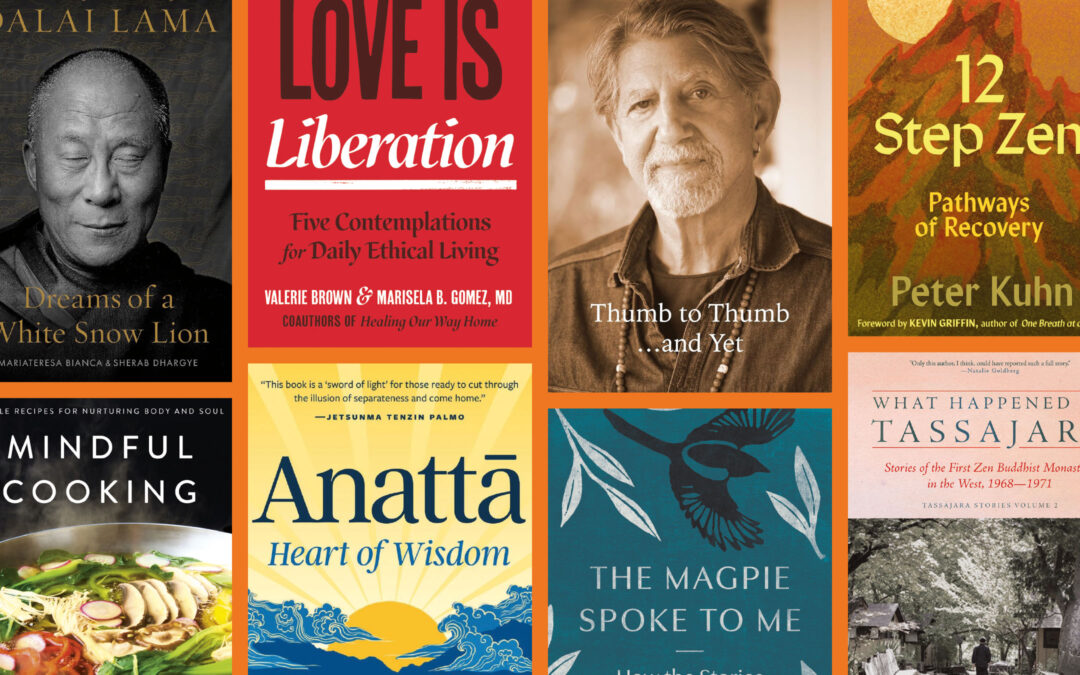
Dreams of a White Snow Lion: The Remarkable Life, Vision, and Deeds of the Dalai Lama (Shambhala) by Mariateresa Bianca and Sherab Dhargye—running well over six hundred pages—is the definitive biography of His Holiness the Dalai Lama. Based on the biography written in Tibetan by Sherab Dhargye in 2015, Dreams of a White Snow Lion incorporates over fifty traditional Tibetan sources, all fastidiously footnoted. While intellectually rigorous, the book remains accessible, with its explanations of more esoteric concepts and its inclusion of interesting tidbits and personal details. For example, the authors explain details about trance states and dreams of previous lives, and they reveal the kinds of toys the Dalai Lama enjoyed playing with in his youth. (He spent time melting down lead soldiers and making them into miniature Buddhas.) The book also discusses the Dalai Lama’s role in international politics and the political situation of Tibet.
Eric Ripert is a world-renowned chef whose flagship restaurant, Le Bernardin, has maintained three Michelin stars for over twenty years. He also happens to be a Buddhist with a deep interest in temple food. Ripert’s new book, Mindful Cooking: Simple Recipes for Nurturing Body and Soul (Random House) is the final book of a trilogy, which began with Vegetable Simple and continued with Seafood Simple. All three books are based on principles of simplicity, quality ingredients, and cooking with intention. The recipes in Mindful Cooking—all entirely plant-based—include socca Niçoise, a beloved street food from Nice, and Okinawan sweet potatoes with yuzu emulsion. Ripert finds inspiration in both his French origins and his travels in Korea and Japan, especially his connection with Venerable Jeong Kwan, a Korean Buddhist nun and master of temple food who was featured in the Netflix show Chef’s Table. I highly recommend this gorgeous and inspirational book to anyone who wishes to cook and eat healthy, simple, yet elegant food. In the words of Ripert: “This book is an exploration of what food can unlock for us, about how it can bring health, joy, mindfulness, and gratitude into our daily lives.”
Thich Nhat Hanh hoped that one day humanity would have a shared ethical foundation rooted in mindfulness, compassion, and nonviolence. To contribute to this universal ethical code, he created the five mindfulness trainings: reverence for life, true happiness, true love, loving speech and deep listening, and nourishment and healing. In Love Is Liberation: Five Contemplations for Daily Ethical Living (Parallax), coauthors Valerie Brown and Marisela B. Gomez share new mindfulness practices and contemplations to accompany these trainings. This book is at once an homage to Thich Nhat Hanh’s original work and a manifesto for social action and change. The authors are BIPOC and LGBTQIA+ Buddhist practitioners and teachers, and the lived experience they bring to bear is invaluable, particularly for social activists and historically marginalized readers.
In Buddhism, the term anatta refers to the idea that no unchanging, individual self exists. In his new book, Anattā: Heart of Wisdom (Hohm Press), author Michael Schauch explores this idea of nonduality and interconnectedness through a series of contemplative essays, stories, and poems. Schauch, who lives with his family in Squamish, British Columbia, has a strong relationship with nature that shines through this book. Whether he’s scrambling through the canyons of Utah, discovering sky tombs in Nepal while hiking, or contemplating life from beside a campfire at his home in Squamish, Schauch continually expresses love and awe for the outdoors. This is combined with a thoughtful understanding of both Tibetan and Japanese approaches to Buddhism and a deep-seated love for a good story. He writes, “May we come to realize the true essence of ourselves. Of our mind, which is actually no mind, or rather universal mind: an interconnected consciousness rooted in the language of the Heart.”
Peter Coyote’s second poetry collection, Thumb to Thumb…and Yet (Four Way Books), takes its title from the way Zen practitioners sit zazen with their hands resting in the cosmic mudra, thumbs lightly touching—a gesture of attention and presence that has accompanied Coyote through decades of practice. Coyote is best known as an Emmy Award–winning narrator of many acclaimed documentaries, including The West and The Roosevelts: An Intimate History, both produced by Ken Burns. He’s also an actor with memorable roles in films such as Erin Brockovich and E.T., as well as a director, screenwriter, poet, and Zen Buddhist priest. Although Coyote is now eighty-four, his poems feel raw, young, and new. The work reflects a lifetime of struggle and laughter, pain and strength. In the poem “Wild Nature,” Coyote writes: “It was always the wildeyed dogs / I loved, panting in the trees, / eyeballing all that pretty meat— / whimpering, / making it all up / every day.”
In the introduction to The Magpie Spoke to Me: How the Stories We Tell Shape Our World (Shambhala), Bonnie Nadzam writes, “If you think your stories do not matter, how I hope this book will change your mind. Every story shared, distorted, or withheld participates in the world we are making together.” Although the author is an ordained Buddhist priest, this is not a book about religion, and although the author is a published author of fiction, it is not a book about the craft of writing. Rather, the book is about allowing meaning to emerge through storytelling. It’s about how stories shape our world. Indigenous healers, Buddhist priests, artists, poets, scientists, and professors have all contributed stories to this collection, which pushes the boundaries of the traditional Euro-Western cosmovision and encourages readers to see the world with wonder, hope, and creativity. Contributors include Joan Halifax, Jane Hirshfield, Wendy Egyoku Nakao, and many more.
12-Step Zen: Pathways of Recovery (Parallax) by Peter Kuhn artfully weaves together the twelve steps as practiced in recovery fellowships with Buddhism’s seven factors of awakening. Kuhn talks about his life as a jazz musician addicted to narcotics, about his eventual recovery with the help of the twelve-step program, and about the sudden and unexpected death of his seventeen-year-old stepson over a decade later, which led him to the Plum Village Buddhist tradition. Now a passionate teacher of the dharma, Kuhn hopes to help people struggling with addiction to deepen their recovery and find joy in life again. “The Four Noble Truths and the Twelve Steps are both paths to spiritual awakening that invite us to turn toward suffering rather than away from it,” says the author. “That may seem counterintuitive, but it is practical and immensely rewarding. Each offers a path through the wilderness of life and a way to make good use of suffering.”
What Happened at Tassajara: Stories of the First Zen Buddhist Monastery in the West, 1968–1971 (Monkfish) by David Chadwick is the second volume in his Tassajara Stories series. In this new installment, Chadwick offers a glimpse into the years immediately after Tassajara’s opening and evokes the people who passed through—hippies, early practitioners, and cultural figures such as Joan Baez, Jack Kerouac, Peter Matthiessen, Alan Watts, and Gary Snyder. Chadwick, who passed away in February, is known for documenting the life and work of Tassajara’s founding abbot, Shunryu Suzuki Roshi. Chadwick’s self-effacing humor, his instinct for an interesting anecdote, and his affection and passion for the Tassajara community make this book a pleasurable read for anyone who cares about the genesis of the Zen community in North America. The volume concludes with Suzuki Roshi’s death from cancer and with reflections on how his passing was felt throughout the community.
The post Books in Brief: November 2026 appeared first on Lion’s Roar.
Recent Comments