
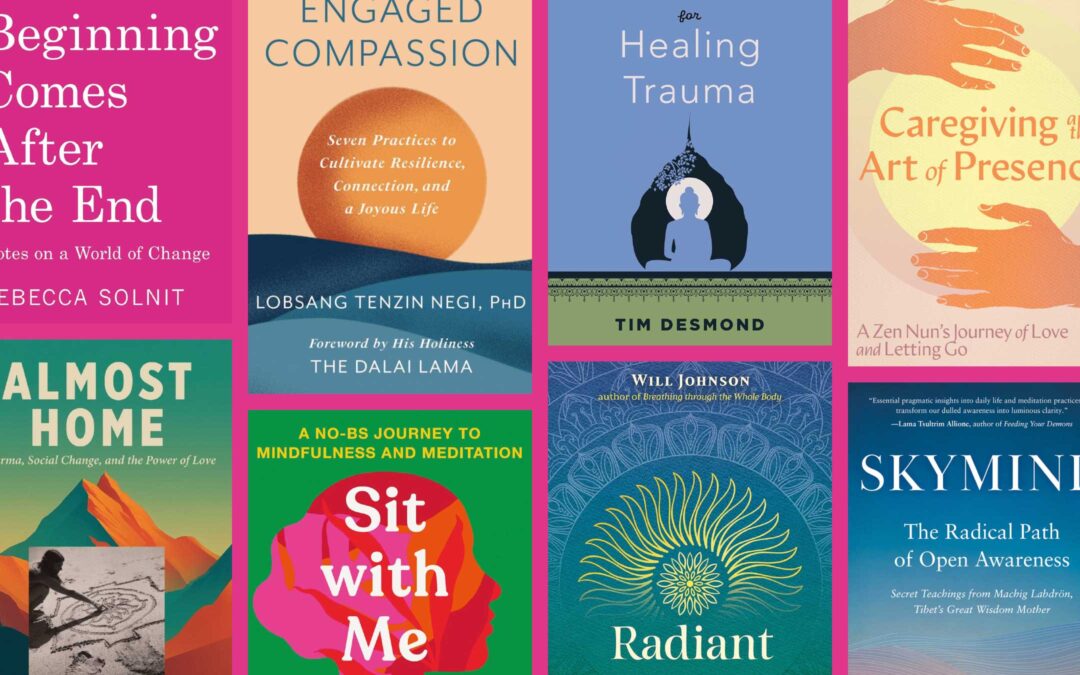
Land is being returned to native tribes. Renewable energy is taking hold as an obvious and cost-efficient choice. Women’s rights are so firmly entrenched there’s now a right-wing backlash against them. Rebecca Solnit, in her new book The Beginning Comes After the End: Notes on a World of Change (Haymarket) argues that positive change is happening, even if it can be hard to see. She encourages us to take a step back and look at history from a wider angle. She explores how seeds that were planted and tended in the last few decades have blossomed: Good things have come out of campaigns, struggles, and visions that might have seemed futile at the time. Solnit, a feminist, Zen practitioner, activist, and political and cultural commentator, is passionate about tracing patterns. Stories from our past are, as Solnit puts it, “seeds with which to plant forests of possibility.”
Building on generations of Asian and Asian American teachers who first brought Eastern spiritual traditions to the United States, Mirabai Bush emerged in the 1970s as a figure who helped introduce these teachings to new communities. In her memoir Almost Home: Dharma, Social Change, and the Power of Love (Wayfinder), she recounts a fascinating, impactful life. Bush traces her journey from a childhood shaped by the stigma of a “broken home” to her early adulthood at Cape Canaveral, where she edited scientific manuals while her husband worked as a NASA engineer. Her path eventually led her to India, where she lived in an ashram and studied with the guru Neem Karoli Baba (Maharaji). Returning to the U.S., she became a pioneer in bringing Buddhist and Eastern-inspired goods to Western markets, coauthored books with Ram Dass, and developed mindfulness programs for organizations ranging from Monsanto to Google. Her memoir captures an evolving spiritual landscape and conveys the love and passion for life that have made her such an influential presence.
Cognitively Based Compassion Training (CBCT) was originally designed to help university students struggling with mental health challenges. Since then, it has grown into a renowned secular compassion-training program employed in hospitals, schools, police departments, and more. This program teaches us how to make compassion a way of life, bringing stability, connection, and purpose to our world. In Engaged Compassion: Seven Practices to Cultivate Resilience, Connection, and a Joyous Life (Simon Element), Lobsang Tenzin Negi explores how this innovative approach was developed through a mix of Eastern religious philosophy and Western science. In the second half of the book, the seven practices that comprise the program are explored one by one. As an adolescent, Negi was trained as a Buddhist monk in Dharamsala at the Institute of Buddhist Dialectics, supervised by His Holiness the Dalai Lama. He’s now the executive director of the Center for Contemplative Science and Compassion-Based Ethics at Emory University, where he also teaches in the Department of Religion.
“When we can look past our need to like one another and get down to the business of loving one another,” writes Oneika Mays, “that’s when the real work of building a better world can begin.” In her new book, Sit with Me: A No-BS Journey to Mindfulness and Meditation (HarperOne), Mays discusses her path as a practitioner of metta, or loving-kindness. She tells the story of her time as a meditation and yoga coach at New York City’s notorious Rikers Island jail complex, where prisoners are often treated as if they don’t deserve peace, comfort, quiet, or love. Part memoir, part meditation guide, Mays uses her experience at Rikers as a reference point to explore the benefits of a loving-kindness approach. Whether you’re a practiced meditator or a novice, whether you’ve been incarcerated or not, this book will speak to you as a human being who’s worthy of love.
Healing from trauma is not a linear path. It’s a cyclical process that involves repeating the same steps but with more depth of understanding each time. Buddhist Practices for Healing Trauma (W. W. Norton & Company) by Tim Desmond is built around this principle. The book is divided into cycles. Within each cycle are strengthening exercises, designed to help us be present with our trauma; acceptance practices, which help us live with our feelings; and transformative practices, which help heal trauma in the present moment. Each cycle includes sutra study that delves more deeply into Buddhist teachings on trauma. Desmond maintains that trauma can be transformed into something valuable that leads to full healing. In his words: “Trauma is garbage. Yet, as any good gardener knows, garbage can be transformed into compost. And compost is an indispensable resource for a healthy garden.”
What if we explored mindfulness practices not just when we’re sitting on our meditation cushion but as we move through our daily lives? What if we explored our breath not just as it passes in and out of our lungs but as it moves through the entire body? This is “radiant mindfulness,” as presented by Will Johnson in his new book, Radiant Mindfulness: How to Reach the Awakened State Beyond the Mind (Inner Traditions). It’s a companion volume to Johnson’s previous book, The Radical Path of Somatic Dharma. While Somatic Dharma addressed embodied meditation in the context of traditional sitting meditation, Radiant Mindfulness explores the idea of embodied meditation as it pertains to our active lives. According to Johnson, you can transform any moment, no matter where you are and what you’re doing, into a moment of awakening. He’s peppered his book with short poems, which he refers to as somatic koans; he hopes they’ll affect the reader on an embodied level.
Caregiving and the Art of Presence: A Zen Nun’s Journey of Love and Letting Go (Parallax), by Sister Tue Nghiem, is a heartwarming story of love and care between a mother and her daughter. Tue Nghiem, a nun in Thich Nhat Hanh’s Plum Village community, learns to know her mother on a deeper level as her mother ages and gets sick. Her book reads like a personal diary, and rather than providing practical advice about caregiving, it tells a human story of struggle, survival, and emotional healing between two people who love one another. The family has strong ties with the Buddhist community both in France and in North America, and Tue Nghiem frequently refers to Buddhist philosophy and mindfulness as she tells her story. At the end of her book, she includes point-form tips for caregivers, also based on Zen teachings.
Machig Labdron grew up in eleventh-century Tibet in a well-to-do family. Exceptionally bright, she read the Prajnaparamita Sutra easily at a young age. Eventually, she was approached by the teacher Kyoton Sonam Lama, who encouraged her to return to the text but to search for deeper meaning. With her unique viewpoint, Machig Labdron developed a practice called chod, meaning “severance” or “to cut through.” It spread widely across Tibetan Buddhist traditions and continues to inspire contemporary communities, including Skymind. Charlotte Rotterdam and Peter Oosthuizen are leaders of the Skymind community in Colorado. Their new book, Skymind: The Radical Path to Open Awareness (Shambhala) includes citations from original texts by Machig Labdron accompanied by contemporary analyses, exercises, and reflections. The teachings emphasize compassion, fearless intimacy with lived experience, and cutting through egotistical attachment to meet life with greater openness and clarity. As Rotterdam and Oosthuizen write, “only by meeting and even nurturing whatever we consider most ‘other’ can true liberation be attained.”
The post Books in Brief: July 2026 appeared first on Lion’s Roar.
Recent Comments