
A few weeks ago, I saw a six-year-old boy whom I’ll call Joseph in the emergency department where I work in western New Mexico. He was brought in by a local foster care service. Before I went in, the temporary guardian accompanying him told me what had happened. The child had been in the car with his family. His mother was behind the wheel. She had been drinking. Suddenly she lost control of the vehicle, and it veered off the road and rolled in the red dirt and sage.
Joseph was ejected through an open window. He flew through the air, landing some distance away. Somehow, he was unharmed. He got up and went back to the vehicle, where he said he had found the rest of his family “sleeping.” They weren’t far from home, so he walked there to get help. The other occupants of the car had either been killed or had been flown to Albuquerque for emergency surgery. We did not know what would become of them.
I looked in through the glass door of the child’s room. He was sitting upright in bed, white blanket pulled up to his chin, looking off into the distance. He looked very small, alone in the center of the room. How do we think about a moment like this?
It turned out that he had no serious injuries, apart from some scrapes. But he had been subjected to something horrible, conditions that were no fault of his own. How would this experience change him? And what about his mother? For me, at least, a feeling of blame arises. Of judgment. Maybe anger as well.
I remember another patient I saw a few years ago. A woman in her forties. She had also rolled her vehicle and was so intoxicated that she couldn’t tell us what had happened. She could have killed herself, or someone else. So reckless.
When she sobered up enough to talk, I learned about her life. She had been a sex crimes detective, and the work had haunted her. The drinking was a way to make it stop. The car crash turned out to be a suicide attempt. My judgment softened. My view of her became larger, and I could see her suffering more clearly.
I think about these two women. What did I not know about Joseph’s mother? What experience had led her to get behind the wheel of a car, intoxicated, with her whole family inside? I don’t know. But maybe she would have had something similar to tell me had she also been my patient. Maybe my view of her would have grown larger, too.
I have so many stories like this. I see people in these crux moments, where the entirety of their past precipitates into a kind of terrible diamond—impossibly hard, impossibly sharp—that illuminates everything and often alters the course of their future.
When I say it illuminates everything, I am referring to the principle of dependent origination. This is the Buddha’s teaching that everything arises from a complex web of causes and conditions. It’s always much, much bigger than any one person. Actually, it’s the size of the entire universe.
My work in the ER illustrates this principle for me. I have begun to sense, just barely, this larger web of context in which all of us live. Behind recklessness, behind anger, behind hatred, behind vitriol is a vast constellation of causes and conditions. Seen from this perspective, I find that judgment is often transformed. I am better able to see the root of suffering in these moments. Behind anger is suffering. Behind recklessness is suffering. Behind violence is suffering. Behind suffering is suffering.
There is a story that Dogen writes about in the Shobogenzo called “Hyakujo’s Fox.” Hyakujo was a Zen master in China in the eighth century. One day an old man showed up at one of his lectures. Hyakujo said, “Who are you?”
He said, “I was once a Zen master and abbot of this mountain. A student asked me whether an enlightened person is subject to the laws of causation. I said, ‘No, an enlightened person is not subject to the laws of causation.’ For this answer I became a fox for five hundred rebirths. Now I ask you: Is the enlightened person subject to the law of causation?”
Hyakujo said: “The enlightened person is not blind to the law of causation.”
At this the old man was enlightened. “I am no more a fox,” he said, “but I have to leave my fox body behind this mountain. Please perform a funeral for it.” Then he disappeared.
The next day Hyakujo led the monks out behind the mountain to a cave, where they found the corpse of an old fox, which they buried.
What does it mean to not be blind to the law of causation? For me, I think it means taking a more capacious view of things, particularly of others. I think it means seeing the suffering, and the roots of suffering, behind whatever it is that we recoil from, or that we judge, or that we condemn. Why is this important?
Well, first, I think it’s important because it’s the way things actually are. This is reality.
But second, I have found that something happens when you begin to perceive things in this larger, more inclusive way. I have found, sometimes to my surprise, that compassion rises up into this spaciousness, like water filling a well from below.
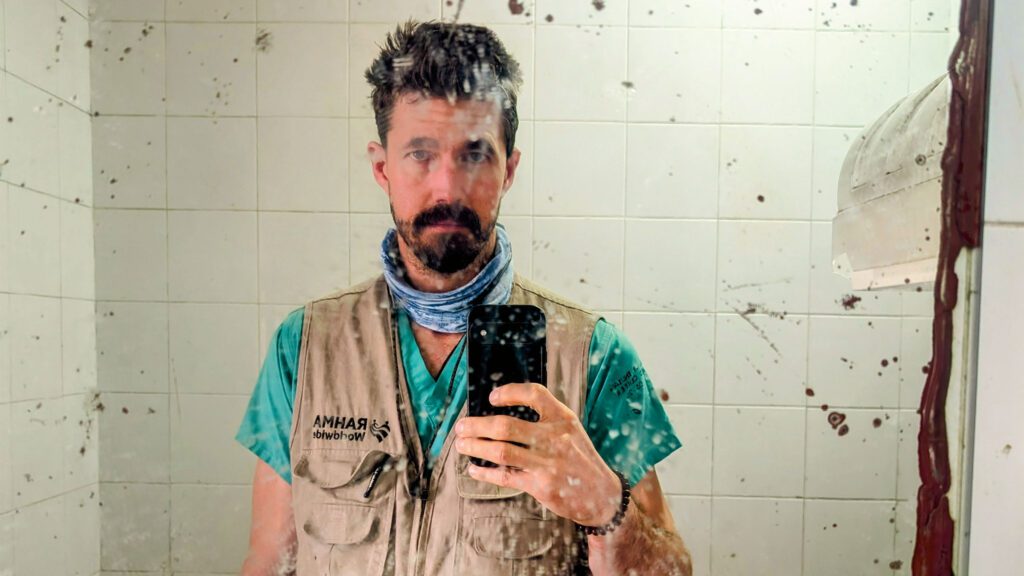
Watching the suffering unfold in Gaza, I experienced an urge to be of use there. I’m trained as an emergency doctor—a useful occupation in a war zone. And so I went, in January of 2025. Dogen has an essay called “The Needle of Zazen.” In a commentary on this essay, Tenshin Reb Anderson says that zazen is like an acupuncture needle that we stick into our lives. I think my urge to go to Gaza was a way to stick another kind of acupuncture needle into my life.
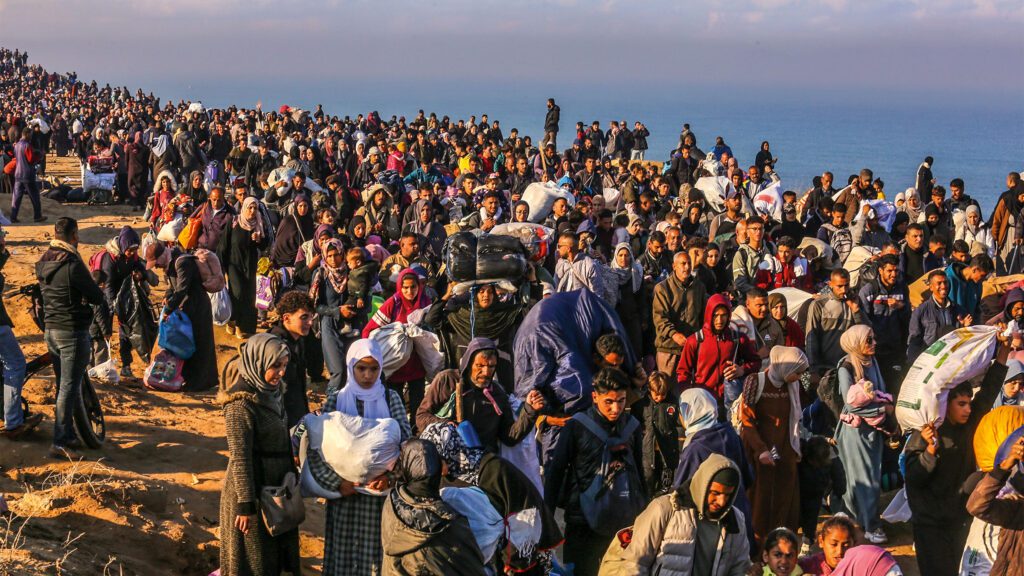
And it was. I thought I knew something about suffering from the ER. But in Gaza I saw it on a scale that I cannot express. More bombs have been dropped on Gaza—a strip of land twenty-five miles long—than were dropped on London, Hamburg, and Dresden combined during the entire Second World War. It was a mosaic of destruction; everything was touched by it. In the northernmost towns, there were no buildings. There were only piles of rubble.
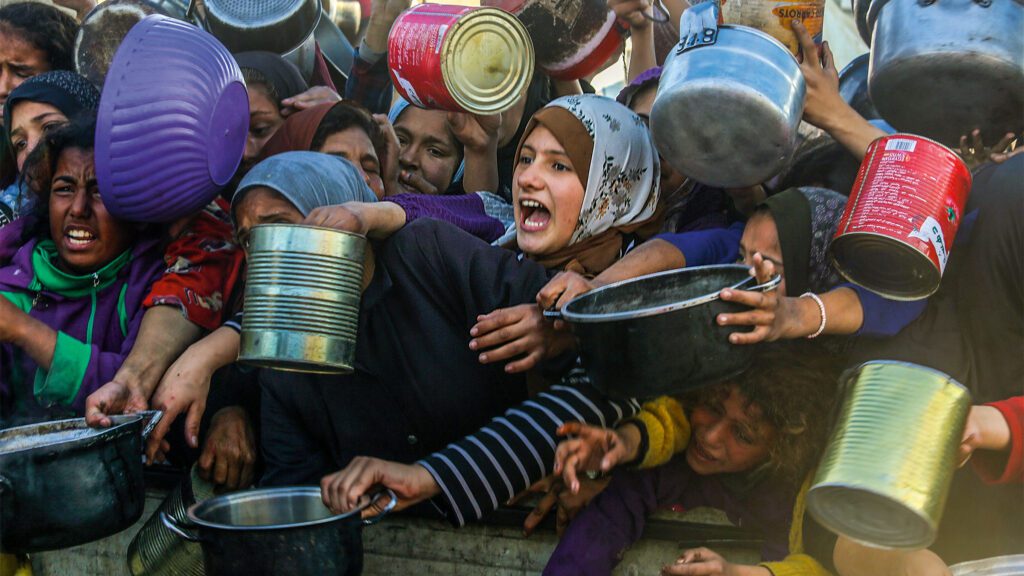
I met doctors who had lost children, wives, parents, grandparents, entire families. I met nurses who were living in tents, skipping meals so their children could eat. I met patients who had lost arms, legs, sometimes both arms and legs. I met children whose bowels had been sliced open from bomb fragments, and whose bones were held together by metal pins protruding from their skin.
I felt like I could just begin to perceive the weight of all the causes and conditions that had given rise to this conflict, the histories, the decisions, the events, compounding for decades, for centuries. For forever, actually. I could almost feel it all turning. It was overwhelming. I felt, also, like I could just begin to register how it all poured forth into the future. How those causes and conditions I witnessed were giving birth to the next moment, the next year, the next decade. What consequences would they yield?
There was another moment that I remember very strongly. We were passing through a checkpoint in Israel. I was riding in a van with my colleagues, who were all Arab American physicians. A soldier, who could not have been more than twenty, climbed aboard our van. She had an assault rifle clipped to her chest. She began to scream at us in Hebrew. No one knew what she was saying. I don’t think we needed to. I could see that the roots of the anger boiling inside of her, trying to get out, were much larger, and much deeper, than her. She was suffering, too.
All of this elicited an unexpected memory. Several years ago, I was walking through an estuary near the coast of Maine. A high berm with a road on it ran through the middle. The water on both sides appeared still and totally calm. Then I noticed a culvert that connected the two bodies of water under the road. Water was pouring through it at great speed, roiling and frothing white as it emerged from the constriction. It was the tide coming in. It had been imperceptible in the larger body of water. But constricted to a specific point, its movement was revealed.
War zones, in a way, are like this. They make visible what’s usually hidden—that we inherit conditions we didn’t choose, that we act within systems of cause and effect far larger than any one of us.
For most of us, Gaza seems very far away. How can we relate to it? Are we implicated in it? What significance should it hold?
When I was in Gaza, a doctor showed me a photo on his cell phone of a huge gray missile sticking out of the ground in front of his house. His family had been inside when it struck, but it didn’t explode. A numerical designation was stenciled on the side. I looked it up—it was a 250-pound guided munition manufactured by Boeing in the United States.
So yes, we are implicated in it, in this way. But there’s another way it involves us, one that relates more intimately to our practice. My teacher, Roshi Joan Halifax, describes the nature of this relationship as a function of what Thich Nhat Hanh called interbeing.
“Each moment is the enactment of every aspect of reality,” Halifax writes. “From the realization of this perspective, our present lived experience is the complete and undivided expression of existence itself unfolding in time.”
“We are not separate from the events unfolding in our world at this very moment,” she continues. “We are not separate from what is happening in Iran, Lebanon, Israel, Gaza, or anywhere else for that matter, including the violence of war, the violence of genocide, and the work of peace.”
So, we are implicated in this, actually in a very intimate way, despite the entanglement occurring over great distances. This is our problem, too. What do we do with it?
When I was in Gaza, sometimes patients or doctors would need my medical assistance. But mostly, what they asked for was to be seen. They felt invisible, cut off, isolated, forgotten. Please, tell the world about us, they would say. They wanted us to bear witness for them.
Bearing witness is an important part of my tradition. Tetsugen Bernie Glassman, Halifax’s teacher, conducted formal bearing witness retreats at Auschwitz. The idea was to go to a place of extreme darkness and witness it.
Here is what he said about this practice: “When we bear witness, when we become the situation—homelessness, poverty, illness, violence, death—the right action arises by itself. Once we listen with our entire body and mind, loving action arises.” Like water filling a well from below.
As Glassman also taught, “When we bear witness, we open to what is, and we learn. The things that we are in denial about teach us. We don’t go to them to teach them. When we can listen, when we can bear witness, they teach us.”
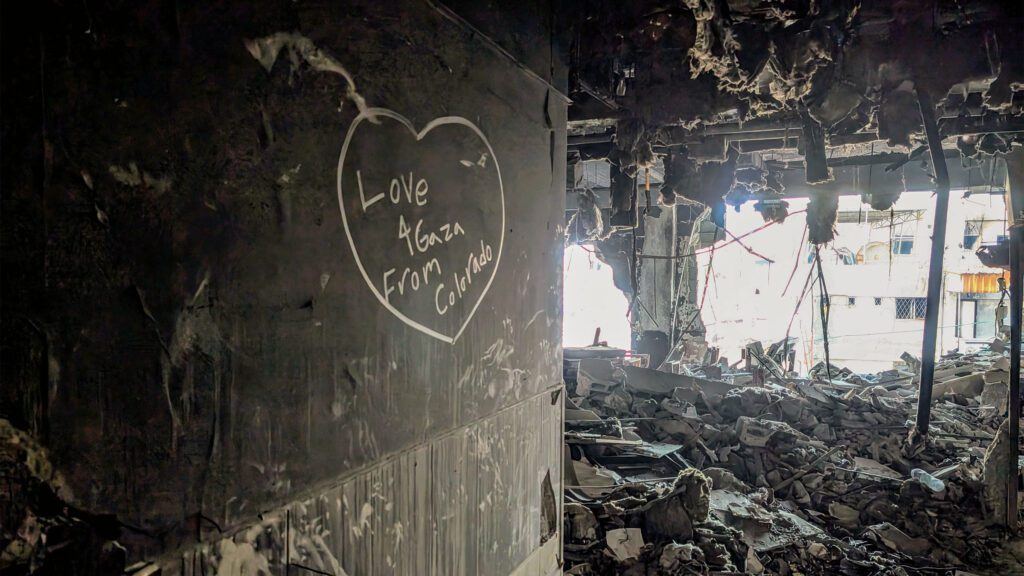
You don’t have to go to a concentration camp, or to Gaza, to do this. “Bearing witness is not something to be done only at Auschwitz,” Glassman Roshi said. “When we bear witness to the unfolding of our daily lives, not shrinking from any situation that arises, we learn. We open to what is. And in that process, a healing arises.”
So, we can do this right here. And if we are not separate from all that is, then bearing witness right here is enough. “Zazen is a form of bearing witness to life,” Glassman Roshi said. We do what we can do.
I have one last story. One day, in the hospital where I was based in Gaza, I met a man named Abdullah. He was just a few years older than me. He was living in the lobby of the hospital, with nothing but a few blankets.
His home had been destroyed by an air strike in November of 2023. Twenty members of his family were killed. Only he and his four-year-old son survived. His son was critically injured and was evacuated to Tunisia. Abdullah had no way of contacting him. He didn’t know if he would ever see him again.
I asked him how long he would stay there in the hospital. There is nowhere to go, he said. “Nothing to do, nothing to have, nothing to lose.
“No life,” he said.
Even so, he maintained a big, broad smile throughout most of our conversation. I asked him how he was still able to smile, given everything that he had been through. He wasn’t smiling for himself, he told me. His heart was heavy. He was smiling to make another happy.
“It’s not for me,” he said, “it’s for you.”
I was astonished, and for a moment, speechless. I have revisited this moment many, many times in my memory. It reminds me of a story about the poet and Zen monk Ryokan. One night a thief entered Ryokan’s hut. Ryokan was poor and had only a single blanket. It was his only possession. He felt great compassion for the thief because he knew there was nothing in the house for him to take. Ryokan could not resist; he gave his blanket to the thief. When the thief left, he wrote a poem:
The thief left it behind
The moon at the window.
Poor fellow, I wish I could have given him the moon!
I think of Abdullah, living precariously in the hallway of a ruined hospital in Gaza, with nothing but a few blankets. Nothing to have, nothing to lose. No life. Abdullah did not even have the moon. Or did he?
Thich Nhat Hanh taught that the present moment contains both past and future. “The secret of transformation is in the way we handle this very moment,” he wrote, no matter what our circumstances may be. Glassman Roshi put it this way: “Our actions—whether they make peace or war—reverberate throughout this universe.” And now Abdullah’s smile is here, present in this very moment, reverberating throughout the universe. It is now part of your life too, wherever you may be reading this.
It’s not for me, it’s for you.
The post Bearing Witness in Gaza appeared first on Lion’s Roar.
Recent Comments