
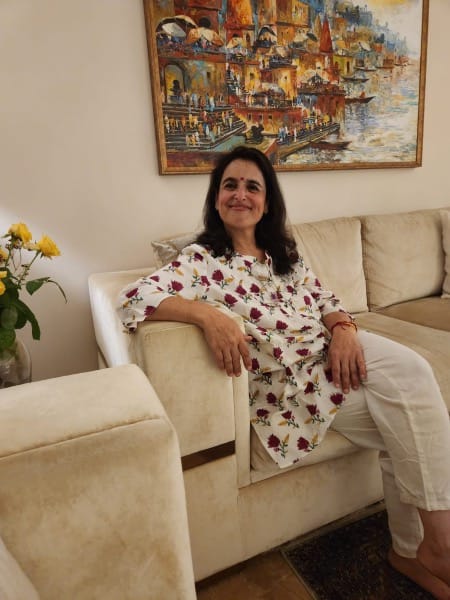
Grief has a way of living inside the body. For Anjali Shastri, that reality hit all at once on August 6, 2021. It had been exactly ten years since she lost her sixteen year old son. She felt low and had no motivation to work out that morning. But she pushed herself to do a jump squat anyway. That single, forced movement caused her to collapse, leaving her with three torn ligaments, a torn meniscus, and a fractured bone.
She was suddenly confined to a bed while working as an IT recruiter. In that quiet space, all her fears slowly began to surface. She was facing an upcoming arthroscopic surgery and a long recovery. Anjali was terrified. Immobile and in pain, she worried she would slip right back into food addiction, which had long been her primary way of numbing the ache of her loss.
Her unhealed grief had slowly turned into a desperate need to control everything around her. She was grieving the loss of her son and finding it hard to be fully present for the family in front of her. Her young daughter needed her, and her older son was quietly struggling with severe addiction. She was struggling to keep her weight stable during bed rest and felt like she was losing control of her life. That’s when her sister stepped in and helped her join a twelve-step recovery program.
Her sponsor did not offer empty comfort. Instead, he gave her the exact wake up call she needed. He bluntly told her that sitting in her grief and self pity was like a pig rolling in the mud. If she wanted to survive, she had to choose to get up. He insisted the way out was simple, though it demanded rigorous honesty. She had to practice gratitude.
“The moment I felt pain, I had to get in the present moment and write down what I was grateful for.”
~ Anjali
That same month, the program led her to the Gratitude app. The silver lining of her fall was finding a tool that forced her to look for the good. She got her leg surgery done and later shared that while it helped her physically, the app was what truly helped her sort her mind for life.
In August 2021, she began the process of daily journaling. Gratitude was not something that came naturally at first. She had to train her eyes to look for the good. She started writing down the simplest things: the fact that she was breathing, the beauty of the sunrise, or the exact abstinent meals she was allowed to eat on her recovery diet. On the days when her mind felt entirely blank, she leaned on the alphabet method. She would force her brain to list one thing she was thankful for starting with every letter from A to Z, always beginning with Acceptance.
The app quickly became a digital space she could return to each day. She built a quiet habit of reflecting twice a day. In the mornings, she focused entirely on her blessings and daily affirmations. In the evenings, she looked back on her day to make sure she was staying on track. Writing every day was like peeling back the layers of an onion. She learned that you cannot lie to yourself on paper. That daily honesty slowly began to change her.
Over the next five years of writing, she became a much softer, more patient person. She stopped reacting out of fear, let go of her need to control her children, and began repairing her relationships.
Something changed within her, and it didn’t just heal Anjali. It reached her family. Anjali found that her grounded presence helped support her older son through his darkest periods in rehab. Instead of pushing or controlling, she would simply text him the app’s daily quotes and pictures to remind him he was never alone. Today, he has completely turned his life around. He is healthy, happily married, and working as a financial analyst.
Anjali now sponsors others, passing along the very tools that saved her life. When asked what she would say to someone going through a dark chapter today, she shares a simple acronym for HOPE: Hold On, Pain Ends.
“The story is not yet written. Trust the higher power. He is the writer. Let him direct your show. You just be another bozo on the bus.”
~ Anjali
Anjali’s story reminds us that even on hard days, we can choose what to focus on. Healing does not mean fixing everything at once. Sometimes, it just means finding one small thing to be thankful for today.
If these words brought you comfort, share this with someone who might need a reminder to hold on and trust the process.
This is Anjali’s story, told beautifully by her and curated in its truest form by me to share with you.
I would love to hear your story. Write to me at preeti@gratefulness.me ✨


Every story is a reminder that a grateful heart is a magnet for miracles.
Recent Comments