
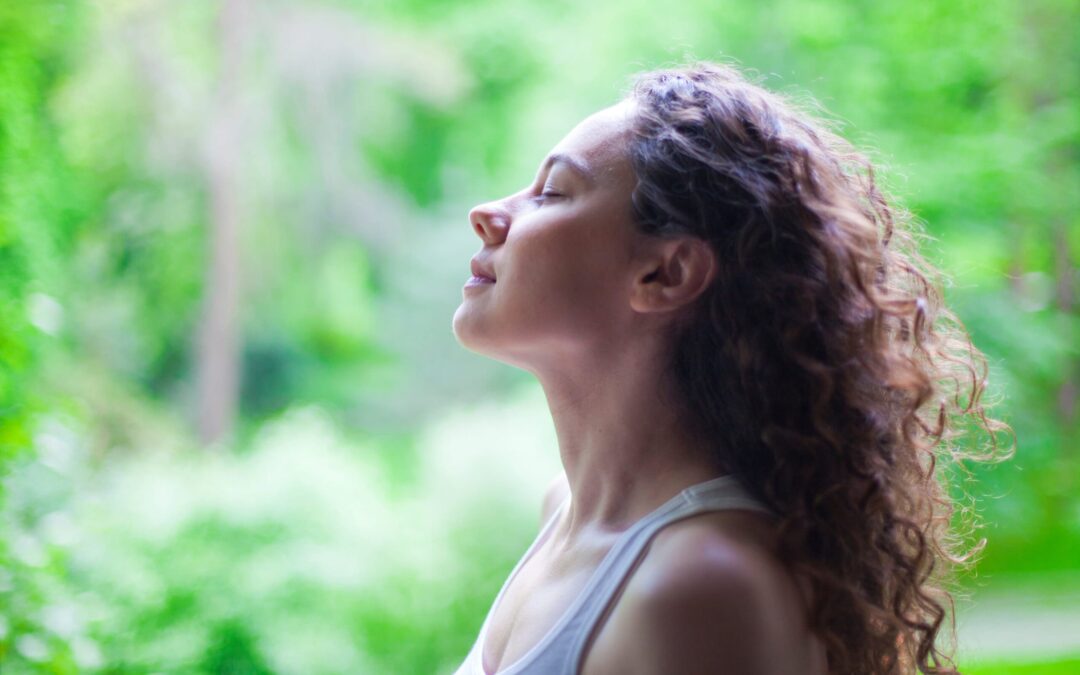

Breathing keeps us alive. We all know this. For most of us, breathing happens well enough, most of the time, without conscious effort. Unless disease or injury interferes, the body breathes on its own. So why, across yoga and so many other contemplative, healing, and spiritual traditions, has breath been treated not as background function but as a primary doorway into health, awareness, and transformation?
The first part of the answer is about feeling. Really feeling. Of course, we are always feeling things — from our senses, memories, and all that is coming to our consciousness. But how clearly, accurately, and fully are we feeling?
Imagine trying to smell a fragrant flower with a stuffy nose. Now imagine smelling that flower with clear nasal passages and the most refined olfactory senses. Imagine all of your senses open, receptive, and refined in ways that enable you to sense with them in the most delicate, subtle, and nuanced ways.
Going further, imagine that, in breathing, you bring sensations of the breath to touch every part of your bodymind — the whole of who you are. For now, just imagine it, or perhaps take a moment to visualize it — or to feel it. With that thought or sense, reflect for a moment on the idea of calming, slowing, or stilling your thoughts.
Body And Mind Are Not Separate Except In Our Imagination
The term “bodymind” reflects the understanding that the body and mind are not separate except in our imagination. What we think and feel is embodied, just as what happens in the body affects how we think and feel. Conscious breathing makes this especially clear. It invites us to experience ourselves more fully, not as separate realms of mind, body, and spirit, but in the complexity and wholeness of human experience — of human being.
In simply sitting and tuning in to our breathing, we will notice our bodymind moving with the movement of the breath. We tend to expand — physically and in qualities of awareness — with inhalations, and settle with exhalations. We are optimally still consciously breathing, allowing and going with the natural effects of our breathing all the while, moving — perhaps imperceptibly to others — to continuously create space and settle, little by little, breath by conscious breath, into a deeper quality of stillness and sheer presence in the whole of it all.
Amid this, our breathing serves as a barometer of energy, resistance, distraction, and intensity. This is the key to how the best yoga or spiritual teacher one will ever have is inside. Much of the practice is learning how to best attune ourselves to the inner messages, which come directly into our awareness in the act of being fully present to the experience. If we are breathing slowly, deeply, and sensitively, with awareness of our breathing and all that it allows to come to our senses, we become more attuned to our interoceptive faculties. This enlarges our capacity to refine, open, deepen, let go, or just be in it.
Put differently, breathing consciously sensitizes us to what is really happening, especially as we refine our breathing, cultivating it to become an ever-finer tool for sensing the subtlest sensations amid whatever we are doing. With whatever is happening, as the breath and manifold sensations more clearly come into our awareness, we can make clearer and better choices for ourselves. All of this is profoundly informed and affected by how we are breathing, where we are breathing, and the sense of connecting our breathing to the sensations we feel.
This is the Indian sage Patanjali’s svadhyaya, meaning “self-study.” We are learning all about ourselves, deep into our flesh and bones, into every aspect of our being and consciousness, discovering anew how we are who we are in the moment.
Visualize The Breath Touching Every Cell
Imagine gently breathing into the entirety of yourself, visualizing the breath touching every cell of your being with awakening, calming, loving energy.
We do not literally breathe into our hips or toes. But there is more going on with breath, movement, and sensation — especially when we add visualization. When inhaling, there is automatic movement in the bodymind, especially in the belly and chest. With effort, we can affect where that movement occurs, regulating more or less movement in different places.
Pranayama — an ancient yogic practice of breath control — brings us into intimate connection with the delicacy of our nervous system and our being. We feel more deeply, more acutely, more delicately. Pranayama can be a powerful tool for consciously cultivating greater clarity, congruence, and coherence in our lives. It can enrich all sensory experiences, infusing every moment with more subtle and delightful sensations. It also opens portals to new and expanded states of consciousness.
Conscious Breathing Opens A Natural Path To Meditation
This intimate attention to breathing offers a natural path into meditation. Allow your awareness to become completely absorbed in the flow of the breath, noticing how and where it arises and what it feels like along the way. Allow the breath to flow softly and quietly, simply watching it without trying to change it in any way. When your mind wanders away from the breath, gently bring it back to the steady, rhythmic flow of your inhales and exhales. Notice the natural pauses between each inhale and exhale, and the quieting and stilling of the mind that can happen there.
With practice, this quality of awareness does not have to remain on a meditation cushion. Walking in the woods, a dry leaf crackles beneath your foot, and in that one moment you are with just that sensation. Your awareness might expand — sensing the sound of the leaves and the sparkle of the dappled light filtering through the trees, perhaps the aroma of the forest — fully present in that expanded moment.
Beyond Self-Awareness Into Relationship
For the majority of people, life is lived in relationship — with lovers, partners, family, friends, co-workers, and community. By consciously cultivating the breath, we can enhance presence, deepen connection, and transform even the most ordinary interactions into beautiful exchanges of energy and understanding.
In many interactions, we are only partially present — distracted, preoccupied, or formulating our response before the other person has finished speaking. Consciously tuning in to the breath can root us in the moment, improving attentiveness and clarity. The breath becomes the thread between presence and participation, between solitude and shared life.
Whether we are sitting alone, breathing into the mystery of being, or breathing with a lover, a student, a friend, or a stranger, the invitation from conscious breathing is the same: to fully show up — subtly, gently, honestly.
Mark Stephens is the author of five bestselling yoga books, including Teaching Yoga and Yoga Therapy. Practicing since 1991 and teaching worldwide since 1996, he has studied and practiced in the ashtanga, Iyengar, and tantra traditions, and has engaged deeply with yoga histories and philosophies, somatic psychology, and evidence-based sources. Mark’s most recent book is Breathing: The Art and Science of Pranayama. (2026, Healing Arts Press).
Find holistic Breathwork Resources in the Spirit of Change online directory.
RELATED ARTICLES:
Your Rhythm Of Breathing Controls Emotional Judgement And Fear
Breathing In Good Health
Recent Comments