
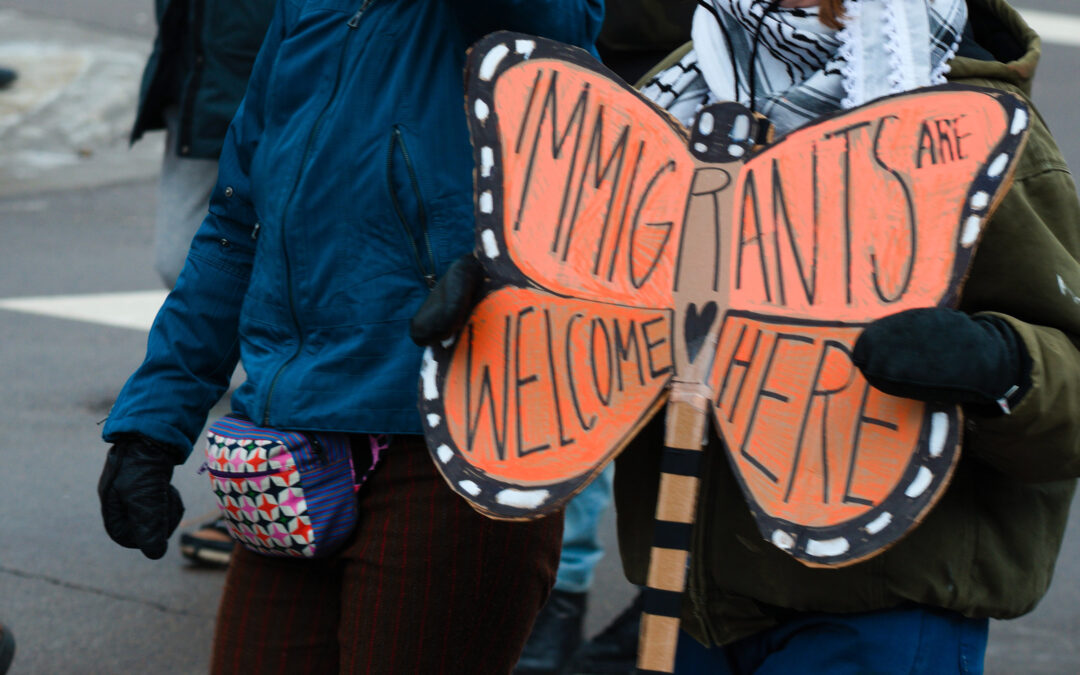
I arrived in Minneapolis at 10 p.m.
I live in Madison, Wisconsin these days, but I grew up here. My mom lives here. My 20-year-old son is a student at the University of Minnesota, where I was an undergraduate, as were my father and my grandfather. I have deep roots in Minneapolis and will always consider it my home.
Driving from the airport to the Airbnb, I noticed thoughts and feelings I have never had before in all my years living in this area. Something has changed.
My driver was an immigrant from Africa. As we pulled away from the airport, one of my first thoughts was whether he is safe just trying to do his job. What must it be like for him to choose between making his living and putting himself and his family at risk every time he gets behind the wheel?
“I’m practicing what the Tibetans taught me. I’m acknowledging the fear without letting it dictate my response. I’m choosing to see clearly rather than reactively. I’m remembering that the people perpetrating harm are themselves suffering.”
As we drove, I thought about all the people and families I know in the area, and the fear gripping the whole community. My wife is an immigrant. My son is half-Tibetan and was born overseas. I’ve been deeply involved with immigrant communities in Minneapolis my entire adult life, especially the Tibetan community (the second largest in the United States) and the Hispanic community through my work with non-profits.
It breaks my heart to see what these communities are facing right now. These are people who came here looking for safety and security and a better life, often leaving their homes because their own countries were no longer safe. In all my years living among refugee communities in Nepal, I heard so many firsthand accounts of the horrors people faced fleeing their countries, the incredible fear and risk they experienced. It never even occurred to me that they might experience that same fear here. In Minneapolis. The place I’ll always call home.
Minneapolis has always been a welcoming place. A place that has been open to people from other parts of the world, which is why we have one of the largest Tibetan, Somali, and Hmong communities in the country, along with immigrant populations from throughout Latin America and the rest of the world. I’ve always felt proud to be from a place that welcomes people so freely, that provides a safe home for those who didn’t have it.
So how did it get to the point where our entire community is under threat?
Masked men pulled people from their cars with seemingly no justification. People were killed without anyone yet held to account. The illusion of safety and security has completely disappeared.
I haven’t been to the protests. I haven’t been on the front lines. But even so, I felt a powerful swirl of emotions from the moment I arrived. Confusion and disbelief. A sense of total disorientation. Tremendous sadness for the people and communities affected. Fear and uncertainty. Anger and frustration at the injustice of it all.
But I was also reminded of what I learned living among Tibetan refugee communities.
I have heard stories so horrific I cannot tell them without crying. I’ve known people who crossed over the Himalayas on foot with friends and family members who didn’t make it through the journey. Children who died in front of their parents. Peaceful Buddhist monks beaten and tortured for no reason other than simply wanting to find a better life. Families and communities who endured the very worst things we can imagine, the most horrible violence and injustice that human beings ever inflict upon one another.
And yet, living in Tibetan communities, there was almost no hint of bitterness. I never heard even a single word about seeking vengeance. A shocking lack of anger or hostility toward the Chinese government.
Instead, what I saw was strength, courage, resilience, and even joy and laughter. A willingness to see that violence comes from deep suffering and confusion. An incredible respect and reverence for life—not just human life, but all forms of life. An understanding that even when people perpetrated horrible things, that did not make them horrible people. It did not make them less worthy of care. Quite to the contrary, it made them even more deserving of care.
The fact that these were people who had themselves endured things I could never imagine made it all the more awe-inspiring.
I remember one conversation with an elderly monk who had spent years in a Chinese prison. He told me about the guards who tortured him. When I asked how he felt about them now, he said, “I practice compassion for them every day. They are the ones who are truly suffering. They have to live with what they did.”
That wasn’t philosophy. It wasn’t a religious stance. It was simply how he experienced the world.
And yet, here in Minneapolis, I can feel how hard it is to access that wisdom. The pull toward fear and outrage is so strong.
The human nervous system is designed for one thing: survival. When we sense danger, an ancient threat response kicks in—fight, flee, or freeze. In Minneapolis right now, threat responses are firing in all directions. And I understand why. The danger is real. But the Tibetan refugees showed me something different: a way to respond to violence and injustice that doesn’t add more violence to the world.
There are people here as well who are role-modeling what this looks like.
These are people whose names we will never hear and whose stories we will never know. The legal aid workers staying until midnight to help families. The neighbors forming safety networks. The volunteers documenting what’s happening so there will be a record. The people putting their bodies between aggression and vulnerability.
They must be feeling the same pull of fear and outrage that so many of us are feeling. And yet they are not adding fuel to the fire. They are simply doing their best to help the people who need it most—the people who are vulnerable, who have nobody to protect them, nobody standing up to make sure their voices are heard.
These are the true heroes whose names will never make it into the headlines. They are working quietly, responding in the moment, embodying the same wisdom and compassion I saw in the Tibetan community. Whether through their own life experience or through consciously nurturing wisdom and compassion in their own hearts, they have somehow learned to keep their hearts open even in the middle of a crisis. It is deeply inspiring to know that these people are out there, trying to help us as a community find our way back from the precipice.
But doing this is not easy. We have forces within the wider community—and also forces within our own hearts and minds—that are in tension and competing to dominate our experience.
The pull of hatred and fear is competing with the slow-moving force of wisdom and compassion. Hatred and fear will always be louder. Wisdom and compassion will always be more subtle. But wisdom and compassion are more powerful. They’re like a slow-moving yet massive river compared to a rushing torrent. A slow river can carve a canyon given enough time. A rushing torrent might have a bigger effect in the moment, but its effect will come and go quickly.
That doesn’t mean wisdom and compassion will win out right now. Whether we take the time and energy to challenge ourselves in this moment to bring out the very best in both ourselves and our communities is not easy. It takes courage. Especially when the pull of outrage is so strong and compelling.
But we can look throughout history and see where these different pathways lead. We can look to the examples of Malala, Martin Luther King, Jr., and Gandhi, compare them to the many violent revolutions and political battles and their outcomes, and simply ask ourselves: Who do we want to be in this moment? And what is the path to get there?
When I think about the most horrible moments in human history and the people I most admire who had to confront these terrible moments, the answer is clear. They are the people who embodied wisdom and compassion.
So I’m practicing what the Tibetans taught me. I’m acknowledging the fear without letting it dictate my response. I’m choosing to see clearly rather than reactively. I’m remembering that the people perpetrating harm are themselves suffering.
That doesn’t mean accepting injustice. It doesn’t mean being passive. The people out in the community are not passive. They are protecting. They are witnessing. They are choosing courage over fear.
So here’s what I’m asking myself, and what I’m asking you:
When you feel that pull toward outrage, toward fear, toward hatred, can you pause for just three breaths? Can you feel the activation in your body without immediately acting on it? Can you create a little space for the currents of compassion and wisdom to emerge?
Every one of us has a role to play in what comes next. Let’s hope we can find our way back to a community built on compassion, not fear.
The post Who Do We Want to Be in This Moment? appeared first on Lion’s Roar.
Recent Comments