
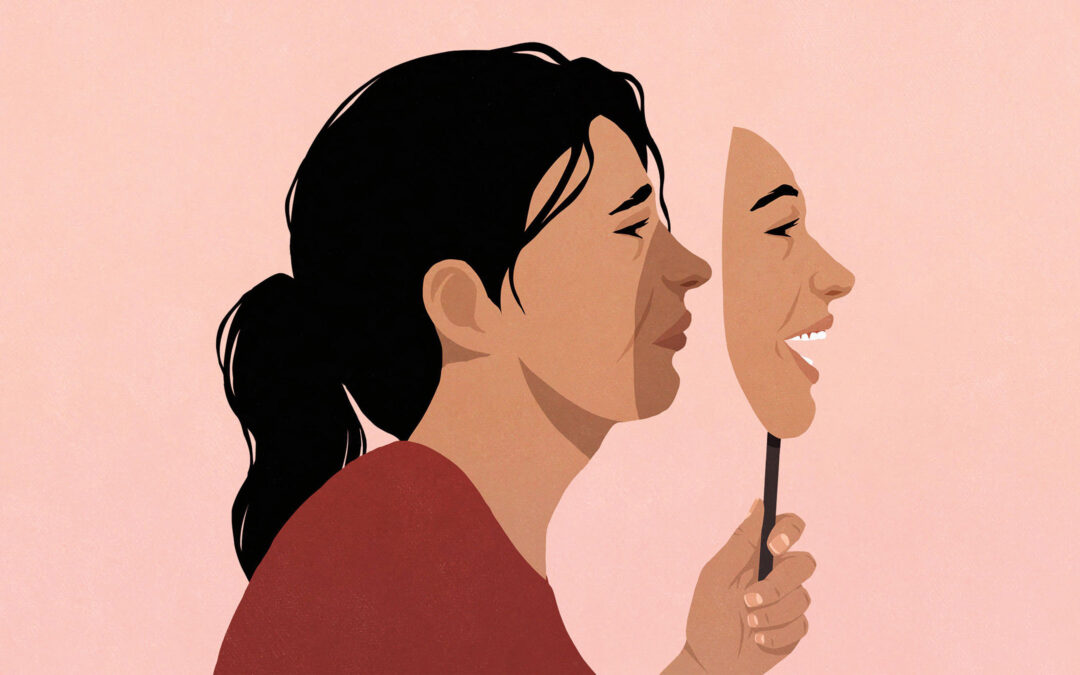
A man has only a hundred dollars in the bank and just got turned down for a job he thought he’d nailed. When his partner asks about it, he forces a smile: “It’s okay. Something better will come along.” On the surface, it sounds hopeful, but the words are a mask. He isn’t sharing his fear or disappointment—he’s managing perception.
A woman reframes a breakup as empowerment: “I was going to leave him anyway.” Beneath the bravado, she feels loss, confusion, maybe even an attachment wound. Still, she posts a photo with the hashtag #singleandlovingit.
Both of these stories show someone hiding hurt behind a performance of strength. In my work as a psychotherapist, I hear such stories often. The flavor is: stay on brand, keep it positive, don’t risk being “needy.” This is a hybrid of false positivity and people-pleasing, and the cost is heavy.
What looks like grit or resilience is often just repression, or what I call “virtual sukha.” Sukha in Sanskrit and Pali means “good space,” a sense of rightness and alignment. Real sukha is ease in the body, balance in relationship, harmony with the world. Virtual sukha is a facsimile. It’s an outward performance with no inward ground—a counterfeit happiness that erodes truth.
In today’s world, we’re encouraged not only to avoid dwelling on bad moments, but to avoid feeling them at all. The pressure is to go, go, go. In that motion, we lose authentic connection with ourselves and with one another. So, when we face loss or disappointment, it’s often as if we’ve been shot with two arrows. The first arrow is the painful situation itself. The second arrow is the wound of being told we cannot feel the first.
The Buddha warned against this in the Sallatha Sutta. He said that when struck by one arrow—pain, loss, disappointment—the “uninstructed person” adds a second arrow by resisting or denying it. This doubles the suffering. Virtual sukha is our modern second arrow: We mask the wound instead of tending to it. Worse still, we convert it into performance: Look how positive I am!
Traditionally, the Buddha spoke of three poisons: craving, aversion, and ignorance. Virtual sukha can be seen as their modern offspring. It is born first from craving—the restless desire for things to be different than they are. Rather than facing the truth of our experience, we reach for a brighter version, a shinier mask, a more palatable story.
Virtual sukha is also rooted in aversion, our resistance to the rawness of what is. Pain, disappointment, and vulnerability feel unbearable, so we push them away. We cover them with slogans, hashtags, or carefully rehearsed lines meant to convince both others and ourselves that we are unbothered.
Finally, virtual sukha depends on ignorance: not knowing how to meet reality with compassion. In this fog, we mistake suppression for strength and performance for resilience.
Together, these poisons give rise to a polished mask of false joy. We tell ourselves, I’m fine. It’s fine. And if it’s not fine, then it must be me. Feelings are often swallowed to keep the peace or maintain an image, but they don’t vanish; they harden into depression, irritability, or withdrawal.
In attachment language, virtual sukha resembles the dismissive or avoidant strategy. We become practiced at hiding our feelings, keeping our connections shallow. Relationships flatten into surface-level transactions, carefully managed to avoid the risk of being truly seen. What looks like calm detachment is often just fear of intimacy.
The cost is not only personal. Social media rewards the mask, praising the curated image while silencing authentic vulnerability. Repression becomes collective, eroding intimacy and fraying the fabric of community. Economically, depression costs billions. Spiritually, the cost is estrangement from each other and from ourselves.
Virtual sukha may protect short-term belonging, but it undermines long-term connection. The more we rely on the mask, the further we drift from honesty, intimacy, and repair. What begins as a smile to keep the peace becomes disconnection from ourselves and others.
At a cultural level, the mask teaches the next generation that only certain feelings are acceptable, leaving kids and teens editing themselves into fragments. Teens refine their image to be “liked” and “loved” online—ironically by people who don’t know them. In the process, they’re encouraged not to know themselves. As someone who’s worked with teens in acute mental health treatment for over ten years, I find it alarming to see this happening. There is a true urgency to address this.
As adults, our responsibility is profound. We need to show children that love is both kind and boundaried. We need to model that life doesn’t need to be the “#bestdayever” to be worthy of care. But how do we actually move away from toxic positivity?
Here the dharma offers a path. Through meditation—specifically the kind that cultivates insight—we can notice the mask before it hardens, because this practice brings our awareness to the five skandhas. These are the five aggregates, or heaps, that together make up what we usually think of as the self: form, feeling, perception, mental formations, and consciousness.
Form is the physical body and sense organs. Feeling, which refers to the sensations that arise in response to our experiences, can be pleasant, unpleasant, or neutral. Perception is the mental process of conceptualizing and categorizing our experiences using the information gained by our five senses. Mental formations encompass all our mental activities, including thoughts, emotions, attitudes, and intentions. And consciousness is the subjective knowledge or awareness that arises in recognition of the other four skandhas.
The five skandhas reveal that there’s no fixed self. There are only habits and perceptions that can be seen for what they are: insubstantial and impermanent.
The twelve ayatanas are the six sense organs—eye, ear, nose, tongue, body, and mind—and their six corresponding objects—forms, sounds, smells, tastes, tangible objects, and mental objects. Mindfulness of the ayatanas shows us where experience arises. Awareness at these gates helps us catch reactivity before craving, aversion, or masking takes hold.
The skandhas and ayatanas reveal how the mask is constructed. The practice points that follow show, moment by moment, how to set the mask down.
Pause before saying, “I’m fine.” Take one breath. Notice your body. Naming sensations interrupts the mask.
Practice loving-kindness for honesty. Repeat: May I be kind. May I be honest. May I be whole. This practice helps us anchor honesty in compassion instead of conflict.
Set compassionate limits. When tempted to say yes out of habit, try: May I care for you, and may I care for myself. Boundaries become an act of love, not rejection.
Notice suppression. Research shows that pushing down feelings increases stress and dysregulation. When you catch yourself repressing, see if you can allow just 10 percent more of what you’re feeling to be present.
Name the poison. Is what’s happening craving, aversion, ignorance, or virtual sukha? Naming the energy loosens its grip.
Dropping the mask of virtual sukha, we step out of hollow happiness. What emerges is authentic joy, where compassion and truth meet. This is not only about mental health. It’s the dharma path itself—and the cultural movement we urgently need.
The post When Resilience Becomes Repression appeared first on Lion’s Roar.
Recent Comments