
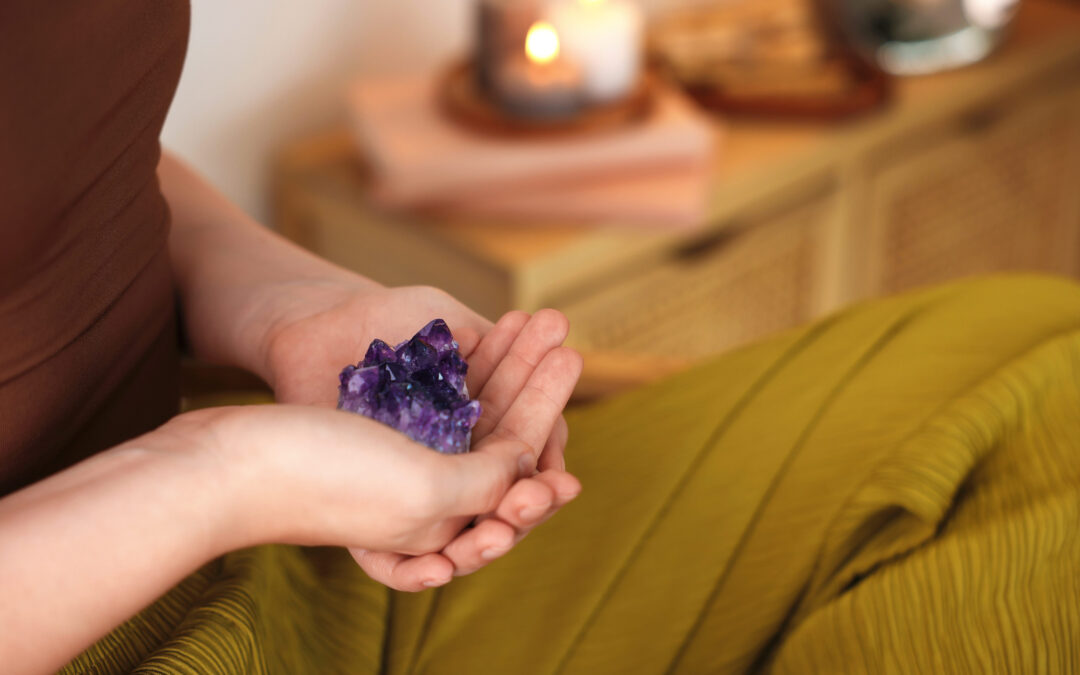

Most of us acquire our first crystal without much ceremony. A smooth piece of amethyst picked up at a gift shop, a tumbled rose quartz passed along by a friend, a chunk of obsidian that caught the light in a way that felt personal. We bring these objects home, set them on a shelf, and move on with our lives. Months or years later, we notice them again and realize we have no idea why we chose what we chose.
That noticing is worth paying attention to.
The idea that people are drawn to specific stones at specific moments of their lives is one of the central organizing principles of how crystal healing works. The stone you reach for is understood to reflect something about your current energetic state, an area of your life calling for support, a chakra that is blocked or overworked, a pattern that is ready to shift.
What feels like aesthetic preference is often something considerably more pointed. For those who want to explore this further before committing to a deeper practice, learning to interpret that pull toward certain stones, and understanding what the ones you already own might reflect about your inner life, is one of the quieter and more honest practices available to anyone willing to slow down long enough to pay attention.
The Body Knows Before The Mind Does
The language of crystals is, at its core, a language of resonance. Every stone carries a distinct quality shaped by its mineral composition and the conditions under which it formed over millions of years. When we handle a crystal and feel something — a sense of calm, a strange heaviness, an inexplicable feeling of safety — practitioners describe this as our energetic field responding to the nature of the stone.
People with no prior knowledge of crystal traditions will, with striking regularity, reach for the same stones that tradition has long connected to what they are currently moving through. Someone navigating grief will often find themselves holding aquamarine or apache tear without knowing those are the stones most consistently associated with loss in the crystal healing literature. Someone working to establish better boundaries will gravitate toward black tourmaline or smoky quartz, long associated with protection and grounding. Someone struggling with self-worth will pick up citrine, the stone most consistently linked to the solar plexus chakra and personal power.
The body, it seems, conducts its own research. The stone you are pulled toward often reflects something about your current energetic state, an area of your life that is asking for attention.
Reading Your Collection As A Map
If you have been accumulating crystals over time, your collection functions as a kind of diary, an unconscious record of what you have been moving through. Laying your stones out and considering them together, rather than individually, can reveal patterns that are easy to miss when you are inside them.
The chakra system, rooted in the Hindu Tantric tradition and most fully described in Sanskrit texts such as the Sat-Cakra-Nirupana, composed in 1577 CE by Swami Purnananda in Bengal, describes seven energy centers running along the spine. Each has a governing element, a quality of consciousness, and, in the modern Western crystal-healing tradition developed through the 20th century, a corresponding set of stones. Reading your collection through this lens is surprisingly illuminating.
BLUE STONES: A preponderance of blue and throat chakra stones in your collection — blue lace agate, sodalite, aquamarine, kyanite — often points to a period of needing to be heard, or of struggling to express something that has not yet found words. These are the stones of Vishuddha, the throat center, which governs authentic expression and truth. People drawn to blue stones may often in the midst of defining something that wants to be said.
GROUNDING STONES: A collection heavy with grounding stones — smoky quartz, hematite, red jasper, black tourmaline — might reflect a nervous system working hard to feel safe. These are the stones of Muladhara, the root chakra at the base of the spine, associated with the earth element and with the felt sense of stability and belonging. People who find these stones irresistible are often in the middle of transitions that have destabilized their foundation — moves, relationship endings, health challenges, financial uncertainty. The collection is not just beautiful to look at; it is a record of what has required steadying.
HEART-CHAKRA STONES: Rose quartz, green aventurine, rhodonite, malachite — tend to accumulate during periods of emotional opening or emotional recovery. Rose quartz has been associated with love and tenderness since antiquity; rose quartz beads have been found at ancient Mesopotamian sites, and the stone was used in Egyptian and Roman jewelery with associations to Eros and Aphrodite. People working through grief, people cautiously returning to trust, people learning to extend to themselves the same generosity they offer others — these are the collectors whose shelves fill with pink and green.
What To Do With What You Find
Reading your collection is one thing. Working with what it reveals is another, and the distinction matters.
Crystal healing is not a passive practice. It does not ask you simply to own stones and hope their qualities seep into your life by proximity. Crystal healing is a spiritual and contemplative practice that asks you to bring intention, consistency, and honesty to the relationship. Its value comes from the quality of attention it asks you to bring to your own inner life.
The most straightforward entry point for crystal healing is through meditation. Holding a stone that corresponds to something you are actively working on, and sitting with both the stone and that inner territory for ten or fifteen minutes each day, creates a kind of dialogue that is physical and sensory in a way that thinking alone cannot reach. The stone does not solve the problem. It creates a container for the inquiry.
Placement also matters more than most people realize. A stone sitting in a drawer is not wrong, but it is also not engaged. Placing a stone you are working with somewhere you will encounter it repeatedly — beside the bathroom sink, on your desk, next to your bed — allows it to function as a consistent reminder of the intention you have set. Every time your eye catches it, something in the nervous system recalibrates, however briefly. Over weeks, those small recalibrations accumulate.
The Stones That Choose You Back
There is a phrase common in crystal healing circles — the stone chose you — that is trying to describe something genuinely observable. The stones that end up in our hands and homes are rarely random. They tend to reflect something in us that was already present, already asking for attention, already reaching toward whatever quality that stone embodies.
The amethyst on your shelf, the one you bought without knowing quite why, has been associated since antiquity with the third eye and crown chakras, with the quieting of mental noise and access to intuition. The Greeks named it amethystos, meaning “not intoxicated,” and carved drinking vessels from it, believing it prevented drunkenness. The stone has carried that quality of clear-headedness across centuries before it ever arrived in a modern healing context. The labradorite you keep moving from room to room because you can never find exactly the right place for it is associated with transformation and threshold states, and with standing at a turning point without yet knowing what lies on the other side. It belongs nowhere because you belong nowhere yet, and that is not a problem to solve. It is a passage to move through.
This is what changes when you stop treating crystals as decoration. They become something closer to a spiritual practice, not in the sense of dogma or obligation, but in the sense of a sustained, honest relationship with your own inner life. The stones are patient. They have been forming for longer than recorded history. They will wait while you figure out what you are asking. The more interesting question is whether you are ready to hear the answer.
Jonathon Thompson, founder of Crystaldatabase.com, has spent over 12 years bridging the worlds of hard science and metaphysical practice. With professional training in crystal healing methodologies, he brings a unique perspective to the crystal healing community, one grounded in both mineralogy and spiritual practice.
Find holistic Crystals and Stones in the Spirit of Change online Alternative Health Directory.
RELATED ARTICLES:
What Are Crystals?
Clearing And Protection For Empaths With Crystals
Recent Comments