
My most intimate knowledge of war comes through my father. During the final days of his life, he began reliving his wartime experiences, memories he had never shared with his family. For decades he had carried them silently, the wounds buried deep within him. In his last hours, those memories surfaced like a long-hidden infection breaking through the skin.
Shortly before he died, he awakened into a delirium believing that he was on the LST [Landing Ship, Tank] he had commanded in the Mediterranean during World War II. He was sure that the ship was again being bombed. The war had ended more than a half a century earlier, yet its poison remained within him. This is one of the truths about war and also genocide: violence does not end when the violence stops. It continues in the nervous systems, in dreams, and in the relationships of those who survive or end up taking their own lives.
War and genocide, however, are something most of us encounter through screens, headlines, and the language of breaking news. Because most of us have not known overt war or genocide, we experience this violence at a distance. And this distance raises important questions: are we gamifying war and genocide, numb to war and genocide, or seeing war and genocide for what they are?
“The real work is not the preservation of institutions. The real work is liberation of all, including ourselves.”
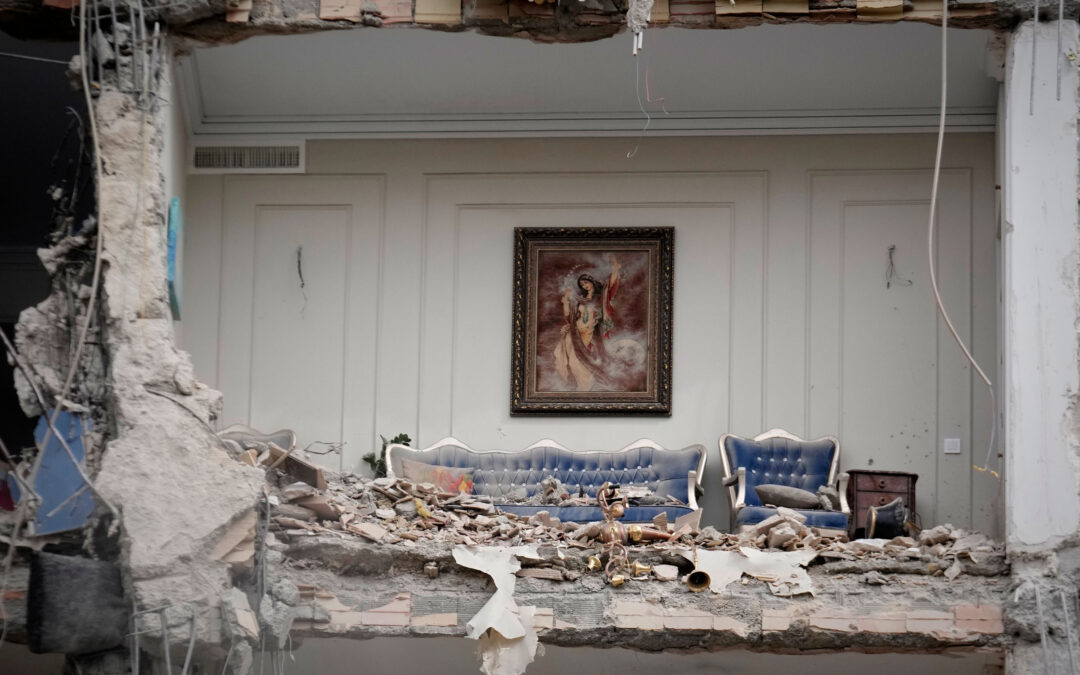
We might ask: What is it to run from bombs? What is it to flee from the debris of a collapsing building? What is it to see bodies in the street, or the wounded carried past you? What is it to live with fear as sirens pierce the air, warning of yet another attack? For most of us, these are imaginings or on our screens. Yet many people in our world today experience this as their daily reality.
When I think about this, my mind turns toward the thousands upon thousands of people who have actually lived in the terrible grip of war or genocide. What will they carry throughout the rest of their lives? And what memories will surface when they approach their own death?
The Buddha states clearly in the Dhammapada: “Hatred is never appeased by hatred.” I once experienced a powerful example of this truth while working in Algeria six years after the revolution that had ended French colonial rule. I was an anthropologist working in the Musée de l’Homme in Paris. The Algerian government contacted me and asked if I would research an alarming problem: in a neighborhood called Bab El Oued, where many revolutionary fighters had come from, suicide rates were unusually high.
Why would the heroes of a revolution be killing themselves?
After many interviews with young men from that neighborhood, what I came to learn was that the violence of the revolution had been internalized. The external enemy was gone, but the habits of violence remained. With no one left to fight, the violence turned inward. For some, they experienced depression and futility. For others, thoughts of suicide. And then there were those who took their own lives.
This is the deeper tragedy of violence. Even when a war ends, a genocide ends, the patterns of hatred and fear can persist. My father’s nightmares were one example of this. On the outside he appeared to be a normal and loving man. Yet within him lived a hidden battlefield. I came to see that both victory and defeat carry suffering.
Not long ago I woke at three or four in the morning with a deep disturbance in my heart. My computer pinged with an alert. When I opened it, I saw that a new war had begun. A mixture of fear and sadness flooded me. I could not pretend to be calm. I could not hide behind spiritual platitudes about impermanence or try to be equanimous. As the hours passed and I read the news, I realized something important. In the face of suffering, there are two mistakes we can easily make. The first is to turn away. The second is to use spiritual practice to bypass what we are experiencing.
My teacher Venerable Thich Nhat Hanh did neither of these in his early years. During the Vietnam War he faced suffering directly. He spoke about it openly. He urged our country to stop bombing his country. At the same time, he practiced deeply so that he would not turn away from or be swept away by his own anger and sadness or the anger and sadness of those in his community of practice.
Sometimes people imagine that spiritual maturity means appearing calm and untouched by suffering, a performance of equanimity. But true equanimity is not emotional anesthesia. Equanimity is the capacity to include everything into our experience without being hijacked by what we are encountering. Equanimity allows us to feel grief, fear, and anger without being suffocated by their grip. Equanimity allows us to respond rather than react. And it is true, equanimity does not erase suffering, but it gives us the strength to come alongside it.
During the Vietnam War, Thay (Thich Nhat Hanh) was asked a difficult question. Would he prefer peace under a communist regime, even if Buddhism disappeared, or victory for a democratic Vietnam that might allow Buddhism to flourish? His answer was unequivocal, born from his genuine equanimity. Peace must come first. Preserving Buddhism, he said, should never mean sacrificing human lives to protect monasteries, rituals, or hierarchies. If human dignity and compassion survive, Buddhism can always be reborn in human hearts. But if human lives are destroyed, what is there left to preserve?
The real work is not the preservation of institutions. The real work is liberation of all, including ourselves. This means examining the terrain of our own mind and discovering the subtle and overt forms of violence we carry and how this separates us from others, including even our so-called enemies.
Then there is the issue of power and empathy, and for me, this relates to the situation of the current war in the Mideast. Modern neuroscience and social psychology offer an unsettling insight: when people accumulate great power, their brains can begin to behave as if afflicted. Empathy can diminish. Risk-taking and impulsiveness can increase. The capacity to feel the consequences of one’s actions fades. This too is suffering, but not the kind we might feel drawn to. We see this pattern of emotional blunting repeatedly throughout history. Demagogues and authoritarian leaders lose the ability to feel the suffering they unleash. Thus the charnel ground of a chosen war or a rampant genocide is not only a geopolitical event. It is also the charnel ground of the failure of empathy and the experience of utter disconnection from our basic humanity.
What might be our particular relationship to what is happening in our world today? Zen Master Eihei Dogen taught that “uji,” or being and time are inseparable. He also taught that “zenki,” or undivided activity, is the dynamic, interconnected functioning of all causes and conditions. Uji and zenki together reveal a world where each moment is the enactment of every aspect of reality. From the realization of this perspective, our present lived experience is the complete and undivided expression of existence itself unfolding in time. It is through realizing uji and zenki that our true and inclusive humanity is revealed.
These teachings remind us that we are not separate from the events unfolding in our world at this very moment. We are not separate from what is happening in Iran, Lebanon, Israel, Gaza, or anywhere else for that matter, including the violence of war, the violence of genocide, and the work of peace.
In Buddhism, the bodhisattva is the archetype of the peacemaker. To walk the bodhisattva path is to recognize that one’s life is inseparable from time and from the lives and activities of all beings and events. From this point of view, we might understand that we are not separate from the actions of our government.
Often people imagine that Buddhism is primarily about personal enlightenment, about meditation, transcendence, or escaping from the wheel of suffering. But my own Zen teachers, Thay and Roshi Bernie Glassman, along with His Holiness the Dalai Lama and many others, have been unequivocal: a Buddhism that turns away from the suffering of the world is not Buddhism. We are one body with violence, with war, with genocide, and with peace as well.
This view of interconnectedness, inclusivity, and immediacy is reflected everywhere in Buddhist literature. In the classic Zen text Denkoroku, written by Keizan Jokin, the first story of awakening of the Buddhist ancestors recounts the enlightenment of Shakyamuni Buddha. Seeing the morning star, the Buddha exclaimed: “I and the great earth and all beings simultaneously attain the Way.” Notice what the Buddha did not say. He did not say, I have attained enlightenment. He said: I and all beings.
In this translation, the other word that catches my attention is simultaneously, the absolute immediacy and inclusivity of our experience: uji and zenki.
At Upaya Zen Center, the place I founded so many years ago, we emphasize the cultivation of bodhicitta, the awakened heart-mind dedicated to the liberation of others. Bodhicitta loosens the grip of self-centeredness and opens us to identifying with the wider world, solidarity with all. When we live in this way, something remarkable happens. We become freer and more fully who we really are.
In times like these, I recall the lineage of courageous Buddhist peacemakers: Maha Ghosananda, Sulak Sivaraks, A. T. Ariyaratne, Joanna Macy, Sensei Alan Senauke, Bernie Glassman, Bhikkhu Bodhi, and many others. Each of these figures have magnetized communities around them, communities dedicated to compassion, justice, and nonviolence. From these Buddhist teachers, we see that no great movement for peace has ever been carried by one person alone. They remind us that peace is not passive nor is it actualized without others. We are in this together, whether as a peacemaker or a warmonger.
Returning to thoughts about my father, who, in the last hours of his life, experienced himself standing on that LST, the war no longer distant but immediate, alive in his body as if it had never ended. What he revealed to me in those moments was not only the immediacy and cost of war, but also how alone such suffering can become when it is carried in silence. I think this is one of the reasons why solidarity matters. Not as an idea, but as a way of being that refuses isolation and stands powerfully together with others, in the case of the current wars and genocides, in the values of nonviolence. Through solidarity, the echoes of war can be silenced.
As we confront the war that is unfolding today, and the horrific genocides, I feel we must act together from a place that is grounded in courage, connection, and compassion. We may be imperfect in this work. We may feel uncertain or afraid. Yet what matters most is our inner gyroscope, the capacity to remain oriented toward nonviolence and as well toward suffering and the potential of suffering ending, even when the world spins with conflict and confusion. War is close to the heart, genocide is close to the heart, and we may discover that meeting war and genocide directly is the way out of it and meeting it openly with others makes the way saner and more liberating for all.
The post War Close to the Heart appeared first on Lion’s Roar.
Recent Comments