
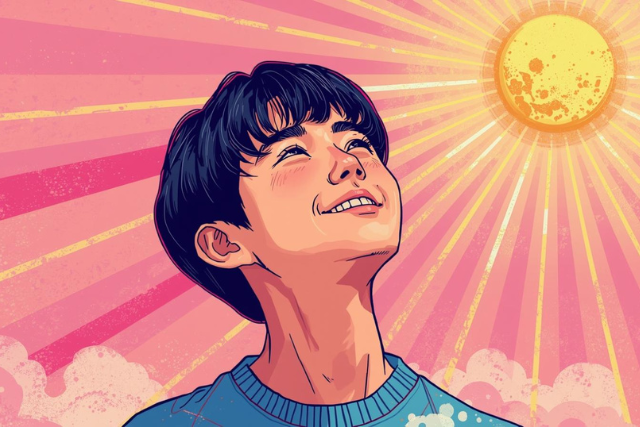

“Only say good words to your child. Even if it looks like they’re not listening, if you repeat those kind words a hundred or a thousand times, they will eventually become the child’s own thoughts.” ~My grandmother
When I think about my childhood, the first word that comes to mind is “night.”
The nights were always the hardest.
My father struggled with alcohol and sometimes turned that pain into violence at home.
As a kid, I felt like danger could appear at any time after the sun went down.
I was afraid to sleep deeply. I kept the light on in my room because darkness felt like losing control.
I slept with my head right next to the door, leaving it slightly open. I wanted the door to bump my head if anyone came in so I would wake up fast.
Part of me was afraid that my father might come into my room and do something while I slept.
Another part worried that he might hurt my mother and I wouldn’t hear it. So I stayed half awake, listening for every sound, ready to jump up and protect her, even though I was just a small child.
Living like this made school feel impossible.
I was too tired to focus, and my body was full of tension from every night. On top of that, people in our neighborhood knew about my father.
Some parents told their children not to be friends with me because of his reputation. At school, I often sat alone. I watched other kids laugh together at lunch while I ate quietly in the corner.
Teachers mostly saw the trouble I caused when my pain exploded into bad behavior. They scolded me often, and soon I started to believe that there was something deeply wrong with me.
In my own mind, I wasn’t a kid who was scared and exhausted. I was “the bad one,” the problem child, the one everyone avoided. I didn’t know how to change that story, so I just wore it like a heavy coat.
My mother was struggling too. She was hurt by my father, worried about money, and constantly anxious about what might happen next. Sometimes, when I caused trouble, she yelled at me because she had no energy left. I don’t blame her—she was doing her best in a situation that felt impossible.
One day, my grandmother visited and saw my mother shouting at me. Afterwards, she pulled my mother aside and said something that changed our lives.
She told her, “Only say good words to your child. Even if it looks like he’s not listening, if you repeat those kind words a hundred or a thousand times, they will eventually become his thoughts.”
My grandmother believed that repetition of love could rewrite a child’s inner world.
My mother took this more seriously than I could have imagined. She started carrying a small notebook.
Inside it, she wrote sentence after sentence—things she wanted me to believe about myself. The pages were full, almost bursting with her hopes for me.
Every day she chose a different line to tell me. Sometimes she said, “You are a kind boy.” Sometimes, “You can grow into a gentle, strong adult.” Other times, “No matter what you did today, you still have a good heart.”
At first, I didn’t trust these words. They felt like lies because my daily life didn’t change overnight.
Kids still avoided me, teachers were still strict, and my father still drank.
Inside, my mind answered, “No, I’m not kind. I’m broken.” But my mother didn’t stop. Even on days when I made big mistakes, she opened her notebook, looked at her list, and chose another good sentence for me.
She repeated these words like a quiet prayer over my life. Sometimes she probably didn’t believe them fully herself, but she said them anyway.
Slowly, something started to shift. I still remember the first time a teacher praised me for helping another student. For a second. I thought, “Maybe I really can be kind.” It was like my mother’s words had been waiting inside me for the right moment to wake up.
As the years passed, those sentences became a new inner voice. I began to imagine a future where I finished school, found meaningful work, and became a gentle adult instead of repeating my father’s patterns.
I still had scars and anger, but I also had this steady background music of kindness in my mind.
It gave me just enough courage to keep going.
Eventually, I went to university. I studied programming and found something I was good at. The first time I was able to buy my mom a phone with my own salary, I felt like I had crossed a line my childhood self never thought possible.
I wasn’t the “bad kid” anymore; I was an adult who could give back to the woman who never gave up on me.
Looking back, I see that my life didn’t change because someone gave me a perfect plan. It changed because someone chose different words over and over again, even when everything around us was still messy.
Love arrived in the form of sentences whispered repeatedly, like drops of water slowly carving a new path through stone. My grandmother was right: words repeated a hundred or a thousand times eventually become thoughts.
At first, my mind was full of sentences like “I’m dangerous,” “I ruin everything,” and “No one wants me.”
My mother’s notebook gave me new sentences: “I’m learning,” “I can be gentle,” “I have a future.”
Over time, those new sentences became the ones that felt most true.
I know not everyone has a mother or grandmother like mine. Many people grow up without anyone to speak kind words over them. Some of us are even surrounded by people who say the opposite—that we are lazy, hopeless, or unlovable.
If that’s you, I’m so sorry. I know how heavy those words can feel.
But here is what my life has taught me: even if no one else has done this for you yet, you can start doing it for yourself.
You can become the one who writes a notebook full of good sentences about your own heart.
You can choose one new sentence each day and repeat it until it doesn’t feel like a lie anymore.
You can decide that your inner voice will be the first place where a different story begins.
If you grew up in fear, like I did, maybe nights are still hard for you. Maybe your body remembers things that your mind tries to forget. On those nights, instead of fighting yourself for being scared, you might try putting one hand on your chest and whispering something gentle, like, “It makes sense that you’re afraid. But you’re not alone anymore.”
It won’t erase the past, but it can soften the present.
If you’re a parent or caregiver, or if there’s a child in your life who is struggling, remember what my grandmother said. They may roll their eyes or act like they don’t care. They may even push you away. But your kind words are still landing somewhere deep inside them, planting seeds they might not recognize until years later.
I used to think healing meant suddenly becoming strong and fearless. Now I think healing often looks like this: a small child who used to sleep with his head against the door grows into an adult who can finally turn off the light at night.
Not because the world is perfectly safe, but because he now carries a different voice inside him—a voice that says, “You are worth protecting. You are allowed to rest.”
My life began in a home full of shouting and broken glass. It could have easily ended there, in the same patterns of anger and pain. But my grandmother’s wisdom, my mother’s notebook, and those repeated sentences gave me a different path.
If you’re reading this and you feel stuck in your old story, I want you to know something. You don’t have to pretend that everything was okay. Your pain is real, and it deserves respect.
But your story isn’t finished, and you are not only what happened to you. You are also the words you choose today.
Maybe you start with just one simple sentence, whispered to yourself in the quiet: “I am more than my past.”
Say it a hundred times if you need to. Say it a thousand.
One day, you might look back and realize that this sentence became the foundation of an entirely new life.
*I don’t speak English well, so I used ChatGPT to help me translate my story. But everything you’ve read comes from my own memories and my own heart. I wrote this because I deeply want to share what my family’s love taught me about healing.

About Chanhyeok
Chanhyeok is an indie programmer from Korea who grew up in a home shaped by his father’s alcoholism and his mother’s quiet courage. He now creates small tools that help people speak more kindly to themselves. His first iOS app, Self Suggestion, sends gentle affirmation reminders to your lock screen in eight languages. You can find it here: https://apps.apple.com/en/app/SelfSuggestion/id6754752885
Get in the conversation! Click here to leave a comment on the site.
Recent Comments