
Last year, two major events occurred in my life: the first anniversary of my father’s fatal overdose and my tenth year of sobriety. That said, sobriety is like Zen—a process that starts over and over with each breath. Suzuki Roshi once said, “The most important thing is to forget all gaining ideas, all dualistic ideas.” I’ve found this to be true for recovery as well. This year also marks ten years since I was last incarcerated and a decade of having a steady, wholehearted Buddhist practice. I owe who I am today to a supportive community, the precepts, and the cushion. But, sadly, my father never found the same reprieve from suffering.
I heard of my father’s passing just after returning from a pilgrimage in my mother’s homeland of Japan. Although it was sudden, his death was not a surprise. While I’d stayed in various temples sitting zazen, I’d had an ominous feeling that the relationship I shared with my father was about to change. For whatever reason, that feeling had lingered with me from Rinso-in to Eihei-ji, Kofukuji to Mt. Fuji. My mother would chalk it up to my empath qualities. When I heard the news, the koan “How does one grieve a stranger?” popped into my mind. No matter what kind of fractured relationship you might have with a parent, their death affects you.
The situation grew more complicated once we received the cause of death: combined ethanol and alprazolam toxicity. They wrote the cause of death as “accidental,” but I believe it was a suicidal overdose. My father had a long history of mental health issues, unresolved trauma, and substance-use disorder. It’s also possible I see it as suicide because, more than ten years ago, I attempted to take my own life and, as convoluted as it sounds, knowing we both attempted to end our lives makes me feel more connected to him.
When I was thirteen, my father had a schizophrenic break, and we lived in motel rooms for most of that year. He was also heavily using methamphetamines and dealing large quantities of drugs. I know this because most of my relationship with him was as a drinking and using buddy. The rest of our relationship was filled with silence and long periods of absence. He knew the art of abandoning, and I held onto a burning rage of hate toward him for many years.
As a teenager, I wanted nothing more than to emulate my father. He had an infinite number of death-defying stories straight from a roadside mass-market paperback. Eventually, that emulation transformed into competition, and all I wanted was to outperform him—through criminal activity, the sheer volume of drugs I injected, and the long list of harrowing life-or-death scenarios that lifestyle invites.
In my early twenties, I found myself lying on a correctional facility bunk wondering if my father had slept on the same solid slab. We shared these types of experiences: jail cells, a prison dorm, a treatment center, and a hospital gurney. What we didn’t share was our willingness to confront our suffering, trauma, and karma. My father’s insecurities and attachment to self kept him from inner exploration. I don’t blame him or judge him for it. There is nothing more terrifying than facing your habitual patterns.
My first experience with meditation was while incarcerated. Then, after my release, I found a sangha and continued to practice. I learned early on from my teacher that my vice-grip attachment to self was the root of my suffering. By letting go of a fixed identity, my relationship with suffering changed—and I began digging up the roots.
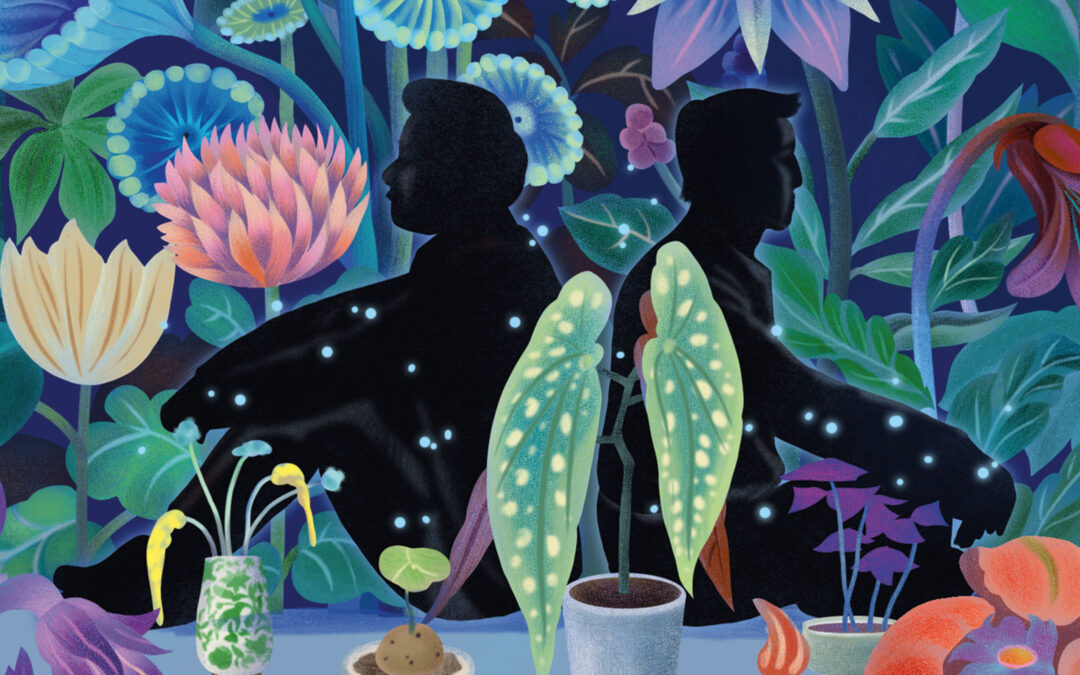
What helped during this transformation was learning about the teachings of Yogacara—a tradition of Buddhist philosophy and psychology that explores how consciousness shapes experience—especially its teachings on the alaya-vijnana, the storehouse consciousness. The alaya-vijnana is like a garden full of seeds—some passed down from our ancestors, others planted through our own experiences, beginning in the womb. These seeds hold everything from the images our mind conjures when we hear a word to the emotions that arise when we lose someone we love, when someone cuts us off on the freeway, or when a friend checks in on us when we’re triggered. Depending on how these seeds are nurtured, they determine our response to situations and experiences. I’d been watering all of the wrong seeds, and now I had an opportunity to nurture the positive ones.
Tending to this garden is a lifelong process. When my father passed away, we weren’t on speaking terms. A few years prior he’d told me no one thought I was Japanese when I described a racist incident I experienced. Existing as a mixed-race being is complicated, and having a parent who doesn’t recognize that makes it even more so. I was so hurt by the comment I retreated back to where our relationship existed for most of my life: absence.
When he died, I was filled with rage, guilt, shame, and—most of all—resentment. All the animosity I used to have toward my father came flooding back. I felt like I had lost a decade’s worth of work in a single instant. Practice, though, gives us an awareness that helps us react to situations and emotions with an appropriate response. That’s the difference between me today and ten years ago. I found myself on the cushion and returning to the Yogacara teachings. I realized my father had watered seeds that reinforced his insecurities, anxieties, and suffering, just like I did when I was younger. Like all of us, he inherited seeds beyond his control, due to causes and conditions. Unfortunately, he continued to water the same seeds his entire life.
When giving a lecture to an assembly of monks, Thich Nhat Hanh said, “Hatred and suffering arise from being caught in the perception that father…and myself are separate realities. When we are caught in conventional designations, our suffering and anger flare up. When we look deeply, we see that we are in our father and our father is in us.”
When I read this, I thought he was speaking directly to me and my relationship with my father. It pierced straight to my heart. The seeds of my father live inside my garden. I carry the same insecurities and pain. To bear resentment toward him means I bear resentment toward myself, which only causes more suffering.
My delusions are inseparable from my father’s. We are not different. We’re both lost in the same maze, searching for a way out. When I understood this, my resentments dropped away like body and mind drop away on the cushion. Now, I practice watering the seeds of compassion, loving-kindness, and wisdom to bring forth lucidity and awakening to all beings.
The post The Seeds I Water appeared first on Lion’s Roar.
Recent Comments