
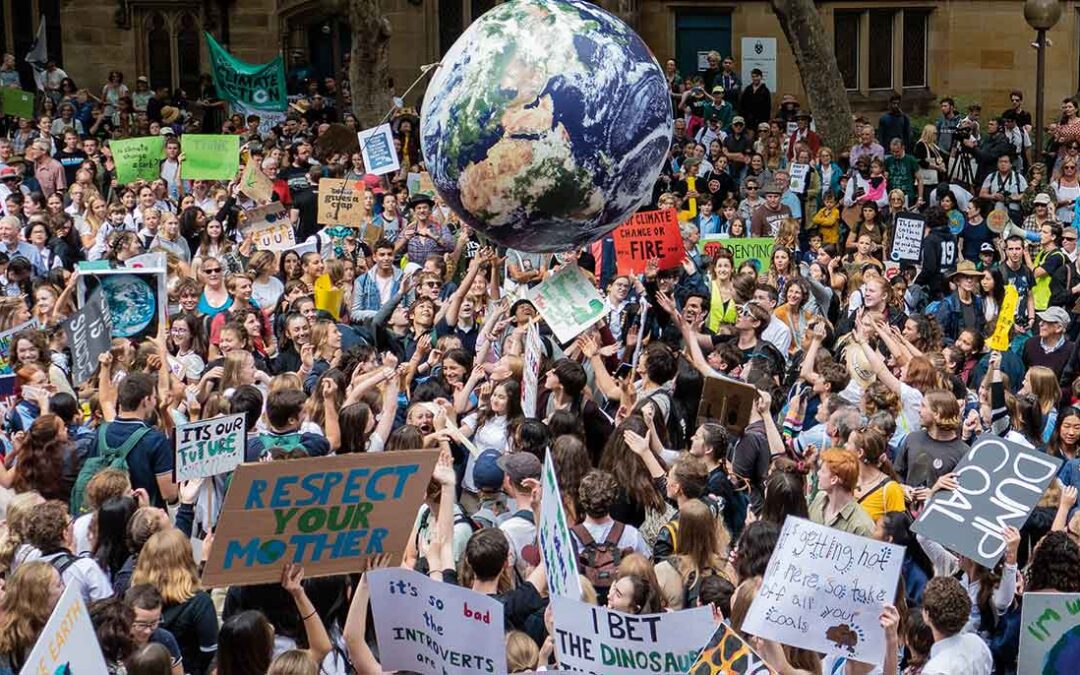
Whether there’s intelligent life on planet Earth is, in a certain way, still an open question.
This is a fraught time. People speak of the polycrises that Earth is facing: climate change with the melting of the polar ice caps and the threat of sea-level rise; the disappearance of the glaciers, the water supply for a large portion of humanity; the loss of species; and the cutting down of the rainforests—the very lungs of the planet—that supply the oxygen we take in with each in-breath. Then there’s the Buddha’s spot-on diagnosis of unbridled greed, hatred, and delusion driving rampant autocracy and the assault on basic human rights and freedoms in so many places, including the United States.
This is an all-hands-on-deck moment on planet Earth. It is up to us, all of us humans together, today, to establish true intelligence, guiding things in such a way that we don’t further perpetuate our multiple crises and the factors driving them. Therefore, the recognizing, taming, and extinguishing of those forces on every level—individual, institutional, governmental, global—has never been of more importance and value to humanity: Everything depends on our capacity for waking up.
“We’re all miraculous beings. We’re all buddhas.”
When we drop into the present moment, we take refuge in awareness itself. This is a refinable skill. It allows us to realize that the mind secretes thoughts endlessly and that its favorite ones are, of course, about me—the story of me, starring me—how horrible something is for me, how wonderful something is for me. But a bit of reflection invites us to discover, befriend, and investigate a hidden dimension that we are born with—called awareness. We can train ourselves to inhabit awareness and invite it to become our default mode.
Through exercising the muscle of mindfulness in regular daily practice—on the meditation cushion and in life itself—you can begin to shift the default mode from mindless self-preoccupation to open awareness, pure awareness. Here, we’re at least momentarily out of the destructive, intrinsically painful winds of not being true to our own nature and all of the unfortunate downstream consequences that inevitably follow from that fundamental disregard.
We can recognize that our true nature is not the story of me. Rather our true nature as an individual human being is entwined with the so-called other in deep belonging and interconnectedness. What truly matters is the story of we, we humans all together, embedded in a more than human world—Gaia—a living and life-giving planet in an unimaginably vast universe of almost entirely empty space.
The autoimmune disease of humanity at the moment is that we seek advantage over, harm, and kill each other for no reason other than the stories we tell ourselves. We need a much bigger story. The dharma—writ large and in its most universal characterization—has the potential to actually heal our very human divisions. But we must each do our part to embody—and take refuge in—what’s deepest and best in ourselves, in our humanity, not solely as “me,” but also as “we”—as a true global sangha (community).
When we take refuge, even briefly, in what is deepest and best in ourselves, when we drop into the full dimensionality of our being, we are immediately, if only momentarily, free from our self-preoccupation and delusion. We reconnect, reembody, and remember the miracle of being in a human body, the mystery and the miracle of embodiment, of sentience, of interconnectedness, of what Thich Nhat Hanh so beautifully called interbeing.
It took me decades, but at a certain point I began to recognize that it’s intrinsically a radical act of sanity and love to take my seat on my meditation cushion in the morning and suspend all the doing for a time, no matter how worthy the doing may be.
This radical act of nondoing—of being—doesn’t shut anything out. It doesn’t suppress thoughts or emotions or the challenges and stresses and suffering and pain that we experience in life. It simply allows us to pause for a moment, to stop and drop in, to actually take refuge in what is. This “gesture of awareness,” to use Francisco Varela’s beautiful phrase, is absolutely essential, in the same way that tuning their instruments is essential for all musicians, no matter how talented they are. They may have great instruments and the best training, yet they still need to tune and perpetually retune their instruments. Taking one’s seat in formal meditation is a tuning. So is carrying it into the world off the cushion, so that life itself and every moment we are alive becomes the real meditation practice.
We’re all miraculous beings. We’re all buddhas. Yet we so often contract around the personal pronouns, I, me and mine, and begin to believe that story of me. Yet no matter how wonderful (or how tortured) the story of me is, it’s never big enough, or true enough, because our truest nature isn’t tied up in the story of me. It’s pure awareness. It is wakefulness embodied, inhabited, and known.
Mindfulness or awareness (I use those terms synonymously) is available to us 24-7. Awareness is an intrinsic aspect of our humanity. It’s not something we have to acquire. We all already have it. So, there’s no place to go, there’s nothing to do, no special something to attain. But because we’re not great at accessing awareness moment by moment, we do need to cultivate access, so it’s here when we need it, which is basically in every waking moment.
If our job is to wake up, we might take heart from the name Swedish biologist and physician Carl Linnaeus gave us, in Latin: homo sapien sapiens. The word sapiens comes from the verb sapere, which means “to taste” and “to know.”
We don’t know what a banana is by reading an entry on bananas in the encyclopedia or on Google. We only really know what a banana is by biting into it. We taste and know it for what it is by directly experiencing it.
Homo sapiens sapiens literally means the species that is aware and is aware that it is aware. This is not cognition and metacognition, but rather awareness and meta-awareness. That’s what mindfulness is and what the buddhadharma invites us to recognize and embody.
So, a koan for humanity might be: Can we live into the fullness of our species’ name—and wake up to our true nature—before we destroy ourselves?
The post The Power of We appeared first on Lion’s Roar.
Recent Comments