
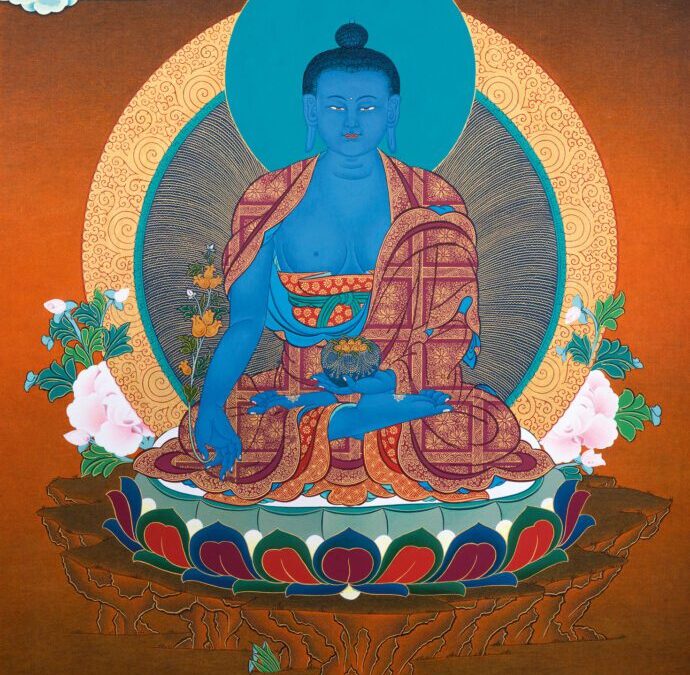
Greed: When Enough Never Feels Like Enough
Marvin Harada reflects on how the desire for “just a little more” manifests as everything from car envy to addiction—and how the act of giving calms the wanting mind.
Back in 2000, our family van was getting old, with lots of miles on it, and we needed a new one. I did my research and decided to buy a Toyota Sienna minivan.
The Sienna came in three models. The top of the line was the XLE. It was sweet. It had wood-grain trim, premium stereo, alloy wheels, and an electric sliding door. The mid-level model was the LE, and it had the premium stereo, the alloy wheels, and the electric sliding door, but not the wood-grain trim. The cheapest model was the CE, and it just had the basic stereo, hubcaps, and a manual sliding door.
We decided that we couldn’t afford the XLE or the LE, and we went with the CE, the base model. After signing the deal, I drove off the lot of the dealership in my brand-new minivan, and I was feeling good. A new car is so great. It had that new car smell, and the Sienna was way better than our old minivan.
But as I was driving home with my new car, another new Sienna passed in the lane next to me. I could see the back of the car as it passed—it was an XLE. It had the wood-grain trim, the premium stereo, the alloy wheels, and the electric sliding door. I caught myself thinking, “Maybe I should have bought the XLE.” Then I thought to myself, “I just bought a brand-new car, and not five minutes later I’m already wishing I had a better one.”
In Buddhism, that is what we call greed. Greed isn’t limited to rich Wall Street stockbrokers or tech billionaires. Greed is within all of us. It means wanting more—a bigger house, a higher salary, a better work position, the latest computer, or a fancier car. Even if we get what we think we desire, in a short period of time we aren’t satisfied and want “just a little more.” We get our dream home but think, “If only it had one more room and the kitchen was just a bit bigger.” In my case, my sense of satisfaction lasted all of five minutes before I was thinking about the XLE. But in time, we loved that CE. I still miss it.
In Buddhism, greed is one of the three poisons, along with ignorance and anger. These powerful mental states can ruin your life, no different from drinking poison. The problem is that we’re often in denial about how these mental states are manifesting in our lives and how detrimental they are.
Ignorant? I’m not ignorant. I am not brilliant, but I am definitely not ignorant.
Anger? Oh, I get mad sometimes, but anger doesn’t control me.
Greed? I’m not greedy. I am very satisfied with everything.
Yeah, right.
So, how do we overcome our greed, or any of the three poisons? Is there a cure, a remedy, an antidote?
Various Buddhist traditions offer differing ways to approach this problem. Some might say you have to suppress or squash those poisons. I find that difficult, if not impossible. For example, if you are on a diet and your weakness is chocolate cake, you may say to yourself, “Don’t eat chocolate cake!” But you end up thinking of chocolate cake all the time. Does it really work to suppress or squash our desires?
Shinran (1173–1262), who founded the Shin Buddhist tradition, of which I am a member, was acutely aware of the three poisons in his life. His approach was to see them deep within all of us. The key is not eliminating them but rather seeing them. Seeing is the first step in transcending or going beyond the three poisons.
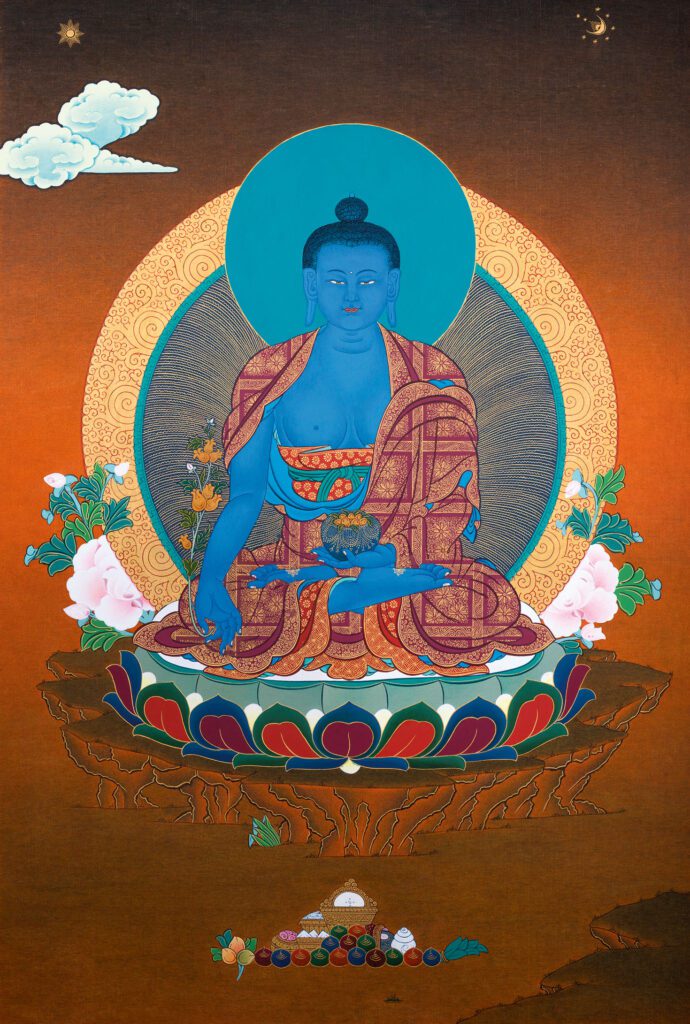
The first step to recovery from drug addiction or alcoholism is to admit that you are an addict. “Oh my gosh! I am an alcoholic, through and through. Look what it is doing to my life, to my family.” Seeing is the first important step to recovery.
Years ago, I learned how drug addiction is a vivid example of the world of greed, what Buddhists call the realm of the hungry ghost. In Buddhist cosmology, beings in this realm live in a state of constant hunger and
thirst, yet nothing can satisfy them; whatever food or drink they touch turns to fire. It is a horrendous existence to imagine, even as a metaphor.
One day, I was at my temple office when a young man I knew from Buddhist youth activities stopped by to say hello. I hadn’t seen him since he was a teenager. He said that he had just gotten out of a rehab program. I thought that he meant he was a counselor or something there, but then he explained that he’d had a serious addiction to cocaine for years.
I learned so much from him about drug addiction. He said that
he had his “drug friends,” which he kept separate from his “temple friends.” He told me that over several years he’d spent more than forty thousand dollars on his addiction. He said, “I could’ve bought a fancy car, but I wasted it away on drugs.” I learned that the first time you use cocaine, the high is so intense that you want to experience it again, yet the nature of the drug is such that you can never match that first high. That’s what hooks you on the drug.
Fortunately for this young man, his parents forced him into a rehab program, and he was able to recover. After our conversation, I had him speak to Buddhist youth groups about the dangers of drug addiction.
The world of greed can range from a cocaine or alcohol addiction to just wanting a little bit more of this or that, like buying an XLE. The Buddha taught that dana—giving—is the antidote to greed. Generosity is the first of the six paramitas, the practices of a bodhisattva, and through it we soften our greed and attachments.
There are four kinds of giving. The first is material giving, such as making a donation or giving a gift to someone. The second is nonmaterial giving, such as offering a friendly face, kind words, or a smile. The third is impure giving, which is to give with some thought of receiving acknowledgement or praise in return. I know a minister who has a wonderful line: “If I ever make an anonymous donation, I find that I am the first one to tell someone about it.” Finally, the fourth kind of giving is pure giving, which is giving without any expectation of acknowledgement, recognition, praise, or reward.
I can honestly say that I have never practiced pure giving, but I have been the recipient of it. I spent five years in Japan studying Buddhism. My wife and I lived in a little apartment close to my school. One day, someone went to our landlady and paid for half a year’s rent for us. To this day, I do not know who it was. The person made our landlady promise not to disclose their identity. They just said, “The young man in your apartment building is studying to become a minister. I want to help him as he will be doing important work to share the dharma in the future.”
I cannot write a thank-you card to this person. I don’t even know who it was. All I can do is honor their wish by doing my best to share the dharma. That was my experience as a recipient of pure generosity.
There are countless ways to practice giving in our daily lives, in big and small ways. There is more joy in giving than in receiving. It truly is an antidote to the poison of greed.
But I still think I should have bought the XLE.

Anger: When the Mind Can’t Stop Fueling the Fire
How can you cool the flames before they burn everything down? With honesty, responsibility, and practice, says Karen Maezen Miller.
We live in an increasingly angry world. And I’m mad about it! I’m angry when I try to go to sleep. I’m angry when I wake up. And when I go looking for a reason not to be angry, I’m angry all over again.
Everyone gets angry. That’s okay. The question is, what do we do with it?
Because it seems like we should do something with our anger, doesn’t it? Some of us earnestly believe that we should simply never be angry, or at least, that anger should be covered up. Some people feel that they must express their anger, while others feel the need to explore and interpret what their anger is all about.
Despite what we try to do with it, anger keeps showing up—in our every disappointment, every instance of fear, every petty argument, and every minor annoyance. It shows up in our resentment and resistance, as a rant, or as a tantrum. Anger is your ego using its outside voice, shouting: “Things are not the way I want them!”
Anger is addictive, an intoxicant. We can’t seem to turn away from it, and it can really stick around—not just for a day, but for years, if we let it. In Buddhism, we call anger a poison. But we’re not powerless against it. It’s only a poison if we swallow it.
We can, and should, use our anger to deepen our practice. We should face it and take responsibility for it, because we all know that the world gets angrier every day, and we’d better not add to it. Everything we think, feel, say, and do has infinite consequences in this world that we share. If we want to live differently, that starts with us. We can use our practice—our active, conscious awareness—to recognize the signs of anger as they arise in our minds and bodies before anger consumes us.
I’m going to tell you how.
The Three Admonitions
These tips are based on a very simple teaching that was articulated first by my late teacher Maezumi Roshi. He called them “the three admonitions.” They apply to everything in our lives that we consider to be a problem, issue, barrier, or dilemma. Life is full of such things. These instructions apply no matter what the circumstance is.
#1: Don’t deceive yourself.
You might think, “I don’t know where my anger comes from,” or “I’m not sure I’m ever really angry.” Don’t deceive yourself.
Our practice is to see ourselves, to notice what we do, and to take responsibility. Be honest about what you do, what you think, and how you feel. Ask yourself: Am I an angry person?
Sometimes I tell people I was not an angry person until I started my meditation practice. What I mean is that I didn’t yet have the self-awareness to truly realize that I was angry. I was still deceiving myself and avoiding responsibility for anything that seemed unpleasant or negative in my life.
However, even at that time, I was getting plenty angry, and I’d always take it to the nth degree. I threw things. I broke and slammed and kicked things. For this, I blamed my Irish grandfather; I could argue that my behavior was all DNA-coded. (You see how I wasn’t taking responsibility?)
One evening near dusk, I was in a rage having an argument with my husband—who’s still my husband—
and I threw my wedding ring across the front yard. Why did I do that? Because I didn’t know how to handle my feelings. I didn’t know what to do with them.
I crawled on my hands and knees across the grass to find that ring. I had to, and I did find it. But I wish this wasn’t a lesson I still remembered. I wish it had never happened. This was me when I was “not an angry person.” There was no excuse for it.
#2: Don’t make excuses for yourself.
Don’t rationalize. Don’t justify. Your anger originates in you and belongs to you. So, don’t try to foist it off on anyone else.
We each have reasons why we are the
way we are; we’ve had experiences that have shaped us. We may not feel as though we can do anything about what’s happened to us before, but we can take responsibility for this moment of our lives.
#3: Take responsibility for yourself.
Your life is huge. It’s vast. It has a lot of power and reaches a lot of people. We’re all living in this moment with billions of other human beings. Whatever happens in your head doesn’t just stay in your head. You don’t simply hoard whatever wonderful (or terrifying) feeling you have inside your body. So, you have responsibility for the kind of world that you—and we all—live in.
I used to believe that it was other people and other things—a word, a look, an event—that “made” me angry. That’s the ultimate cop-out. But isn’t that how we so often see it? Something makes you angry. What someone said or how they treated you made you angry.
Believing that it was all these people, known and unknown, and all these circumstances, preventable and unpreventable, inciting my anger only multiplied my anger.
We call that a projection. We project our negative feelings outward, and then we react to our projection. That’s delusion, and it’s also how we avoid responsibility.
In our practice of sitting, being quiet and still, keeping our eyes open and not ruminating or judging, we can see how anger originates in our minds and bodies. As you expand your awareness through practice, you will feel anger’s energy rising like a wave in your body. You get an early warning: Anger is present.
Fully informed by that feeling, you respond. You stop and take a breath. You can take two breaths, a dozen, two dozen breaths. If you do that—pause and breathe, not acting or reacting, calming your body, cooling your head—a remarkable thing happens. Anger goes away by itself when you don’t add fuel.
This is worth examining, and scientists have taken a close look. Hormones flood the body and unleash their power when you are angry. But the experts say these chemicals are completely flushed out in ninety seconds! A minute and a half. You can wait that out, right?
You can. You have a practice. And if you don’t, I suggest you get one.
Four Ways to Respond When You’re Angry
After I had been practicing for about fifteen years—that’s half my practice life—someone asked my husband if he’d noticed a change in me.
He said, “She’s easier to get along with.”
I took that as a profound gift of encouragement. It’s one thing to manage anger when you’re alone, but it’s another thing to deal with it around other people, at work, or at home with family, because that’s where you can really hurt others and rupture relationships.
From my own hard-won experience, these are the four practices that have helped me meet anger differently.
#1 Tell people that you are getting angry.
Don’t scream. Tell. This is before any of the throwing begins, before your reactions arise.
I realized that I was angry or frustrated so often in my home life that it would benefit everybody if I could just say it. Announce it. Neutrally, nonjudgmentally, as a statement of fact. Like a weather report. It’s a courtesy, a kindness that you are sharing with the people around you, letting them know that the sky’s about to fall.
What does this sound like? It sounds like “I’m getting angry, so I don’t wanna talk about this right now,” or “I’m going to go take a break before my head explodes,” or “I need to cool off.”
It’s honest. It doesn’t blame anyone. It’s not an excuse. And you’re taking responsibility.
#2 Remove yourself physically from the situation.
In our practice, we call this “taking a backward step.” Don’t throw yourself forward. Take one step back. This is not what they call “the silent treatment,” which is another kind of attack. It’s simply another courtesy: “I need to step out of the room before I say something that I’ll regret.”
#3 Atone.
Atone is kind of a fancy spiritual word. It means to apologize and forgive. Anger has arisen. You’ve had conflict. People are in pain, and it needs to end. Offer no excuses, no rationale, and no justification. Just say you’re sorry.
At some point, I realized I had better be the first one to say I’m sorry, because I can. My practice tells me that, and I prove it to myself over and over.
You don’t even have to say that you forgive, but you do. Why? Because you can. You don’t lose anything. (And just so there’s no mistaking here: Forgiving doesn’t mean approving.) Forgive, so you don’t carry around the weight of anything undone for the rest of your life.
#4 Begin, maintain, or resume your meditation practice.
To practice is to take responsibility—supreme, utmost responsibility—for the kind of world you live in. And it works. Sometimes the big epiphanies in your practice are just seeing what you do and then doing it differently.
I’m quite fond of the late Zen teacher Kobun Chino Roshi. He gave us a beautiful explanation for why we practice: “The more you sense the rareness and value of your own life, the more you realize that how you use it and how you manifest it is all your responsibility. We face such a big task living this life. So naturally we sit down for a while.”
Let me reassure you that the peace you seek is already here. Going beyond anger will always lead you right back to where you are, not to the storm inside your head but to the stillness and the silence within you.
You can learn how to find this still and silent place for when you need it next time.
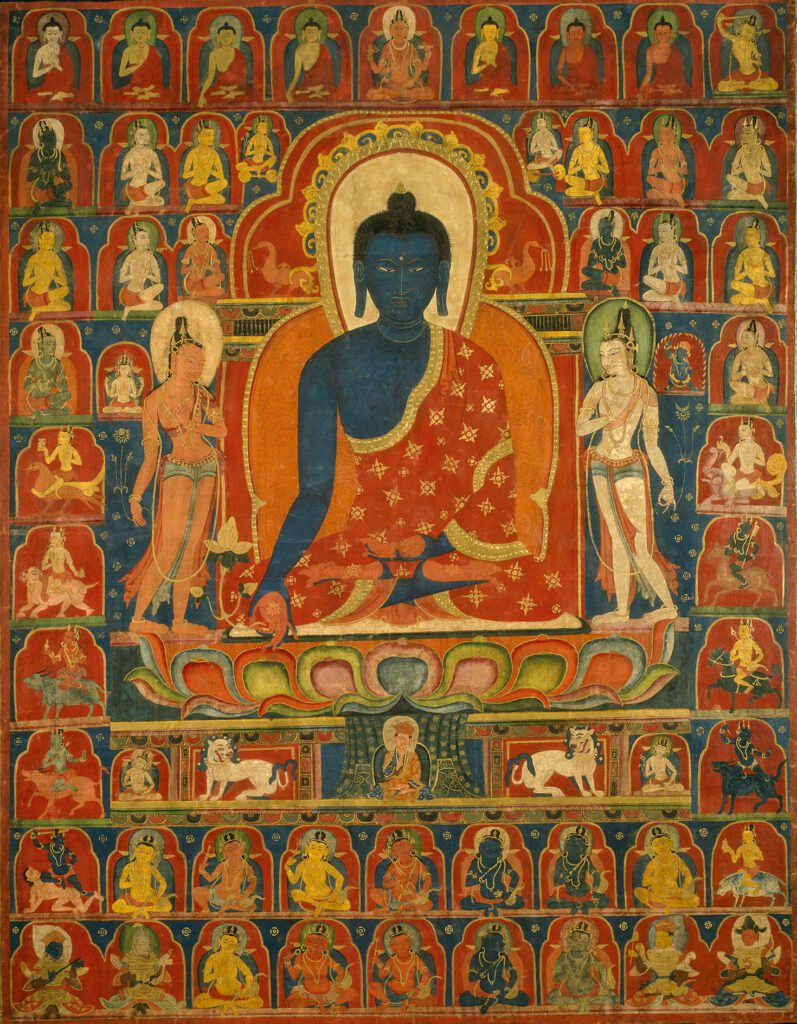
Ignorance: When You Resist Reality
Alisa Dennis uncovers how ignorance drives our need to control—and how clear seeing softens that grip into equanimity.
Last spring, I was given a teaching about ignorance, one that unfolded quietly on my outdoor deck.
It was planting season here in the American South, and like many people, I felt a pull toward the earth as a kind of refuge. The world was feeling chaotic, often cruel—unhinged, even. So, I went to my neighborhood nursery and wandered among the tables of incipient blooms.
I was especially drawn to the purslane, a succulent with spoon-shaped leaves and tiny five-petaled flowers. After I repotted it, the purslane flourished. It spread quickly, filling the pot until it overflowed in a dense mat of leaves and color.
Each morning, I noticed how the purslane flowers opened with the light and then closed again each evening. This reminded me of the way the heart opens and closes in response to inner and outer conditions, how we soften or contract depending on what meets us. I tended the plant daily, watering it, admiring it, enjoying how effortlessly it expressed life.
After a few weeks, I began to notice small bits of stems and petals scattered around the pot. At first, I couldn’t make sense of it. Then one afternoon my wife said, casually, “I saw a squirrel eating your plant.”
Soon, I saw it myself. A squirrel climbed onto the deck and began nibbling on every part of the purslane. I watched at first with curiosity. There was something beautiful about its focus, in the ease with which it took what it needed. The squirrel seemed completely at home in the moment.
But as the days passed and the plant thinned, something else began to arise in me: a subtle clenching in the body, irritation, frustration. I felt it in my chest, jaw, belly. This was dukkha—the unsatisfactoriness the Buddha spoke of so often, the tension that comes from wanting things to be other than they are.
I caught myself thinking, This is my plant—I bought it. And almost immediately, another awareness followed: me, my, mine. I could see, in real time, how suffering was being constructed with the story I was telling myself about ownership. This was ignorance in its most ordinary form, not philosophical or abstract, but immediate and embodied. A plant. A squirrel. A tightening heart.
When the Buddha spoke of ignorance, he wasn’t referring to a lack of intelligence or education. He was pointing to something far more intimate: the way we habitually misread our experience. Ignorance is the way the world feels solid when it’s not, the way the self feels central when it’s not, the way we keep expecting what is changing to finally settle down and behave. Ignorance is not a moral failure, it’s a perceptual one.
Along with craving and aversion, ignorance is one of the three poisons. These poisons cloud the natural clarity of the mind and heart, while disguising themselves as reason and self-protection. From ignorance, craving arises. When craving is frustrated, aversion follows. Together, they keep the wheel of suffering turning.
In truth, I didn’t own the purslane. I was, at most, a temporary steward of the soil, the pot, the water, the conditions that allowed it to grow. I hadn’t made the purslane flourish. I hadn’t made it a nutritional powerhouse replete with hydration, fiber, and vitamins. And yet my mind kept insisting that purchase meant control, that desire conferred entitlement.
As the leaves dwindled, I began shooing the squirrel away. It would dart off, startled, then return again and again. Then another thought appeared, one that felt entirely reasonable at the time: I’ll buy more purslane. If I buy more, maybe I’ll get to keep some. Maybe I’ll finally be able to enjoy the plant the way I want to.
I was negotiating with reality. This is how greed often appears—not as excess, but as strategy. Not as a voice shouting “more,” but as one whispering “just enough.” Just enough protection. Just enough control. Just enough to make life cooperate with my preferences.
This is greed growing directly out of ignorance. Because we don’t fully accept that things change, we try to manage change. We add, rearrange, plan, and then plan some more. We believe that with the right setup, disappointment can be avoided.
Buying more purslane wasn’t really about the plants. It was about trying to secure a particular experience. It was the hope that I could outmaneuver impermanence. That if I had enough, I could finally relax.
Eventually, the situation resolved itself in a different way. I didn’t buy more plants. Instead, with only a few stems left, I moved the pot to the front porch, hoping the squirrel wouldn’t follow. But within a couple of weeks, it did. The last of the purslane disappeared.
And somewhere in that process, something softened.
I stopped trying to win. I stopped negotiating. I surrendered, not philosophically but as a release felt in the body. The tightness eased. The breath deepened. The dukkha loosened its grip.
In its place arose something quieter: wonder, which is what I’d wanted as I contemplated planting flowers at the start of spring. I began to marvel at the squirrel’s determination, its clarity of purpose. I felt a surprising warmth—loving-kindness—toward it. Nature was not being cruel. The plant had become nourishment. Life was continuing.
Around this time, I was reading Robin Wall Kimmerer’s Braiding Sweetgrass, where she writes about the natural world as a gift economy rather than a marketplace. In such an economy, value is measured not by ownership or extraction but by relationship and reciprocity. The earth gives freely, and what is asked of us in return is care, respect, and restraint. Seen this way, the purslane was a gift that passed briefly through my hands, just as it passed into the life of the squirrel. When I relaxed into the gift economy of nature, my heart relaxed, too.
Looking deeply, I saw that the purslane was not something to be managed but a being expressing its nature. It grew, flowered, offered itself, and passed on, like each of us does. The squirrel responded with equal clarity. My role was not to interfere endlessly but to witness, learn, and adjust my own relationship with the living world.
Ignorance is considered the deepest of the three poisons because it makes greed and aversion seem reasonable. Greed arises when we believe what is impermanent can be made to last. Aversion arises when we believe what threatens “mine” must be resisted. Both rest on a misunderstanding of reality.
The antidote to ignorance is wisdom, the kind that comes from direct seeing rather than theory. Wisdom recognizes that impermanence is not a flaw; it’s the nature of things. Wisdom knows that it isn’t pessimistic to recognize unsatisfactoriness; it’s seeing the truth. And wisdom understands nonself not as loss but as interbeing.
So, how do we practice with this? We begin by noticing dukkha in its subtle forms: the tightening in the body, the clenching around preference, the thought that says, This shouldn’t be happening or If things were different, they’d be better. Rather than judging these moments, we meet them with curiosity and care. This mindful noticing is wisdom at work.
We cultivate gratitude for the generosity of life. Everything we enjoy arrives through countless conditions we did not create: sunlight, rain, soil, beauty, and more. Remembering this softens entitlement and opens the heart.
When irritation or resistance arises, we invite loving-kindness. We remember that other beings are simply following their nature, even if it might not be our preference. The squirrel wasn’t opposing me; it was being a squirrel.
And we allow equanimity to grow—the capacity to remain present without living in contraction, to let things come and go without needing to control them.
The purslane didn’t survive the season. But it fed a squirrel, and it fed understanding. In that way, it was never lost.
This is what the Buddha offered—not mastery over life, but freedom from confusion. When ignorance loosens, even loss becomes a teacher. The fog lifts, and we find ourselves standing in the midst of change with greater clarity, ease, and kindness.
As spring returns and the rapidly shifting winds of life swirl around us, I find myself less certain that I know how things should go and more willing to learn from how they actually do. What the season offers is not a conclusion; it’s an invitation to remain open to what is arising and passing away.
What wisdom might we carry into these fertile times? Perhaps it’s this: to understand that equanimity is not resignation but freedom, not passivity but presence. Equanimity is a way of stepping off the wheel of samsara, no longer driven by grasping or resistance, no longer ruled by the poisons of ignorance, craving, and aversion, but resting in a freedom that does not require life to be otherwise.
A Guided Practice to Invite Equanimity
Bring to mind something simple you enjoy: a small pleasure, a routine, a relationship. Notice how it feels in your body to reflect on it. Is there ease—or a subtle tightening, a wish for it to remain unchanged?
Now imagine this thing you enjoy beginning to shift so that it no longer meets your expectations. Notice what happens inside. Where do you feel it? In the chest, throat, belly? This tightening is dukkha.
Gently notice the story that arises. Do thoughts arise like “mine,” or “If things were different, they’d be better”? See if you can hold these thoughts with curiosity.
Invite a sense of warmth or kindness. You might silently say, “Just like me, this being/thing is following its nature,” or you can simply rest in appreciation for the mysterious web of life unfolding in this moment.
If discomfort is present, offer yourself care. You might say to yourself, “This is uncomfortable. I recognize it. I’m here with you now.” Allow, as best you can, a little space for sensorial release.
Finally, notice what it feels like to let things be as they are, even briefly. Feel the body soften. Feel the breath move. This is a taste of equanimity—not indifference but balance.
When you’re ready, gently return to your day, carrying with you the possibility of meeting change with a little more awareness and kindness, and a little less need to hold on.
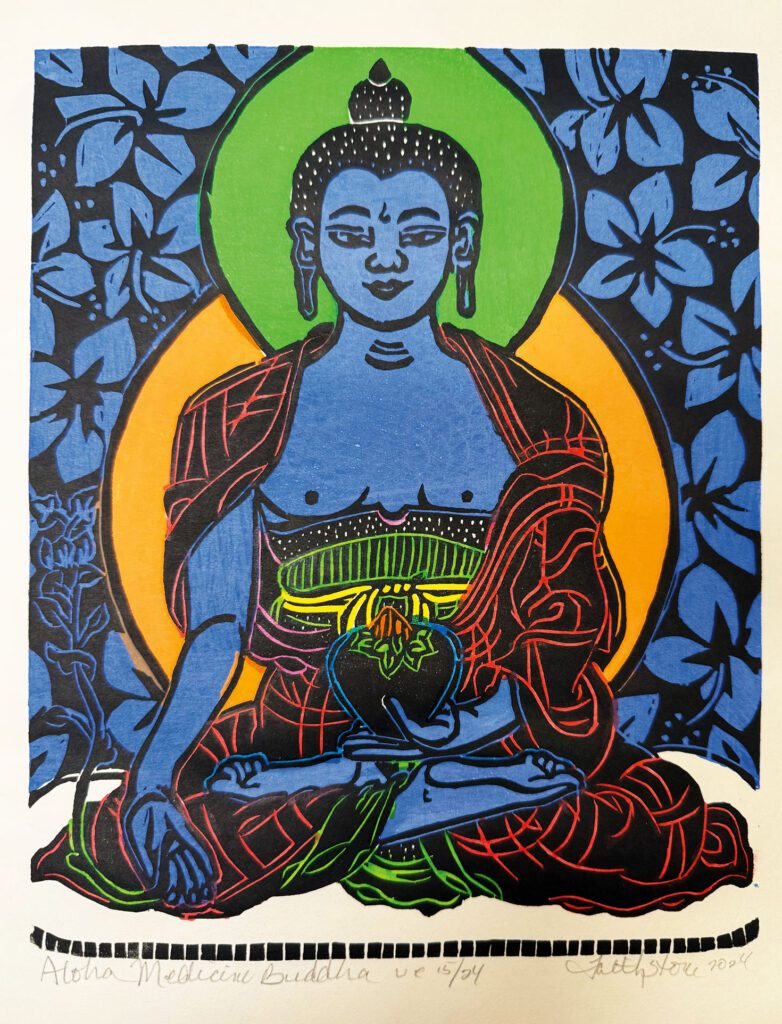
Learning the Difference Between What Heals & What Harms
A concluding reflection on the subtle way greed, anger, and ignorance infiltrate our lives and even our practice. Pamela Ayo Yetunde invites readers to carry the medicine of the dharma into the world.
When I was a child, around the age of nine, I unintentionally overdosed and poisoned myself. I wasn’t trying to do myself harm—on the contrary. I took nearly a whole bottle of aspirin to ensure that I would never fall ill and suddenly die as my father had a year before.
After I took the aspirin, I gleefully ran to my mother and proudly told her what I’d done. I thought she’d be relieved to know that I would be forever healthy. Instead, my mother rushed me into the car and drove me straight to the hospital, where they pumped my stomach.
What I’d thought was medicine (because my mother had given it to me when I was sick) was actually poison when I gave it to myself in the wrong quantity. In life, we often mistake medicine for poison, and vice versa.
Many people come to Buddhism looking to heal the ways they feel poisoned, contaminated, polluted, slimed, or just plain yucky. The catalog of unpleasant sensations is long and winding, but Buddhism gathers all these forms of distress under a single word that helps us recognize our shared human condition in need of care: dukkha, Sanskrit for suffering, stress, or unease.
The dharma offers an antidote to suffering, yet it is not a fast-acting pain reliever. It’s more like a slow-release capsule, and—like any medicine—it can be misadministered. Even Buddhist practice can become harmful when misunderstood or misused.
A good teacher might offer this warning label: We can become greedy, angry, or deluded about our practice, imagining that mindfulness makes us superior, or that insight exempts us from ordinary human flaws. When that happens, the very tools meant to heal us can reinforce the poisons we hoped to escape.
In Buddhism, the three poisons at the root of all suffering are identified as greed, anger, and ignorance, also translated as passion, aggression, and indifference, or as clinging, hatred, and delusion. These forces can infiltrate even our most sincere attempts at practice. Like my childhood confusion with the aspirin bottle, we may take too much of what we think is medicine, or take it in the wrong way, and end up reinforcing the very patterns we hoped to heal.
The teachings remind us that our desire to thrive is wholesome—until greed, anger, or ignorance distorts it. Recognizing these distortions is itself a form of medicine. Sometimes the antidote is as simple as a moment of clear seeing.
When I reflect on the three poisons and their antidotes, I think it wise to separate anger from hatred. People, especially children and women, are often criticized when they express anger, and when that criticism becomes part of their self-understanding, this runs the risk of exacerbating anger and rage. Unfortunately, this admonishment against anger
occurs in Buddhism. Traditionally, it’s been said that being angry causes one to become ugly and can lead to an unfortunate rebirth. Notice whether the warning is medicine or poison.
As I see it, anger is not the enemy, hatred is. Anger can reveal what matters to us, while hatred corrodes us from within. Discernment—another form of medicine—is required to know the difference. One way to
know whether anger is poisonous is to know whether it’s leading to or becoming hate.
The last time I had a flash of hate—even after twenty-three years of meditation practice—was when someone trampled on a national sacred ceremony of reverence held for someone I deeply respected. The purpose of the incursion was to draw attention away from the ceremony of mourning and toward the interloper. It was a disgusting move, and I was poisoned by hatred.
Fortunately, I noticed how sick I felt, openly acknowledged the contamination, and, for my own healing, allowed my breathing to deepen and my muscles to relax. Emotional regulation, not love, was the first medicine, followed by the reminder that grasping for attention is commonplace, then the understanding that hatred begets hatred, especially when we don’t heed the warning label to attend to our hearts and minds.
Remember to breathe deeply in and out a few times to care for yourself when you are in anger’s throes. Love and compassion are antidotes to hatred and even indifference, and when pointed in the right direction, they can be a salve. But do we need to reach immediately for the ointment when anger is present? You can use anger to get in touch with what is really important to you, to know how cultures punish oppressed people for feeling it, and—at the same time—not let it blind you into justifying future sadistic behaviors.
One great antidote for delusion and ignorance is the cultivation of humility. Chaplains usually spend time with people of various beliefs and are tasked with supporting their well-being regardless of their belief system. How are they able to do this? By being in training with different worldviews. Learning how to ingest and stomach reality checks builds a humility muscle.
If you’ve been paying attention to the news, then you’ve seen evidence of the three poisons in many sectors of our society. Greed shows up in widening inequality and the hoarding of resources. Anger erupts as polarization and retribution. Ignorance fuels xenophobia, disinformation, and the dismantling of institutions meant to support collective well-being. These poisons are not abstract—they shape the world we live in.
What’s driving all of this? At the heart of these crises is a profound delusion: that our well-being is separate, that some can thrive while others suffer. What should we do in such a sick and sickening world?
We begin with our own minds and hearts. The medicine we cultivate through practice—clarity, humility, compassion—becomes medicine we can offer to others. The bodhisattva path invites courage. Our practice communities can become apothecaries, places where antidotes are cultivated together.
If ever there was a time to know the difference between poison and medicine and to consume medicine in its most efficacious amount, it is now. May the insights from these teachings support your own healing, and may your practice become the medicine the world needs today.
The post The Antidote to Greed, Hatred & Ignorance appeared first on Lion’s Roar.
Recent Comments