
Just before dawn, when the world is still and dark, we renew our devotion to compassion as our hearts turn toward light. A single candle flickers on the shrine, the air alive with presence and prayerful intent. In this threshold between night and sunrise, between silence and activity, we call upon Tara, the swift liberator whose compassion responds the moment she is called.
Green Tara’s mantra, Om Tare Tuttare Ture Svaha, reverberates in the silence, a sacred sound that countless practitioners have whispered with devotion over centuries. Its rhythm opens the heart before the mind can follow. With each repetition, an often imperceptible contraction inside us begins to soften. We notice the distance and boundary we’ve placed between the one who calls out and the one who is called upon, and we allow it to become transparent and dissolve. Tara’s presence is not somewhere else. She is the living pulse of compassion itself, the quickening of the awakened heart that responds before thought has time to arise. Her Tibetan name, Drolma, means She Who Liberates. Her liberation is not bestowed from above but rather awakens from within. Tara reminds us that the luminous awareness we’re invoking is already here, ready to meet the world’s turmoil and anxiety with fearless love.
Praises to the Twenty-One Taras is a text rooted in a canonical Buddhist scripture celebrating Tara’s swift, liberating activity. In the Vajrayana tradition, it is a cherished practice to recite the text while engaging in visualization and devotion. This article—the first in a four-part series—introduces the practice, the text, and Tara herself, the dynamic female embodiment of compassion. Here the focus is on bringing Green Tara into one’s own path of practice. The three articles that follow will explore her twenty-one emanations.
Tara’s emerald form, vibrant and alive, embodies the freshness of dawn, the vitality of renewal. We begin in the quiet before sunrise, with homage to the mother of all buddhas, Green Tara, and to the mantra that carries her presence through time.
For more than a thousand years, Tara’s mantra and praises have been chanted in India, Nepal, Tibet, Mongolia, and beyond. In India, during the flourishing of the great monastic universities of Nalanda and Vikramashila, she emerged as a beloved figure. Her practice later spread to Tibet, carried by teachers deeply devoted to her. Among them was the eleventh-century Bengali master Atisha, who regarded Tara as his constant guide and protector.
But Tara is not distant history. Her vow is alive in every moment we turn toward compassion rather than fear. She is the mirror of the awakened heart itself, immediate and unpretentious, as close as our own breath. When we invoke her, we’re not calling upon an external savior but recognizing the boundless compassion that has never been separate from our own awareness.
Tara’s legend begins with Avalokiteshvara, the bodhisattva of compassion. As he gazed upon the vast suffering of beings, his tears of overwhelm gave rise to two lotuses: from one emerged Green Tara, whose compassion moves as swiftly as the wind; from the other, White Tara, whose compassion is steady, healing, and life-sustaining.
Though their expressions differ, both arise from the same source: compassion so deeply moved by suffering that it responds instantly to bring relief. So it is with all her manifestations, each arising from the same boundless heart, meeting beings in precisely the way they need to be met. In Tara’s story, compassion is never passive. It does not turn away; it moves, it responds, it takes form. This is Tara’s living essence: the immediacy of love expressed as action.
In a prior life, she was the princess Wisdom Moon, devoted to the buddha of her time. When she vowed to attain awakening for the benefit of all beings, the monks around her urged her to pray for rebirth as a man, believing enlightenment could not be realized in female form. Wisdom Moon replied that ultimate reality is beyond distinctions of gender. She vowed to awaken and liberate beings in the form of a woman, ever responsive to the cries of the world—her timeless promise to act swiftly whenever beings call for help. Because of this vow, she became known as She Who Ferries Beings Across the Ocean of Fear. Her Sanskrit name, Tara, means “star,” the guiding light that leads travelers across darkness. Just as the morning star heralds dawn, she illuminates the path to awakening.
Tara’s form is envisioned slightly differently across traditions and even within lineages. Likewise, while Praises to the Twenty-One Taras is shared across Tibetan Buddhism, each lineage approaches the associated practice in its own way, and there can even be variation inside a single lineage. In this series, I’m presenting Praises to the Twenty-One Taras through the lens of the Atisha lineage.
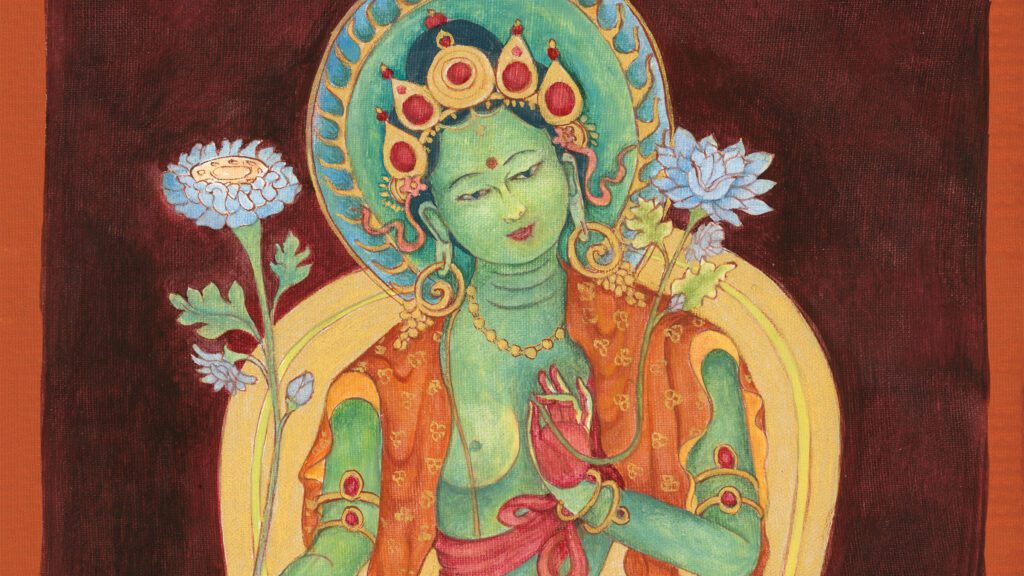
In the mandala—the sacred dwelling place—of the twenty-one Taras, Green Tara stands at the center. She is the source and essence of them all, the wellspring of compassionate, discerning wisdom. Her blue-green radiance, associated with the element of wind, expresses the unobstructed, dynamic energy of compassion moving freely in all directions.
To contemplate her is to feel the same discerning compassion awaken in ourselves. Her green brilliance is not distant or abstract. It’s the vitality of breath, the courage that arises when we open rather than contract. When we rest in her presence, compassion reveals itself not as something performed but as the nature of awareness itself—spacious, responsive, alive. In this way, Green Tara invites us to live as she does, grounded in stillness and ready in movement. Her image is a mirror of our own potential: fearless compassion meeting the world.
Seated on a lotus and moon disc, Tara’s right leg extends slightly forward, poised to rise, an expression of readiness to meet the world’s cries for help. Her left leg remains folded in meditative ease, showing that the movement of compassion is never apart from the stillness of wisdom. Her right hand rests upon her knee, palm open in generosity that flows to all beings. Her left hand offers refuge, holding a blue utpala lotus, symbol of her ability to engage fully in the world’s murky waters without being stained by them. She is both completely at rest and completely engaged, the balance of wisdom and compassion made visible.
Tara’s emerald presence embodies the union of wisdom and compassion: ineffable, ungraspable, expansive awareness whose compassionate nature unimpededly manifests in response to beings’ needs. From her radiance, twenty-one Taras emanate—each a facet of her all-encompassing heart, a distinct expression of her enlightened activity.
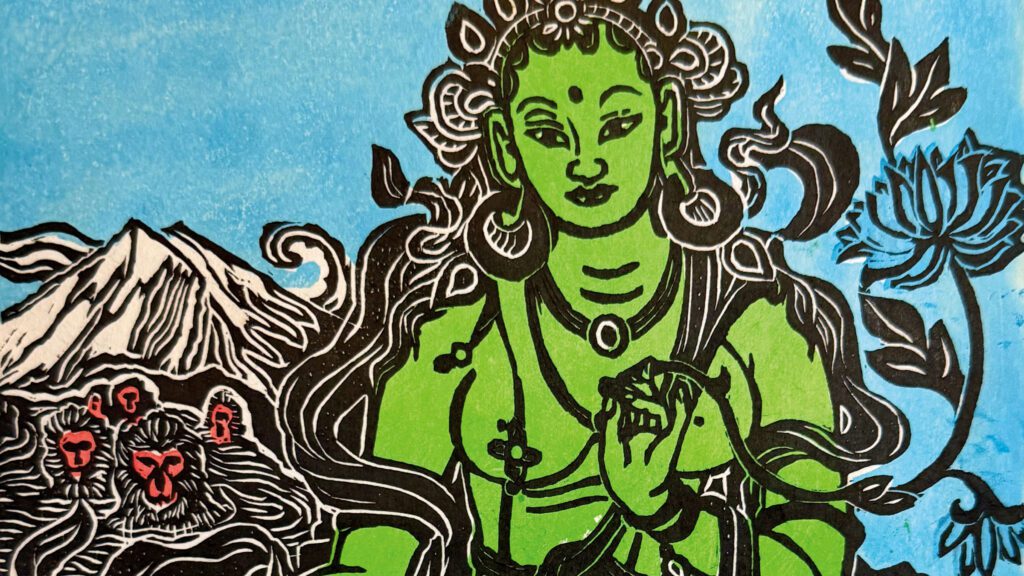
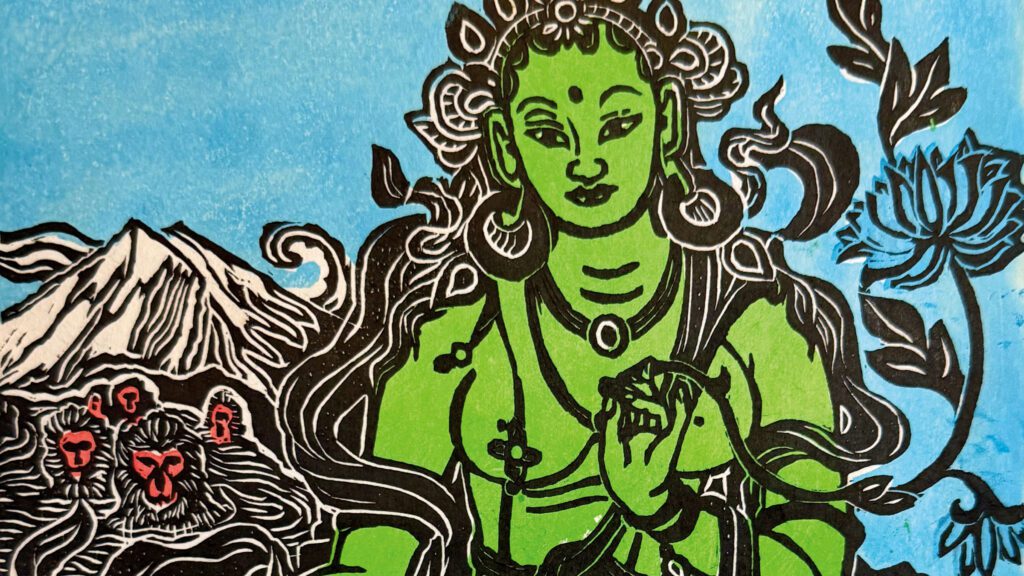
“Green Tara with Mount Fuji and Snow Monkeys” by Faith Stone
Around her, the other Taras radiate like colors through a prism, each appearing in response to what beings most need, as spontaneous as light touching whatever it illuminates.
The mandala of the twenty-one Taras can be seen as a living expression of our awakened potential, each form revealing a distinct expression of wisdom’s compassionate activity. Their colors shimmer like facets of a single jewel. Their gestures and symbols express the countless ways awakened awareness responds to the needs of beings. When we contemplate these twenty-one Taras, we’re not imagining distant ideals but glimpsing how awareness moves when unobstructed by grasping and self-reference.
Some Taras appear serene, embodying peace and equanimity. Others are dynamic and fierce, displaying the sharp, clear energy that cuts through confusion or fear. Each form reflects a quality of awakened responsiveness: listening, protecting, nurturing, illuminating, showing how compassion acts when free of self-concern. To call upon Tara in any of her forms is to open to that possibility within ourselves, allowing awakened activity to express itself through our own body, speech, and mind.
Through meditation and devotion, the twenty-one Taras become a living path of realization. Each form gives shape to an aspect of awakened awareness that we’re learning to recognize and embody: fearlessness, discernment, equanimity, steadfast love. As we visualize or recite the praises, we’re not manufacturing these qualities but tuning the heart to the current of wisdom and compassion that moves through all the buddhas. Tara’s presence reminds us that awakening is not something added to who we are; it is the unveiling of what has always been true.
In this living mandala of twenty-one Taras, Green Tara remains the center and the heart, the ever-fresh source from which awakened qualities flow. Yet her brilliance seems obscured when the mind contracts in fear or confusion. The ancient teachings describe these obscurations as the eight great fears: patterns that veil our natural wisdom and keep us from recognizing the fearless compassion already within us.
Traditional texts enumerate these eight fears as lions, elephants, fire, snakes, thieves, imprisonment, water, and demonic forces. While these were outer dangers common in ancient India, the images also point inward to states of mind that truly endanger us. The raging elephant of ignorance tramples discernment when we move through the world half-awake. The lion of pride roars so loudly it drowns out the voices of others. The fire of anger scorches our peace. The snake of jealousy strikes even those we love. The thieves of distraction and false belief steal away our attention and purpose, while attachment and greed imprison us in endless craving. The flooding waters of desire pull us under, and the demons of doubt whisper that awakening is not possible. These fears are not obstacles to avoid but energies Tara transmutes through awareness and compassion.
Tara’s first vow was to protect beings from fear, her compassion moving toward whatever obscures clarity. When we call upon Tara, we’re not asking to be spared from life’s uncertainty but to awaken within it. Her protection is the liberating insight that sees through fear itself, the recognition that every reactive emotion, when met with awareness, reveals its own wisdom. Ignorance opens into spacious knowing, anger clears into mirror-like awareness, pride softens into equanimity, desire reveals discerning warmth that sees beauty without grasping, and jealousy transmutes into all-accomplishing activity.
To pray to Tara is to place our fears in the embrace of her fearless compassion, allowing them to dissolve into the clarity always present in us. In times of distress, we can speak to her directly, bring our trembling to her feet, or imagine resting our head in her lap, held in unconditional care. In this intimacy, devotion and insight become one gesture as the heart relaxes into its own awakened strength. This is her true protection: the awakening of courage and trust in the indestructible heart of awareness itself.
When the winds of fear and confusion settle, what remains is quiet luminosity, a felt sense of connection that has always been here. In the Vajrayana tradition, this is called jinlap, often translated as “blessing.” The Tibetan word joins jin, meaning brilliance or transformative energy, with lap, meaning to be touched or affected, as by a wave. It is the radiant current of awakened energy flowing through lineage, teacher, and practice, supporting our unfolding until we recognize it as innate.
Among the earliest hymns of devotion to Tara is the Praises to the Twenty-One Taras. Some traditions hold that the Buddha himself first spoke these praises, while others recount that Nagarjuna (the renowned second-century Indian master of the Middle Way teachings) received them in a vision of Tara, who entrusted him with this teaching on compassion inseparable from emptiness.
The Praises to the Twenty-One Taras opens with a line of homage to Green Tara, followed by a single verse in praise of her mantra, Om Tare Tuttare Ture Svaha. The next twenty-one verses each honor one of Tara’s forms, radiant expressions of wisdom responding to the needs of beings. These praises are treasured as more than poetry or devotion; they are a map of awakened activity revealing how compassion manifests in countless ways.
Om, homage to the noble, exalted Tara, the One
Who Liberates.
With this opening line, we bow to Green Tara herself, the living heart of all the Tara forms. With reverent hearts we acknowledge the Mother of All the Buddhas, the timeless embodiment of compassion, born from Avalokiteshvara’s tears.
Homage to Tare, the swift and courageous one,
Who with Tuttare dispels all fears,
And with Ture brings all benefit.
With the syllable Svaha, I bow down.
This verse encapsulates the essence of Tara’s presence. Tare invokes her swift compassion, ever ready to respond. Tuttare dissolves fear and confusion at their root. Ture awakens the qualities of enlightenment within us, and Svaha seals the prayer in trust and surrender. Reciting the mantra, we connect with Tara through vibration, releasing the natural rhythm of compassion that has always been alive within the heart.
To chant Om Tare Tuttare Ture Svaha is to let the current of blessing find its voice through us, each syllable carrying the full power of her vow to dispel fear, bring benefit, and awaken the same fearless compassion within our own hearts.
To receive blessing is to become attuned to enlightened energy. When we call upon Tara, the sense of separation between supplicant and source grows transparent as her compassion meets our devotion like water poured into water, carried on the sound of the mantra. Each syllable releases obstacles and awakens the confidence that path and fruition are not two.
Visualizing Tara, the practice becomes a conversation of energies: calling and answering, offering and receiving. As attunement deepens, blessing flows naturally through our lives. It moves through gestures of patience, words of kindness, and the resolve to protect what is just and speak truth with compassion. In these moments, we’re not using Tara’s blessing but recognizing its unimpeded flow. The more we open, the more we feel her presence as the ceaseless pulse of compassion.
In the end, the stream of blessing and the one who receives it are not separate. To open to Tara’s jinlap is to recognize that the same luminous awareness that flows from her heart flows through our own. Resting in that recognition, we discover a refuge beyond circumstance, sustained by an unbroken continuity of awakened care.
A Practice for Receiving Tara’s Blessing
1. Take Refuge and Awaken Motivation
Find a comfortable seat and let the breath settle. When ready, take refuge in the Buddha, dharma, and sangha, and awaken bodhicitta, the heartfelt wish to benefit all beings. Read or recite the following three times:
Until enlightenment, I take refuge in the Buddha, dharma, and sangha.
Through the accumulation of merit and wisdom,
May I awaken for the benefit of all beings.
2. Visualize the Seed of Tara
With eyes open, gaze into the open sky before you. Sense the boundless, luminous awareness that has held generations of practitioners invoking Tara’s compassion. From this openness, a brilliant TAM (see facing page) appears, the seed syllable of Tara’s wisdom. Light radiates from the TAM, making offerings to all awakened beings. Their blessings return as light, gathering back into the TAM, which transforms into Green Tara, Mother of All the Buddhas, seated upon a lotus and moon disc—radiant, blue-green, and pulsing with life.
3. Invoke Tara’s Presence & Receive Her Blessing
Light radiates from Tara’s heart, giving rise to her twenty emanations, each a facet of her awakened compassion arrayed around her like a mandala. From your heart, offering goddesses appear, making boundless offerings to Green Tara and her retinue. Gently open to devotion as you recite this opening homage to Green Tara and the verse in praise of her mantra three, seven, or twenty-one times.
Om, homage to the noble, exalted Tara, the One
Who Liberates.
Homage to Tare, the swift and courageous one,
Who with Tuttare dispels all fears,
And with Ture provides all benefits.
With the syllable Svaha, I bow down.
As you chant, visualize luminous wisdom-awareness nectar flowing from Tara’s right hand into the crown of your head. This river of light removes fear, obstacles, and obscurations, filling you with warmth, confidence, and joy. Feel it as jinlap, the living current of awakened energy, flowing through you and all beings. Allow yourself to receive her blessing completely.
4. Recognize Tara Within
Visualize Tara and her emanations dissolving into light that flows into your heart. Your body becomes radiant, inseparable from hers. You are Tara: the union of stillness and activity. In your heart center, on a lotus and moon disc, rests the syllable TAM, encircled by her mantra: Om Tare Tuttare Ture Svaha. As you chant her mantra, light radiates outward, bringing peace, love, and protection to all beings.
5. Dissolve and Dedicate
Gradually allow the visualization to dissolve until only a drop of blue-green light remains in your heart. Let that light melt into space like a rainbow fading into the sky. Rest naturally in luminous openness. When ready, dedicate the benefit of your practice by reciting the following:
Through this goodness may awakening spontaneously arise in our streams of being.
May all obscurations and distortions fall away.
May all beings be liberated from suffering and the stormy waves of birth, sickness, old age, and death.
The post She Who Liberates appeared first on Lion’s Roar.
Recent Comments