
Andrea Miller: You are an executive producer of the new documentary Wisdom of Happiness. As you define it, what is happiness?
Richard Gere: We all want to be happy, but we have different definitions of what that is. That’s why we have these conflicts in the world: We have different ideas of how the world should be to make us happy.
Anything that breaks down the conceptual overlay that we have—how our minds work and how we expect the world to be—to the degree that we can break that down and not identify with any of it, we move toward a profound happiness. Not a simple, superficial one, but one that is lasting. The happiness we’re talking about is in the world of liberation, not in satisfying the senses.
Can you say more about how we achieve that happiness?
To the degree that you can start to soften this idea of “me”—soften the self-cherishing—then this freedom can start to emerge.
What role does suffering play in awakening?
The human birth is the optimal one for two reasons: We have the ability to be very intelligent, and we suffer. We want to get out of the suffering. So, that gives us the impetus and energy to look deeper into things, looking into our own minds. And that’s the nature of meditation—just looking at the mind from different angles. If we use our intelligence—not our animal nature, but our higher intelligence—to transform suffering or remove the suffering or separate from the suffering, then we have fulfilled the promise of having a human birth.
The world we’re in right now is educating us as to the nature of suffering, even in America where we seem to have everything. I mean, even our lama friends—they love Western bathrooms. They like to have hot water. But the sensory pleasures of the best dark chocolate or the most incredible restaurant or clothes or whatever it may be pales in comparison to a lasting bliss, which comes from the deep work we do on ourselves.
Would you say that meditation is the best way to work with our difficult emotions?
Meditation, at the very least, gives us space to explore and look at our minds. It loosens up some knots. The surface noise of the mind is overpowering—it’s hard to see below the surface of that or beyond it. So, a simple meditation can kind of shut down the chatter that we’re all stuck with in this world. We all yearn for happiness, for freedom. Depending on how deep you want to look, that happiness is going to be more and more profound.
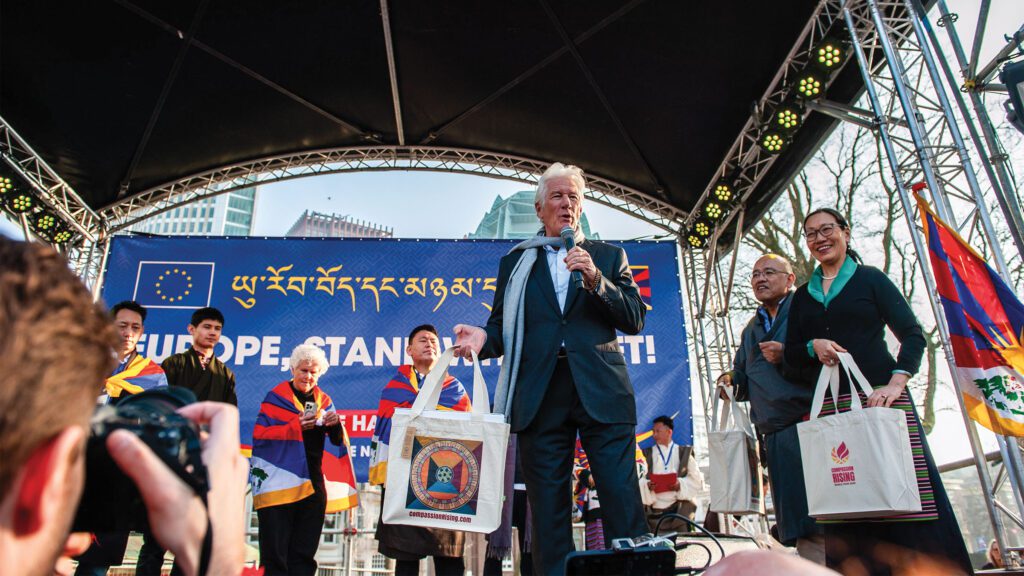
Photo by Romy Arroyo Fernandez / NurPhoto / Shutterstock.com
Why are we suffering? Why are these afflictive emotions driving everything that we do? How can we transform them? From a Buddhist point of view, you go to the root cause. You can do the surface, but it ends up being just a drug on the surface. The root cause is this rock-solid belief that we exist the way we appear to exist, that we are eternal, that we’re separate from the rest of the entities—the physical and the mental universe—and that we’ve always been this way.
We have very hard boundaries around this idea of “me,” “I,” “self,” and that is the root cause of all the afflictive emotions right there—self-cherishing. They say that when you’re in the jaws of self-cherishing, all the other demons are lined up behind with their jaws wide open. So, the cause of all the other afflictive emotions—those demons lining up for you—is this false belief in a self. Buddhism goes right at that.
How has Buddhist practice helped you in your life?
People ask that all the time, and I say, well, I get less angry, which is not bad. I have a little more patience, maybe a little more ability to see other people’s stories. The practice creates space where you don’t spontaneously spin out. Before you allow that thought process to weave an opera that takes you to a negative place, or you say something that creates a negative universe, or you do something that creates a negative universe—before all that happens, you’re able to redirect the energy of the mind.
Could you tell me about the first time you met His Holiness the Dalai Lama?
I had a strong drive to go meet the Dalai Lama, and I didn’t even know that much about him. I was a Zen Buddhist, and at that time, there wasn’t that much literature [in English] from the Tibetan point of view. I had read those Evans-Wentz books from the twenties and thirties, which were profound. But I didn’t know politically what had gone on in Tibet at all. I didn’t know about the invasion and the occupation. I didn’t know the Dalai Lama was living in exile. So, I had quite a romantic yearning.
A friend of a friend, John Avedon, was writing a book about His Holiness and the Tibetan experience in exile as well as their history. I was talking to John, and he said, “Don’t go to Tibet—the Chinese aren’t gonna let you see anything. Go to Dharamshala. That’s where the community is. His Holiness is there. Other high lamas are there. You’ll meet Tibetans and have an open experience.”
So, I did. At that time—the early eighties—it was not easy to get to Dharamshala. It was monsoon season and there were bad overnight trains. It wasn’t easy to find who you were supposed to find. But one thing led to another, and I ended up staying with His Holiness’s youngest brother, Ngari Rinpoche, and Rinchen Khando-la, his wife, whom I’ve maintained a close friendship with ever since.
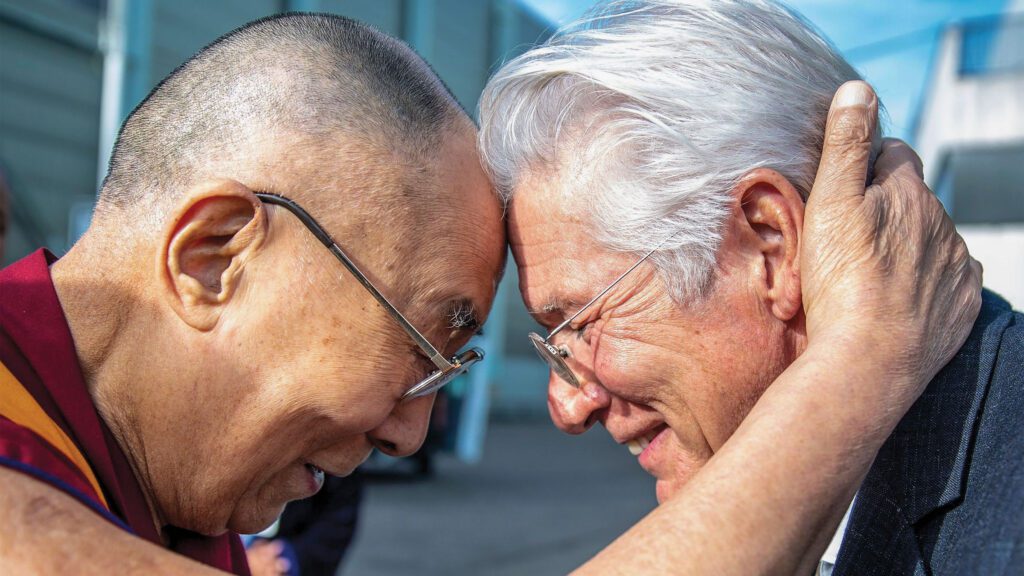
I was there for several weeks before I had an audience with His Holiness. I really got to know the Tibetan community and grew to love them enormously. People have this very romantic idea that when you meet a high lama, especially His Holiness, that he’s going to see how you are the ultimate student he’s been looking for, and he’s going to wave his hand and you’ll be enlightened. Of course, when I met the Dalai Lama, that didn’t happen. His Holiness is much more insightful than all that, and he’s very skillful at removing those silly expectations and getting to the point.
He didn’t know who I was. His brother told him, “He’s an American actor, and he’s pretty well known.” So, we started talking about emotions, and he was saying, “When you do your acting, and you’re angry, are you really angry? Or when you’re crying in a scene, are you really sad and really crying? Even when you’re happy, are you really happy?” It was a such an amazing conversation with him. Of course, he was tying it not to acting but to the fact that these emotions are manufactured for us in real life, or what we take to be real life.
There’s nothing innately angry or sad or prideful or joyous. They’re just labels on a manufactured state, and we have to take responsibility for it like I do as an actor. Yeah, I made those emotions. I conjured them like a magician. We do that in real life, but we don’t realize that we are the magician bringing forth these afflictive emotions. So, we’re driven by them, not knowing that we are ultimately in control.
How did your relationship with the Dalai Lama evolve after that?
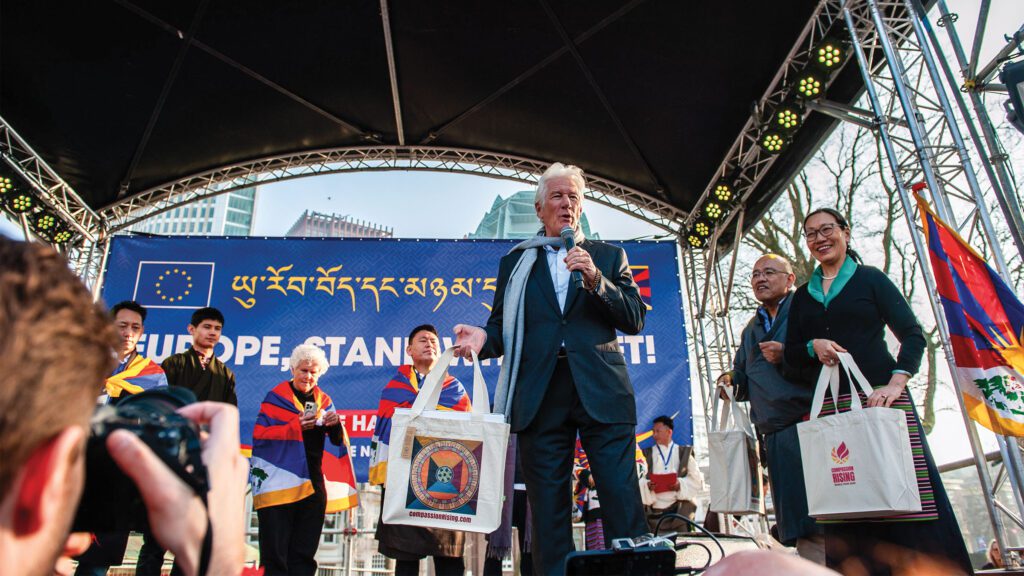
I started going to teachings after that. I was regularly going to India and also seeing His Holiness around the world. He was traveling quite a bit at that point. In 1989, he won the Nobel Peace Prize, and I was fortunate enough to be there in Oslo when he got it. Then things changed because His Holiness became so much more known in the world and traveled even more. I became much more involved, too. Bob Thurman and I had started Tibet House in New York. I then became involved with the International Campaign for Tibet in Washington, and we expanded to Amsterdam and Berlin and Brussels.
So, everything just became more intense. Fortunately, I was able to meet many other teachers as well—extraordinary teachers. Many of them were educated completely in old Tibet. I was getting the real stuff from these teachers. It was an amazing journey I had through that whole experience.
There’s so much going on right now in the world—so many different conflicts and challenges—that for many people Tibet is not top of mind. Why do you think it’s important we bring more focus to Tibetan autonomy and cultural preservation?
Tibet was an extraordinary experiment. In the eighth century—when Padmasambhava brought Vajrayana Buddhism to Tibet, along with Shantarakshita and others—the Tibetans took it seriously and really started to create institutions that would foster those ideals and create bodhisattvas and buddhas. Instead of building factories, they built monasteries and nunneries, and they created a unique culture around it.
It became what their culture was—a culture of kindness, a culture of compassion, completely infused with the Buddhistic ideas of interconnection and shunyata [emptiness]. It was a noble experiment that pretty much ended in 1949 and 1950 with the Chinese invasion. This experiment is deeply important now, because the world seems to have lost the simple but profound ideas of kindness, wisdom, and compassion, which were codified by the Tibetans in how you can actually live.
What role do you think people in the West, particularly Buddhists in the West, should play in advocating for Tibetan autonomy and cultural preservation?
I remember seeing His Holiness in Bodhgaya many years ago. It was probably in 1987 or 1988, maybe earlier. I was asked to come to his room, and he sat me down. It was late afternoon, and the light was in my eyes. He was backlit, and he changed the Venetian blinds to soften the light. Then we had a long talk.
He said, “Look, we really rely on the kindness of our Western friends. We can’t do this alone.” It struck me that for those of us in the West who profoundly love the Tibetans, who profoundly love our teachers, who profoundly love His Holiness, it is our responsibility to be their protectors in the world, to be their translators, to open doors for them. I can’t think of anything more profound to do in this life than that.
In Wisdom of Happiness, the Dalai Lama speaks poignantly about how to achieve peace and happiness in our troubled times. Could you talk about the filming technique that was employed to make this documentary especially powerful?
It’s a technique that came from Errol Morris, a documentary filmmaker. There’s a mirror placed in front of the camera lens, so His Holiness is talking to someone who’s off to the side—but because of the mirror, the image of that person appears directly in front of the lens. So, as he’s speaking to them, he’s looking straight into the camera. That creates the experience that he’s talking directly to you.
That’s profound in itself. I’ve seen this movie with audiences in movie theaters all over Europe, and now it’s opening in the U.S. People can see it anytime, anywhere—you can stream it. Yet it’s a different experience to see it in a movie theater with strangers. You still have this personal experience with His Holiness, but the difference is this: When the lights come up, you realize there’s a community of people who have had that experience with you, and that experience radiates to create a community of possibility. You realize that if we stick together, we can change the world. This Tibetan experiment can be relived—and reignited—in our present world.
The post Richard Gere & the Wisdom of Happiness appeared first on Lion’s Roar.
Recent Comments