
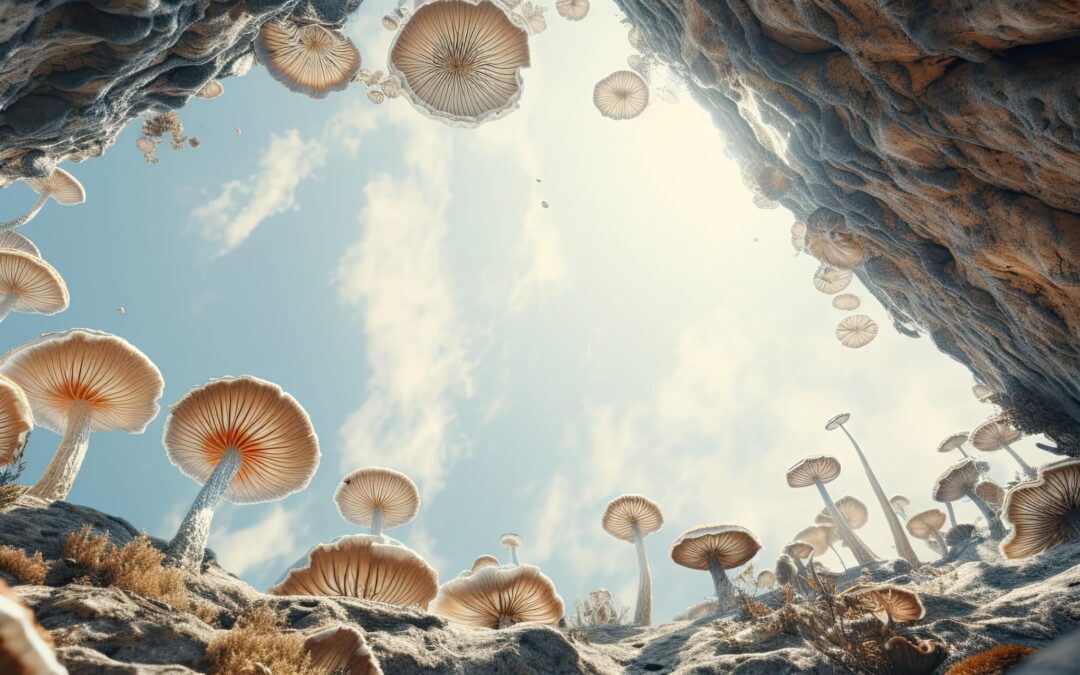

The more we learn about evolution, the more we understand it to be a process of cooperation and symbiosis. We might even call it generous. This cooperation is key. Living alongside a group of people doesn’t automatically lead to increase well-being. Rather, it is when we cooperate with others and understand their needs and our own that we truly benefit from being a part of the collective. It is similar to how mycelia alongside plant roots do not benefit the plant. It is only when they join together that both species become stronger and more nourished.
The Illusion Of Individuality
Humans, of course, operate within numerous illusions: The illusion of control. The illusion of objectivity. The illusion of right and wrong. We also hold tightly to the illusion of individuality — the idea that we are little islands who can operate and survive without others.
When we look a bit closer, however, we see that only about 47 percent of the cells in our bodies are human cells. The of “us” is bacteria, fungi, and other microbes. The is that we evolved in reaction and relationship to the world around us, and are inextricably linked to the species we coevolved with. To survive and to allow our planet to thrive, we are being called to remember our symbiotic relationships with all of our relations. Where we end and begin is fuzzy, and this is true in the world of fungi as well.
Mushrooms emerge from underground mycelial networks made up of teeny tiny structures called hyphae. Mushrooms pop up, seemingly overnight. Yet, when we look closer, we see that the beautiful, vibrant, unique creatures we see above ground are the result of intelligent, sophisticated processes and infrastructure that take pace out of our sight. Mycelial networks are sometimes referred to as the “internet of nature,” but I disagree. Mycelial networks are living, breathing organisms. They aren’t restricted to where fiber-optic wire can be placed. Only 65 percent of us have access to the internet. Yet, 100 percent interact with the fungal world through every breath and every step.
We are not observers or participants in nature. We are nature. Large, historical movements are often narrated as “popping up out of nowhere” — think French Revolution, Arab Spring, or the Movement for Black Lives (M4BL). When we pay closer attention, we see that the network held the intelligence and intention of that event before it was seen by the world. I often think of what came to be known as DAPL (or Dakota Access Pipeline) protests in my home state of North Dakota. The news talked about “protestors coming out of the woodwork” and “making sudden, outrageous demands.” This coverage ignored the centuries of Indigenous activism. Capitalist narratives painted water protection as a “new, hippy-dippy idea.”
However, our ancestors have related to water as sacred since time immemorial, and passed that down through stories and body memories. “Water is life” was never a slogan. It is a deeply held inner-knowing for all of us. The camps and the people who stewarded those camps through brutal cold and brutal police responses could never have emerged overnight. They are the result of deep community organizing that has bound us for generations. They emerged because of a human knowing that in protecting water, we protect love. In coming together, we come home to ourselves and our ancestors’ dreams for us.
It is examples like this — of our brilliance and interconnectedness — that give me hope that we can return into right relationship with all of our relations by following the lead of mycelial networks and, in turn, aligning with the vision of our ancestors. This knowledge and recognition can divorce us from the illusion of independence, and deliver us into a life that honors the unions we have with all other beings.
Speaking of delivery. As a doula, I make sure that everyone in the birthing room goes to the bathroom when the birthing person prepared to start pushing. Why? Because of mirror neurons. If the support people in the room are holding their bladders, they are tightening their pelvic floors. When this happens, mirror neurons kick in, and the birthing person’s pelvic floor also tightens and makes it harder for the baby to make their way Earthside. If a baby’s heart rate drops during labor, I ask everyone in the room to take some deep breaths. As our heart rates steady, so does the baby’s. We are intertwined before, during, and after our births. Our bodies communicate through breath, nervous systems, and eye contact without our conscious participation. We are entangled through every interaction with each other and our planet.
We Belong Alongside All Our Relations
Over time, fungi have adapted an incredible resilience that allows them to survive in extremes. Humans have done something similar. Bismarck, North Dakota, in winter is intolerable, but in a large coat and warm car, you can get your errands done. Even in places where we live on top of each other, fungi are on top of us as well. A group of foragers in New York City have identified more than one thousand species of mushrooms since 2011. In places that we think of as devoid of nature, there are weeds in cracks, trees in parks, rats in train tracks, and fungi everywhere else. No matter where we live and walk, our built environment cannot separate us from our place in nature.
One major difference between humans and our fungal relatives is that, in most cases, fungi support and sustain the environments they live in. Humans, as of late, have been doing quite a bit of damage wherever we arrive. Despite all of their life-giving contributions, mushrooms are the source of some of the worst plagues on earth. They are also the best medicine we have, and provide vital nutrients to plants, soils, and animals. Similarly, humans have the capacity to organize and revolutionize, as well as the ability to harm and destroy.
We used to live in a more symbiotic relationship with the land and beings around us. We knew which plants to forage and how to not overharvest. We lived in a more seasonal rhythm, and saw the birds that flew over our heads as teachers. Our ancestors knew that we had a place and a role among our relations. We had practices to support interspecies thriving. On the west coast of Turtle Island, for example, Indigenous communities created elaborate, intentional systems for fishing salmon that supported the population of both people and fish for millennia.
That’s all to say, humans belong on this planet. We are a part of the interconnected web of life. Since time immemorial, the planet has benefitted from our belonging. It’s our more recent ways of operating that have knocked us out of a healthy orbit, extracting far more than we contribute, and threatening this web of connection.
Let me be clear that I am not suggesting a return to the good ol’ days. I understand the dangers of a nostalgia of simpler times when people with uteruses had even fewer rights, members of my lineage were killed for sport, and great ideas were seen as witchcraft. Even if we throw it way, way back to the Akkadian Empire, life was hard and complicated, and power structures reared their ugly heads in all sorts of sneaky and overt ways.
The cool thing about living when we do is that we can reconnect with our ancestral ways of knowing the land and its species, while also honoring the progress — however meager it sometimes seems — toward true belonging for every being. In many ways, they are related. The colonial mindset of nature as something to be conquered and extracted from dovetails quite well into the way we see interhuman relationships play out in extractive and exploitative ways.
If we think wildness is bad and should be domesticated, we are naturally going to organize in accordance with systems of oppression and try to tame our own wildness. This mindset also causes us to then reject the wildness of the people around us. When we remember that we belong here, we remember that all of our relations belong here — in all iterations of their wildness.
Reprinted with permission from Our Ancestors Want Us to Be Mushrooms by Madison Murphy Barney (July 2026, Red Wheel Weiser).
Madison Murphy Barney is a Two Spirit, Indigenous sister, doula, author, and public health storyteller. She authors the popular weekly newsletter “Our Medicine” and is frequently called upon as a thought leader in storytelling, health, equity, and community care.
Find holistic Energy Healing And Medicine in the Spirit of Change online Alternative Health Directory.
RELATED ARTICLES:
What Are Your Ancestors Trying To Tell You?
Mushrooms: Mycological Marvels In Nature And Your Kitchen
Recent Comments