
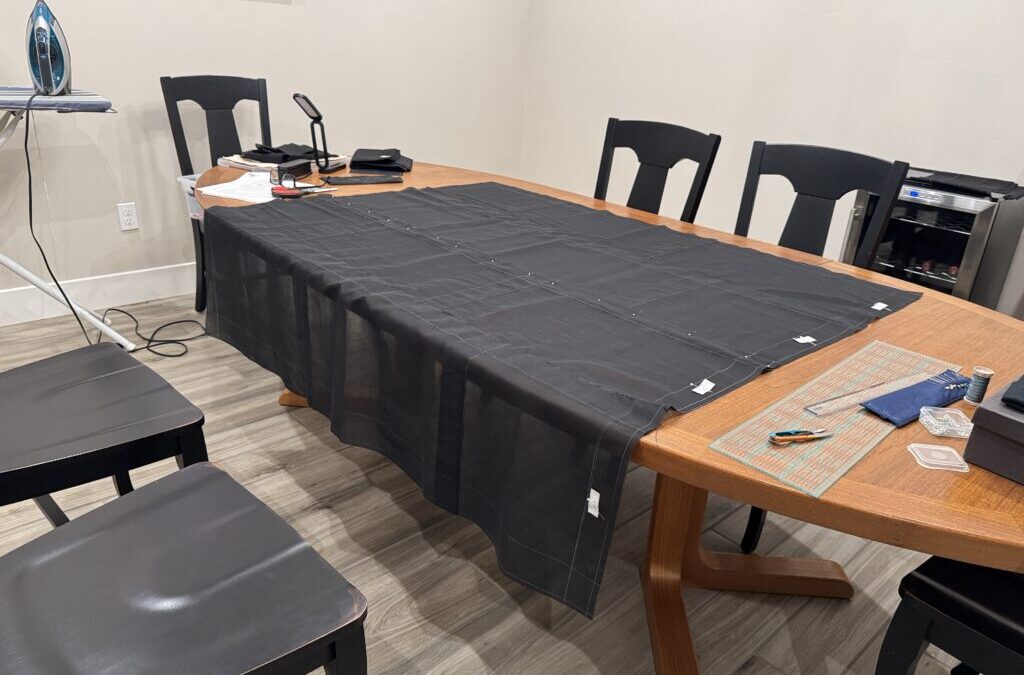
Several months ago, I asked permission to ordain as a priest at the Berkeley Zen Center. To become a priest has been a lifelong dream of mine — or at least one that I’ve dearly held in my heart for the last thirty years of my adult life. When my teacher said “yes” to my request, my immediate response was to burst into tears. My next response was to begin sewing.
In the Suzuki Roshi tradition passed down within Soto Zen, one is tasked with hand-sewing their ordination robes prior to receiving ordination, each stitch representing a mantra, or prayer — “Namu Kie Butsu,” meaning, “I take refuge in the Buddha.” This sewing isn’t of the formal liturgical robes and kimonos, but of an okesa — the traditional “Buddha’s robe,” a great patchwork quilt of cloth that will wrap around the inner robes during Zen ceremony and meditation.
“When our collective liberation is accomplished, it will also be because we didn’t check out when faced with overwhelming circumstances.”
All in all, the okesa measures around four by six feet, and consists of thousands of tiny little hand-stitches. The idea of completing this sewing project alone seemed an overwhelming task, almost like being asked to “empty the water from Lake Tahoe with a teaspoon.” Perhaps that was the point — this wasn’t something I could truly do “alone.”
I unrolled a long section of cloth on my dining room table. I gently flattened the fabric with my hands, pressing against the wooden surface that held so many memories: my aunt’s wedding cake, family holiday meals, even my high school math homework and the tears that often accompanied it. Squinting at the intricate diagrams and measurements written for me by my sewing teacher, I remembered the “This Old House” mantra to measure twice, cut once, but inevitably still made small mistakes along the way.
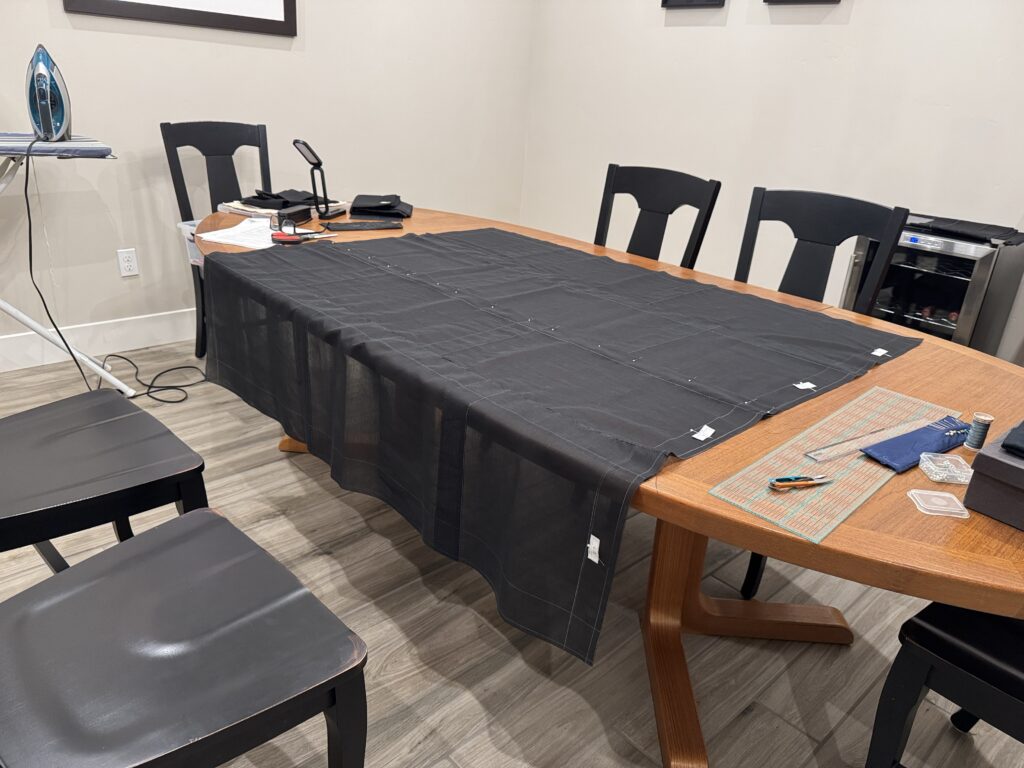
Drawing my breath sharply, I knotted the thread and made the first stitch: Namu Kie Butsu. After an hour of sewing, my dog begged for attention, and I stopped to survey my work before throwing the ball for him — six inches sewn, perhaps a hundred (or more) feet to go.
I played ball with my dog for a while, and eventually sat down again to sew, a headache brewing like a storm cloud in the back of my skull. I looked over the piles of cut cloth, and ran my fingers along the bumpy stitches I’d added, joining the first two sections of the okesa. I didn’t know how long this sewing project might take, or if my clumsy stitches would even be able to transform these scraps of cloth into Buddha’s robe or not. I added another six inches of stitching, ruminating on the task ahead.
Beings are numberless; I vow to save them.
The vow seemed overwhelming, almost to the point of absurdity, when I first took refuge nearly 25 years ago. How does one hold or even approach such an impossible task, other than to regard it as mere poetry, meant to bring a light to one’s path along the way, I wondered?
News and politics lately have been on my mind more often than not. Reading of cruel new executive orders from the White House, raids on immigrant communities, and violence perpetrated against transgender people have broken my heart. Memes have circulated with updates to Martin Niemöller’s famous poem, “First they came,” followed by the added statement, “and I spoke up, because I remembered the rest of the poem.” And so I’ve been speaking up. Months of strongly worded letters and voice messages left for my elected representatives were coupled with showing up at rallies and protests, holding my handmade signs high in the air with hundreds of others. And yet the news of horrors and of hate kept coming.
Somewhere inside the din and swell of the crowd within the last protest, I realized that as an individual speaking out, my lone voice felt small, yet as a movement, each of us were part of a whole, much as many small stitches make up the whole of my growing okesa.
My attention faded once or twice in sewing this past week, as my body dealt with an illness that had crept in. I looked at a long line I’d just sewn: my stitches had wandered off the line of tailor’s chalk, their chunky, unevenly spaced forms squat on the thin cloth. I gently picked each out, preserving the thread so I could carefully start over.
I noticed my attention to the political situation in the United States also fading, as I numbed my feelings in shamatha meditation and merely “dedicating the merit,” checking my mind out as an escape from feeling overwhelmed by the grief of the world. So many of my neighbors, friends and chosen family didn’t have the option to “check out” though — their very survival and well-being demand an alertness that my own privilege gave me the sense that somehow, I could turn away from. Just as each stitch within my okesa supported the others, our collective well-being in community means turning in to uncomfortable places, even starting an action over, if necessary.
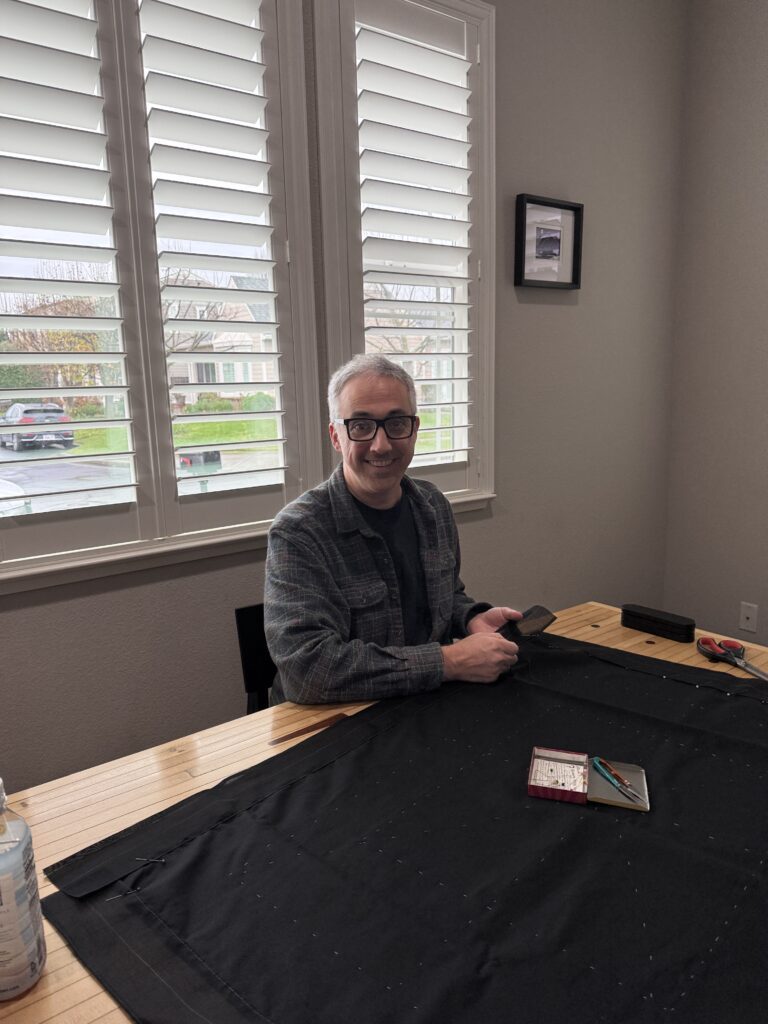
Sewing my okesa is not a truly solitary act. Many friends have lent stitches to my project, and when I finally receive it from my teacher this coming spring in my ordination ceremony, I receive it from the sangha, from the very community I vowed to support, to awaken with. When I finally put on the robe for the first time, I will wear the stitches I made with great mindfulness, as well as the threads I took out and re-sewed when my heart’s intention was brought back to my inattention.
The overwhelming task will have been accomplished, because I didn’t check out, tune out, or drop out, no matter how tempting it may have been. And when our collective liberation is accomplished, it will also be because we didn’t check out when faced with overwhelming circumstances. May we, with all beings, fully realize the Buddha’s Way.
The post One Stitch at a Time appeared first on Lion’s Roar.
Recent Comments