
I want to share a story, one that I think is important for us to recall at this time in our country. For as my friend Rebecca Solnit reminds us, our memory of the past provides us with the ingredients for insight into what might serve the future.
It is the story of the solidarity built during the Indian Salt March in 1930. Gandhi saw the monopoly and taxation of salt as an injustice, affecting all Indians, particularly the very poorest who could ill afford this essential staple. He chose to challenge the British government’s actions through satyagraha or nonviolent resistance against the British authority.
At the age of 61, he left his ashram on foot with only 78 others to make the 245 mile journey to the village of Dandi on India’s coast. As they walked from village to village, this small group of 79 grew exponentially as people from all walks of life began to join the march. Shop owners closed their stores and joined. Students left their classes. Farmers abandoned their fields. Hindus marched with Muslims. The highest caste walked alongside those of the so-called lowest caste. By the time they reached Dandi on April 5, many thousands were walking together, in solidarity, against the British rule.
“We must understand that democracy is woven through our collective spaces, our collective embodied actions, where we encounter each other, stranger and friend directly, and find our way through and with each other.”
At the coast, Gandhi picked up a small lump of salt from the mud. It was a simple act, but it was an act in defiance as Gandhi proclaimed: “With this, I am shaking the foundations of the British empire.” This small gesture inspired millions of people throughout India to process their own salt in violation of the law and within a few weeks, more than 60,000 people were thrown into prison, including Gandhi himself.
The British authorities responded with violence. At the Dara saltworks, police brutally beat nonviolent protesters as they approached the salt deposits, but the protesters refused to fight, nor would they withdraw.
This Salt March did not immediately bring India to independence, but it unified Indians across religion, caste, and class. Even today, it is an example of the power of solidarity and nonviolent resistance.
This campaign transformed the independence movement in India from an elite struggle into a massive civil disobedience movement of inclusivity, and it laid the groundwork for India’s independence in 1947. It is an example to us of how nonviolent resistance and protests carried out by ordinary people, united in a vision of care for others, can challenge the most powerful of oppressors through solidarity.
What Is Solidarity?
In 2011, Grace Lee Boggs wrote in The Next American Revolution: Sustainable Activism for the Twenty-First Century, “Movements are born of critical connections rather than critical mass.” Today, I honestly think it is both: critical connections plus critical mass.
Let’s look at what might be meant by solidarity, where, in our current situation, connection and critical mass could well make a difference.
Solidarity from a Buddhist point of view is expressed through mutual support and shared responsibility, emphasizing the interconnectedness of all beings, and the importance of actively addressing suffering and working towards collective well-being. I think these words express what a bodhisattva-based, socially engaged, participatory community is, and that is what we are exploring today.
As a first mental gesture, I think we should consider what Bill McKibben recently wrote: “What can I, as one individual do? Stop thinking as an individual.” And also what feminist theologian Ivone Gebara has written: “Nothing is saved alone; everything is saved in community.”
A few years ago, I worked with Dr Joe Henrich, an evolutionary anthropologist at Harvard. Joe shared that as a cultural species, we are dependent on learning from others, and I would suggest the same rubric applies to engaging in transformative, participatory political actions. We bring things alive in and through relationality, through community and collective actions that are focused on benefitting the greater whole.
Joe shared that the so-called “collective mind” found in interconnected groups generates richer ideas than in groups who are isolated and boundaried. We also know that these communities must be diverse for this generativity to happen. And like the Salt March, the solidarity movement of the Eastern Bloc, the Civil Rights Movement and the Vietnam Anti-war Movement of the past in the United States, protest movements, which have made and changed history, were nonviolent collective actions based on mutual support, diversity, inclusivity, shared responsibility, emphasized interconnectedness and cause and effect, and actively addressed immediate and long-term suffering, and pointed toward collective well-being.
From one point of view, the research in evolutionary anthropology has interesting parallels in the ethos of the bodhisattva perspective, emphasizing values related to respect, a sense of responsibility toward the wellbeing of all, compassion, inclusion, equity, justice, benevolence, resilience, wisdom, and collective action or solidarity.
Here is a little side trip with a koan that reflects this view:
A monk asked the tenth century Rinzai teacher Shoushan Xingnian, “What is a bodhisattva before she becomes a buddha?”
Shoushan replied, “All beings.”
The monk said, “How about after she becomes a buddha?”Shoushan said, “All beings. All beings.”
Shoushan is saying we are not separate from any being or thing. All beings indeed. Every being and thing. This is what Roshi Bernie Glassman meant by “one body,” or Thich Nhat Hanh meant by “interbeing.” This is the essence of solidarity. All beings….
We can also reflect what our African sisters and brothers call Ubuntu: “I am because you are.” One way we can look at Ubuntu is that we rise through lifting up each other. Or, in the words of the late neuroscientist and philosopher Francisco Varela: “The only world we humans know is the one we can create together through the actions of our coexistence.”
Truly, we have no life without others.
Interconnectedness
We can think of Avalokiteshvara, the bodhisattva of compassion, with her many hands and eyes. This image of the bodhisattva attitude reflects the actualization of interdependence and interbeing as a lived collective and participatory experience. All beings, all beings….
I remember Roshi Bernie and I were at a gathering in the Netherlands when someone asked if their individual efforts really mattered in helping to make the world a better place. Bernie asked everyone in the room to raise their hand if they had helped at least one person in their lifetime. When virtually everyone raised their hand, he pointed out that this showed how much collective impact was already present in just that one room. So many eyes and hands, one body, solidarity.
One of the most powerful visions of solidarity exists in the Avatamsaka Sutra, in the image of the Jeweled Net of Indra, where each node of the net is a precious and unique jewel that reflects all the other precious and unique jewels. The net is set against the boundless, empty sky. Indra’s net is a powerful image exemplifying the interconnectedness of all beings and things, the preciousness of each being and things, and the absence of a separate self, in the space of fundamental openness, a vision reflecting natural solidarity.
Recently, my colleague Lance Henderson reminded me that the AIDS Memorial Quilt was and still is an extraordinary expression of a network of collective loss, grief, love, compassion, and interbeing. Each panel, each individual quilt a life, a loss, and each reflecting the shared life, loss and love of the whole. The quilt was an embodied and visual metaphor of the power of collective action against the stigma and inaction in relation to AIDS. The quilt was and continues to be a powerful example of solidarity and collective action for the greater good.
Democracy and the Embodied Commons
Now, I want to touch into issues related to the rise of authoritarianism that we are experiencing today. Human rights lawyer Mónica Roa has pointed out in her brilliant article “Fascism and Isolation vs. Democracy and Interconnection: The Narrative Antidote to Authoritarianism” that we are caught in what she calls “narrative disputes.”
On one side of the equation is the tightening grip of AI, global corporations of extraction, the climate crisis, and, as well, of how COVID-19 has affected our psychosocial and global reality. She points out that the dominant narrative of individualism, competition, and notions of personal autonomy squeeze the life out of actions that are essential for strengthening democracy and building a culture for the greater good of all.
Increasing personal isolation undoes the benefits of our shared embodied experience of meeting each other in the commons of our everyday life, where we connect, discover, learn from others, and negotiate contact and cooperation. Instead, so many of us find ourselves isolated in the two-dimensional disembodied cubicle of the digital world.
Roa shares that “The narrative of individualism — both told and lived — has paved the way for the rise of authoritarianism by fragmenting our societies and eroding the communal ties that sustain us.”
As Rebecca Solnit, in her powerful new book No Straight Road, quotes Jessica Chang’s comments about mutual aid during the pandemic, “In the modern/colonial world, we are disciplined to be lonely. The oppressors call this loneliness ‘individuality.’” Along with important research in cognitive science by Molly Crockett, Joanna Macy, Mónica Roa, Rebecca, and Grace Lee Boggs make the point that relationality is the very basis of wellbeing, and that mutuality, empathy, caring, compassion, the commons, and community are essential for individual, collective, and species survival and for an open democracy.
Terry Tempest Williams, at Upaya Zen Center last November, made the point that now is a time to return to narratives that restore the vision that our connection with others and the natural world and that these narratives and actions of connection are core to a democracy that is truly open and, in fact, to our own personal survival.
In a way, we are in a loneliness hangover from the pandemic. Many of our embodied and connective experiences have been replaced by what Roa calls “individualized consumption of entertainment and services.” AI diagnosing our illnesses and giving us so-called care; gazing at our iPhones instead of at each other; sitting on our couch alone watching a film on Netflix and not sharing laughter in our local theatre; ordering out for dinner and not seeing what meal is being brought to the person at the next table; ordering from Amazon and missing the interpersonal negotiations of live shopping; going to a virtual museum to see a Rembrandt and not being caught in the revery of the viewer next to us; doing virtual meditation practice and not smelling the years of incense that has penetrated the wood and cushions of this sacred space; having a virtual office and no water cooler moment; being silently transported by a driverless car to a half empty glass tower in downtown San Francisco, instead of joking with the gig worker; or smashing the “like” button on X, instead of being enveloped in the “summer of love feeling” or the shared “sense of the possible” experienced at a protest rally.
When we sit in Upaya’s temple and do zazen with others, when we gather around the great table at Upaya for our dinner meal, when we together join a protest at Santa Fe’s capitol, when we plant the Three Sisters Garden as a community, hands in the dirt — this is where democracy can grow.
We must understand that democracy is woven through our collective spaces, our collective embodied actions, where we encounter each other, stranger and friend directly, and find our way through and with each other.
Roa writes that “technological platforms have imposed an individualism that now, for so many of us, governs our daily lives, maximizing economic gains.” I keep pointing out that our attention has been colonized by the corporate world when we take ourselves out of the spaces for collective living. Without these public spaces, the commons of our churches and temples, our parks, our theatres, our museums, our protests — embodied experiences of mutuality and connection — it becomes more and more difficult for us to visualize a commonly held and lived future.
Yet, know that there is another way.
Freedom is not achieved in isolation but through embodied connections that inform, enliven, and sustain us. As cognitive scientist Molly Crockett has pointed out, a country is not more secure when it shuts itself off from the world but when it meets with others, collaborates with others in addressing global issues. We can ask ourselves: are we as individuals more secure in our experience of relative isolation? I think not. Again, Joanna Macy points out that “It is the delusion that the self is so separate and fragile that we must delineate and defend its boundaries; that it is so small and so needy that we must endlessly acquire and endlessly consume; and that as individuals, corporations, nation-states, or a species, we can be immune to what we do to other beings.”
Together We Rise
Like the nonviolent Salt March or the Civil Rights Movement and Vietnam Anti-war Movement of the sixties and seventies, today’s protests related to our climate catastrophe and the horrors of the Gaza genocide and the current Mid-east war— experiences of collective, nonviolent defiance — are embodied moments that have gathered many around a common purpose dedicated to transforming political, social, and environmental realities for the greater good. They are collective actions about increasing security for all, not just ourselves.
Erica Chenoweth, a political scientist and professor at Harvard Kennedy School, studied nonviolent civil resistance movements and made an important discovery about the effectiveness of nonviolent movements: every campaign with active participation from at least 3.5 percent of the population succeeded, and many succeeded with less. Yes, we can speak about “the tyranny of the quantifiable,” to quote Rebecca Solnit, but this 3.5 percent number gives us an interesting benchmark. All the campaigns that achieved the 3.5 threshold were nonviolent; no violent campaign achieved that threshold. This finding suggests that no government can stand up against a challenge of 3.5% of its population without either accommodating the movement or disintegrating.
In the United States, it would take just eleven-and-a-half million people to meet that 3.5 number. So we are urged not to surrender possibility to despair or hopelessness. We need imagination and each other to move forward.
Repairing the Brokenness
Roshi Bernie, my teacher, had imagination. He was dedicated to tikkun olam: the project of “repairing” the brokenness in the world. He did not let brokenness stop him. In fact, he invited many of us to go to where there was brokenness, because he imagined a world where brokenness was repaired.
That is why imagination and the bodhisattva ideal of many hands and eyes, of lived interbeing, are so important right now. Instead of the fantasy of “the worst is yet to come,” it fosters imagination, imagination seeking the best of all possibilities and to do our collective best to actualize that possibility with and through each other in solidarity.
Looking deeply, we can see that the history of social movements and enduring social change is not the work of single individuals but of communities living the narrative of connection, of interbeing, of ethical, courageous, and caring solidarity, interconnected communities dedicated to the wellbeing of all. One person like Gandhi, Dr. King, Lech Walesa, Thich Nhat Hanh, Greta Thunberg, Mohsen Madawi might be the spark, but the movement only works because, like fire, we rise up together.
We must activate our collective power — the one that shows up in how we live, create, and narrate — to build a way ahead where the lived experience of interbeing, inclusivity, and solidarity is key to our shared freedom and well-being. “The point is not just to defend what we had, but to imagine something better: a society where well-being is not a privilege for a few,” to quote Rebecca, “but the certainty that each person’s well-being, each beings’ wellbeing, depends on the well-being of all.”
Or, to quote Joanna Macy: “If the world is to be healed through human efforts, I am convinced it will be by ordinary people, people whose love for this life is even greater than their fear.”
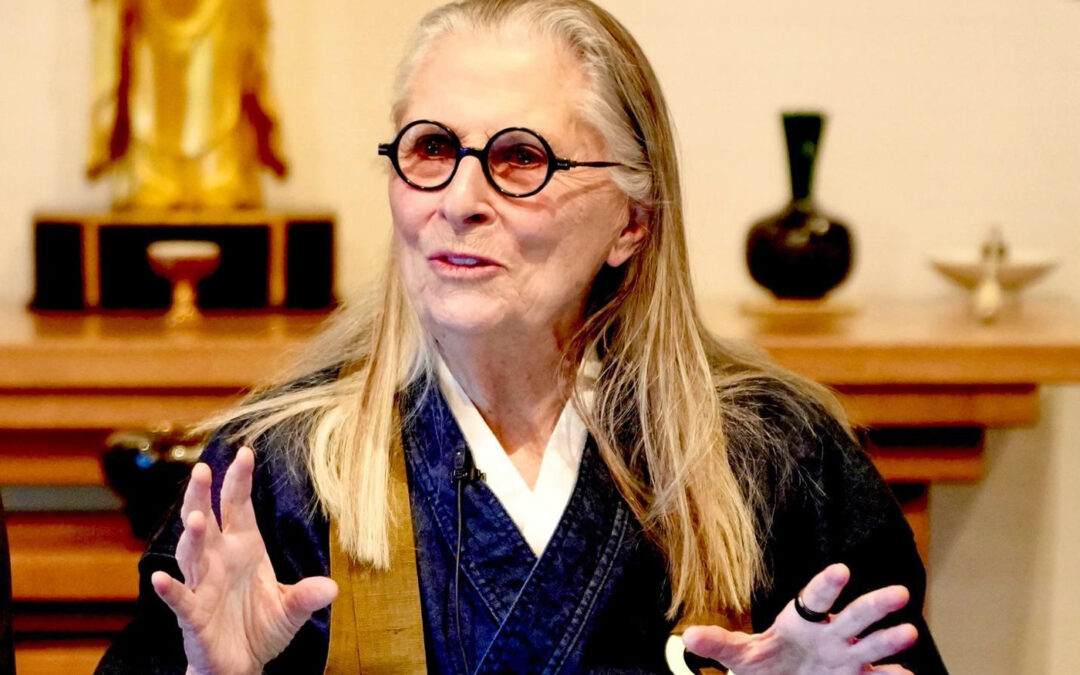
Adapted from a talk by Roshi Joan Halifax from Upaya Zen Center’s Awareness in Action series. You can watch the session in full by registering here.
The post Like Fire, We Rise Up Together appeared first on Lion’s Roar.
Recent Comments