
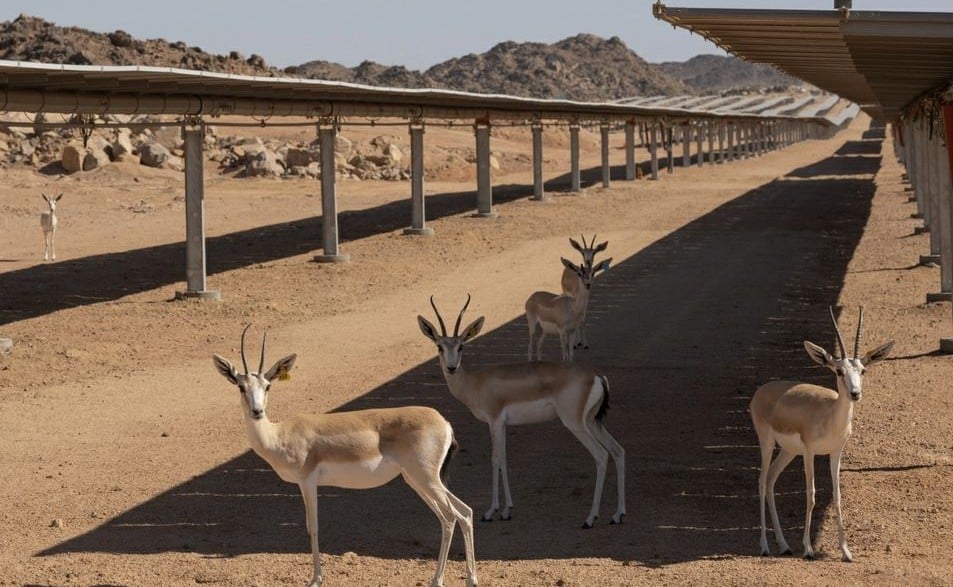

Saudi Solar Park Proves Brilliant Breeding Ground For Threatened Sand Gazelles
by Andy Corbley, Good News Network
In clearing two hurdles with one bound, Saudi conservationists have turned a large solar farm into a breeding shelter for a vulnerable species of native gazelle. Located near the Red Sea coastline in a massive, 24,500-square-mile nature reserve, the solar plant is now hosting Arabian sand gazelles, a species of special consideration for wildlife managers. Though commonly found across the world’s zoos, it’s believed only 3,000 of these small ungulates survive in the wilds of the Arabian Peninsula and Turkiye. Zoos are one thing, but a 250-megawatt solar power installation is another.
Wyoming Is Now A No-Kill State
by Best Friends
Using the most current shelter data available, national nonprofit Best Friends Animal Society just declared Wyoming the latest state to reach no-kill*, which means every shelter in the state saved 90% or greater of the pets in its care for 12-consecutive months. The state now joins five other no-kill states, Delaware, Idaho, New Hampshire, Rhode Island, and Vermont, in saving every healthy or treatable pet in their shelters. Wyoming reached no-kill at the end of August 2026, saving 92% of all pets in its animal shelters for 12 consecutive months.
More Than 1 Million Comments Opposing Roadless Rule Rollback
by Brian Willis, Sierra Club
Today, the Sierra Club and partners around the country announced that more than one million public comments were submitted in opposition to the Trump administration’s proposed repeal of the Roadless Area Conservation Rule, demonstrating overwhelming public support for protecting some of the nation’s most treasured national forests. “When the Forest Service spearheaded creation of the Roadless Rule in 2001 they used a robust public process to develop commonsense conservation policy. Contrast that with this administration, which aims to scrap the Roadless Rule for specious reasons while offering woefully inadequate opportunity for the public to engage.
Parents Hold Premature Twins For 1st Time Using Groundbreaking ‘Skincubator’
by Katlyn Fernandez, WFLA News Channel 8
A father and mother in Texas made history by becoming the first in the state to hold their premature twins skin-to-skin using the groundbreaking “Skincubator.” According to Children’s Memorial Hermann Hospital in Houston, Dorian Ojemen’s wife gave birth to their twins on Aug. 7, at 26 weeks. The parents could only touch their children through the openings of their NICU incubators for almost two weeks. Staff members at the hospital gave the parents “a wearable device that allows critically fragile newborns to experience skin-to-skin contact while remaining connected to essential medical equipment.”
Teenagers Worldwide Are Tackling The Plastics Crisis
by Michaela Haas, Reasons to Be Cheerful
When students in Singapore looked around their school cafeteria, they could see a problem shared all over the world: Single-use Styrofoam was ubiquitous. They soon learned that the school’s 2,000 students used 72,000 pieces of Styrofoam and other types of plastic every year. To find a solution, they joined the Unplastify Challenge, a global movement initiated by the Latin American social enterprise Unplastify and funded by the National Geographic Society, a nonprofit that seeks to foster environmental stewardship. What makes the program unique is its audience, design and scope.
Recent Comments