
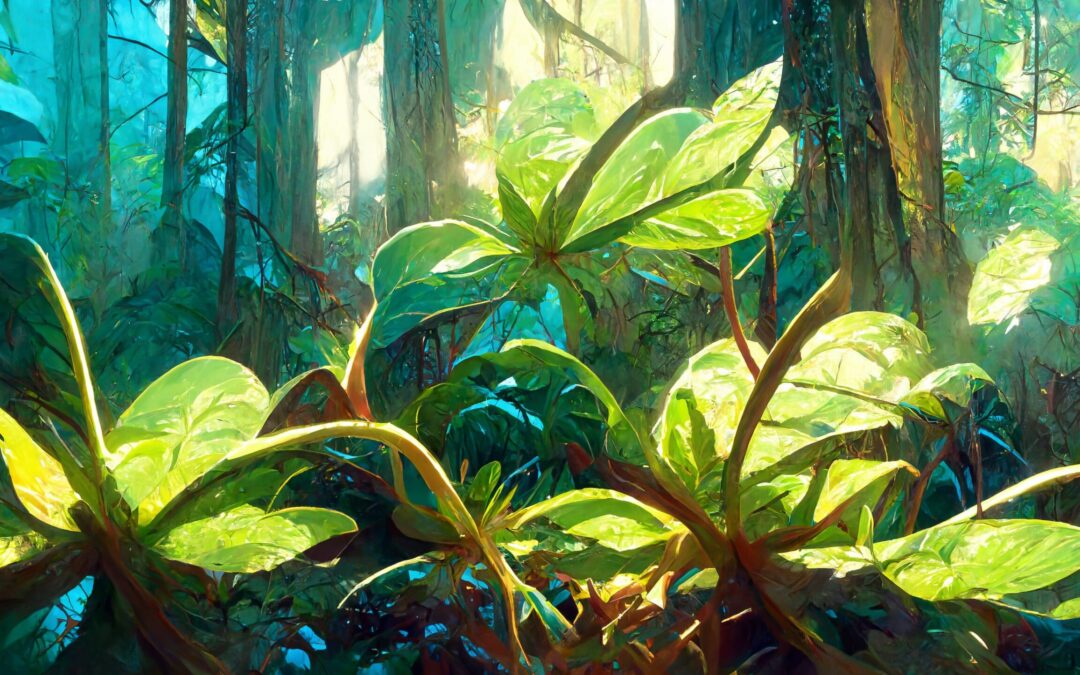

When I was a kid in Michigan there was a patch of woods with a stream running through it behind our neighborhood, and one of my great pleasures was turning over fallen logs to see what lived underneath.
It was always more than you’d expect: beetles and centipedes and pale threads of root, the soft orange of rotting wood, that rich dark smell of soil doing its slow work. Nobody was in charge down there, and yet nothing was wasted. Everything was feeding something else.
I didn’t have the words for it then, but I remember the distinct feeling that the woods weren’t a battlefield. They were more like a vast, patient, mostly invisible act of sharing.
That memory came back to me this week reading about Toby Kiers, an evolutionary biologist who just won a MacArthur “Genius Grant” for doing, with quantum dots and imaging robots, what I could only do with my hands and my curiosity: looking under the forest floor. And what she’s found down there is astonishing.
Beneath almost every plant on Earth runs a web of mycorrhizal fungi, threads finer than a human hair, trading nutrients with plant roots. Kiers and her colleagues have learned to tag phosphorus with glowing nanoparticles and actually watch the trade happen, and what they’ve documented is essentially a living marketplace.
Earth’s Astonishing Trader’s Network
The plants pay the fungi in carbon, the sugar they pull out of sunlight; the fungi pay the plants in phosphorus and nitrogen drawn from the soil. And it’s no sleepy exchange. The partners negotiate. Plants steer more carbon to the fungi that deliver the best return, and fungi withhold nutrients from plants that don’t pay fairly.
Kiers calls these networks “one of Earth’s circulatory systems”, and says watching them trade is like watching the best poker players in the world. The fungi even favor future opportunities over short-term gains. They’ve been refining this underground economy for more than 450 million years, since before there were trees, since before there was much of anything alive on land at all.
This isn’t some sappy, sentimental story about how nature is sweet and everybody hugs. There’s reward and punishment in that fungal market, hard bargaining, even cheating. But that’s exactly the most important part.
Cooperation in nature isn’t the absence of self-interest. It’s what happens when self-interest discovers, over and over, across billions of years, that the partners who work together tend to outlast the ones who only fight.
And it runs deeper than the forest floor. It runs all the way down into you and me.
The most successful living things on this planet have always been the best collaborators, and that includes us.
The biologist Lynn Margulis spent her career, much of it being dismissed by her peers, arguing that the eukaryotic cell, the kind of cell that built every plant and animal and fungus and human being, is itself a “merger.”
The mitochondria powering every cell in your body (yes, the same ones you learned about in seventh-grade biology) were once free-living bacteria that, a couple of billion years ago, moved in with a larger cell and simply never left.
You are not a single organism in any simple sense: you’re a cooperative, a federation of once-independent lives that figured out they did better together. Every breath you take is powered by an ancient act of partnership.
The most successful living things on this planet have never been the fiercest competitors. They’ve always been the best collaborators, and that includes us.
Here’s Why I Keep Circling This
The story our culture tells about nature isn’t a neutral description; it’s a mirror we hold up to justify how we treat each other. For a century and a half, we’ve run our economics and our politics on a cartoon of Darwin, “survival of the fittest,” “nature red in tooth and claw,” a world of ruthless competition where greed is just realism and kindness is a luxury we can’t afford.
Elon Musk tells us that compassion is a pathology. Capitalists think of themselves as Masters of the Universe and are trying to live forever because, they say, their ability to amass wealth amongst so much poverty is proof of their inherent superiority. We built whole ideologies on it. And it turns out to be, at best, half the story, and arguably the smaller half.
A Russian naturalist named Peter Kropotkin saw this clearly more than a century ago. Traveling through Siberia, he kept looking for the bloody, every-creature-for-itself competition the Social Darwinists had promised him, and mostly couldn’t find it.
What he found instead, again and again, was animals surviving brutal conditions by helping one another, and he wrote it all down in a book called Mutual Aid: A Factor of Evolution. His argument was simple and, we now know, largely right: cooperation isn’t a soft exception to some harsh law of nature. Cooperation is one of the central engines of evolution itself.
Giving Ourselves Permission To Cooperate
So, what do we do with this? I don’t think it means we paper over conflict or pretend competition doesn’t exist. It means we stop mistaking the cartoon for the truth.
The next time somebody tells you that greed is just human nature, that it’s every man for himself because that’s how the world really works, you can know, with the full backing of modern biology, that they’ve got it almost exactly backwards.
The fungi worked out fair trade before our ancestors crawled out of the sea. The cell learned partnership before it learned much of anything else. We are the descendants, top to bottom, of billions of years of life learning to work together.
That’s not a reason for naive optimism. But it is, I think, permission. Permission to build companies and communities and economies around the assumption that people mostly want to contribute, not just compete.
Permission to treat mutual aid not as charity but as the most natural thing in the world, because it literally is.
So, the next time you’re tempted to believe the cynics, go turn over a log. Put your hand in the soil. You’re standing on top of the oldest and most successful cooperative the planet has ever known.
Reprinted with permission from Thom Hartmann’s substack The Wisdom School: What It Means To Be Human.
Thom Hartmann is a NY Times bestselling author 34 books in 17 languages and the nation’s #1 progressive radio host, as well as a psychotherapist and international relief worker. Sign up to receive The Hartmann Report, a daily newsletter of Renaissance thinking about progressive politics, economics, science, and the issues of our day.
Find holistic Aromatherapy Resources in the Spirit of Change online Alternative Health Directory.
RELATED ARTICLES:
Our Ancestors Want Us To Be Mushrooms
Building A Society On The Cooperative Wisdom Of The Forest
Recent Comments