
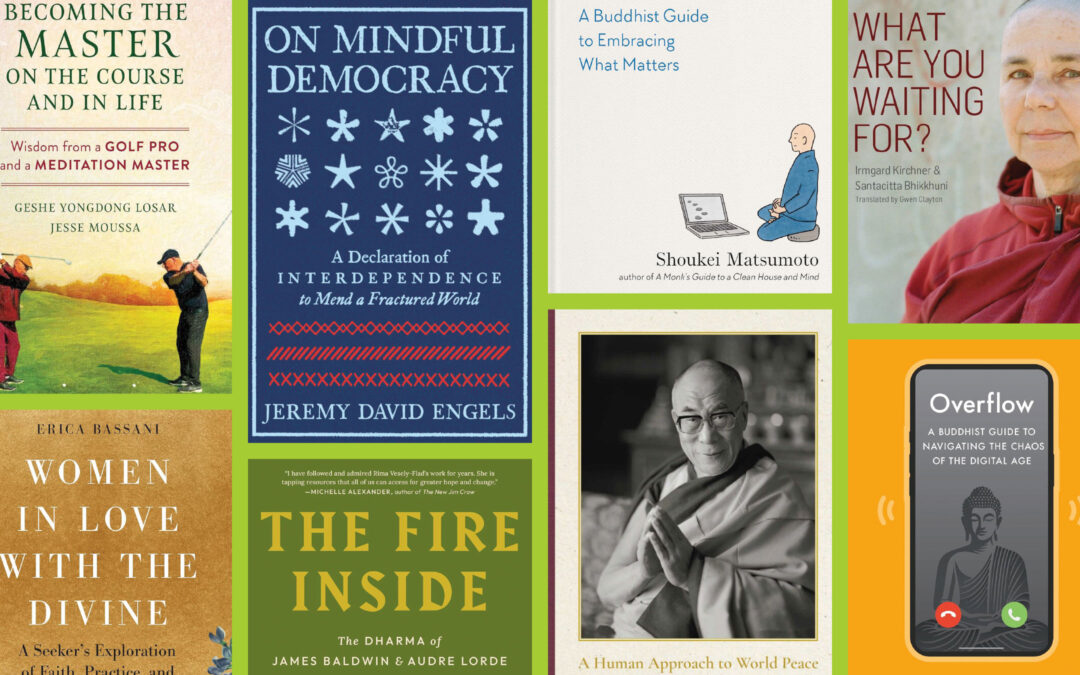
Geshe YongDong Losar, a Tibetan lama who emigrated to Canada in his late twenties, decided that he wanted to learn how to play golf. Enter Jesse Moussa, professional golfer and private golf teacher. As the two men spent time on the golf course together, they came to realize that lessons in playing golf often echo Buddhist teachings on how to live well, and that Buddhist teachings were equally applicable on the golf course. In this way, their joint project, the book Becoming the Master on the Course and in Life: Wisdom from a Golf Pro and a Meditation Master (Wisdom Publications), was born. Themes such as expectation, relaxation, commitment, and balance are explored, with each man writing his own chapter on each theme. Read this book if you are a golf lover who wants to improve your game or if you simply love exploring Buddhist philosophy in a variety of contexts.
“The time has come to raise the voices of this distinctly feminine spirituality that runs close to the ground, so it can ignite a movement of openhearted contagion,” writes Erica Bassani in her book Women in Love with the Divine: A Seeker’s Exploration of Faith, Practice, and Feminine Power (Shambhala Publications). In her personal quest for spiritual meaning, Bassani sought role models and found that women’s spirituality had historically often been relegated to the shadows. With her new book, as well as her multimedia project Women Awakening, Bassani hopes to bring women’s spiritual practices and relationship to the divine to the forefront. The Women Awakening Project is an online platform that features texts, interviews, and more from women spiritual teachers across a wide spectrum of traditions. Her book is a collection of conversations with twelve women from different spiritual paths, including Buddhism, Daoism, Hinduism, Christianity, Islam, and Judaism.
Jeremy David Engels’s latest work, On Mindful Democracy: A Declaration of Interdependence to Mend a Fractured World (Parallax Press), explores how mindfulness can help revive true democracy. The author has composed a new Declaration of Interdependence with the same number of words as the original Declaration of Independence. The reader is invited to sign it and carry it with them as a pledge to reach out and connect to different people and communities every day. Engels believes that by embracing our interconnectedness and by fostering Beloved Community—a concept popularized by Martin Luther King Jr. to describe a society grounded in justice, compassion, and mutual care—we can live more democratically. According to Engels, “When it comes to the challenge of caring for each other and for this life that we share, it’s all hands on deck. Even small acts of kindness and compassion help to build a world that is freer, happier, and more at peace.”
Literary giants James Baldwin and Audre Lorde are both known for their exploration of racism, sexuality, and politics in America. In The Fire Inside: The Dharma of James Baldwin and Audre Lorde (North Atlantic Books), author Rima Vesely-Flad celebrates their work, tying their ideas to Buddhism. She writes that her Buddhist practice has allowed her to understand the insights that Baldwin and Lorde express, as she seeks to liberate herself from suffering through the power of ideas and words, and via the heritage of Black, queer luminaries and Buddhist teachers. Vesely-Flad also presents a variety of practices that she has collected and adapted from different sources, including a fire ceremony from Lama Rod Owens’s 2024 book The New Saints and the sadhana of awakened melanin, which was developed by Justin Miles, a teacher in the Shambhala tradition.
Following the Japanese bestseller A Monk’s Guide to a Clean House and Mind, author and monk Shoukei Matsumoto returns with Work Like a Monk: A Buddhist Guide to Embracing What Matters (Tarcher). Matsumoto believes that his job is like that of a translator; he helps make ancient Buddhist wisdom comprehensible to modern folks, in this case addressing the world of work. The book is written as a dialogue between two fictitious characters, each of whom represents an aspect of the author’s own identity. A businessman employed in human resources and whose responsibility is to make work happier for employees discusses Buddhism with a temple priest who lives peacefully in his mountain temple, providing comfort and calm to the local population. Themes include walking, pilgrimage, the act of greeting, and being a good ancestor. Matsumoto’s sees stories and everyday actions like cleaning as paths to mindfulness.
His Holiness the Dalai Lama wrote the famous essay “A Human Approach to World Peace” forty years ago, when he was in his fifties. With the generous help of the International Campaign for Tibet and in honor of the Dalai Lama’s ninetieth birthday, his essay has just been republished. A Human Approach to World Peace: His Holiness Tenzin Gyatso Dalai Lama XIV (Wisdom Publications) includes a foreword written by Richard Gere, who also took some of the black and white photos of the Dalai Lama that are included in this new edition. The book includes an epilogue in which the Dalai Lama looks back at the work he’s done for world peace over the years. We are reminded that a universal, humanitarian approach to global problems is the only way to harmony, and that love and compassion are the moral fiber that binds us together. In an increasingly connected world, we can no longer ignore how interdependent we are. Our newfound understanding of this shared humanity can help us on our path toward peace.
This pair of Austrian authors clearly had a lot of fun putting together their book What Are You Waiting For?: A Conversation About Buddhism Between Two Friends (Windhorse). Journalist Irmgard Kirchner and her cherished lifelong friend Buddhist nun Santacitta Bhikkuni have a wideranging dialogue about Santacitta’s Buddhist path. With Kirchner’s frank, curious questions and Santacitta’s unusual and colorful life story, the book offers a fascinating read for both seasoned Buddhists and curious newcomers. A former student of cultural anthropology and a dance and theater performer, Santacitta went on to spend many years in formal meditation practice in a male monastic environment. Later, she traveled to the United States, where she helped open a branch monastery for women. She was ordained at Spirit Rock Meditation Center in 2011. The book explores the basic principles of Buddhism, what it means to be a woman Buddhist, and how to begin a Buddhist practice.
Overflow: A Buddhist Guide to Navigating the Chaos of the Digital Age (Shambhala Publications) provides a spiritual navigational guide to help manage the pitfalls of our contemporary lifestyle. If you wonder how to make decisions when you’re overwhelmed with possibilities, if you find it impossible to stay focused when there’s so much noise, if you seek serenity in the face of being solicited repeatedly by emails, texts, and calls, and if you’re open to Buddhist spiritual practices, this book may be for you. Meditation can help with decision-making, physical and mental health, our capacity for empathy, creativity, and recognizing our true nature. Author Vincent Thibault draws largely on the Nyingma tradition of Tibetan Buddhism, although some exercises are presented in a nontraditional manner. He hopes that his book will provide a deeper understanding of what Buddhism is and how it can help us in our current predicament. He believes that through spiritual practice, we can transform digital overload into spiritual overflow.
The post Books in Brief: March 2026 appeared first on Lion’s Roar.
Recent Comments