
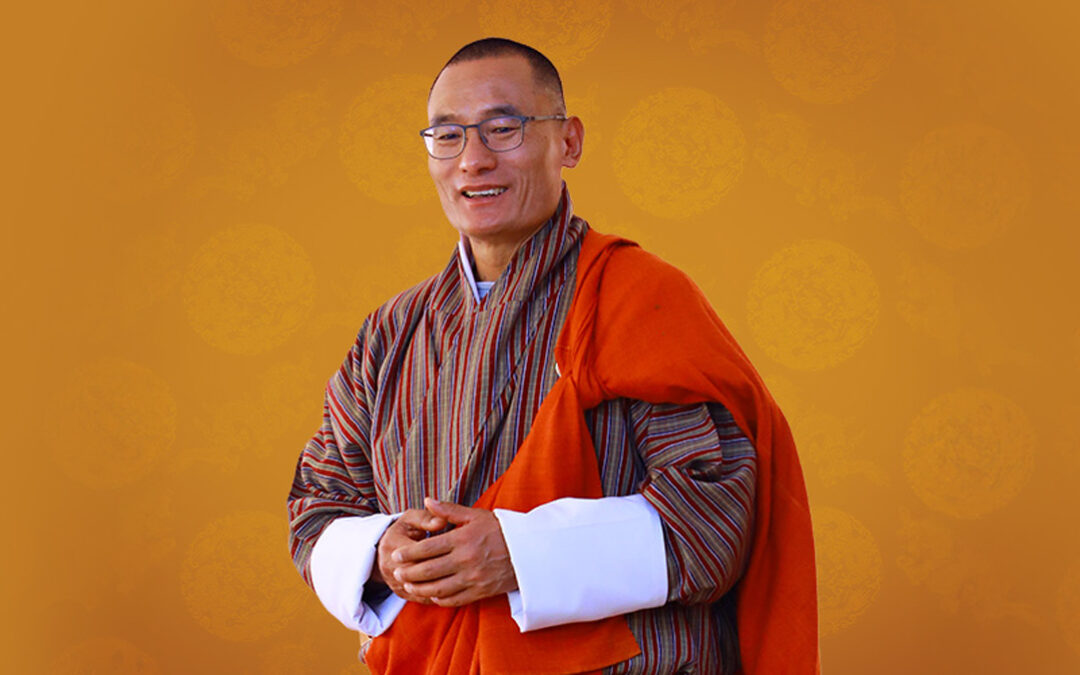
Lion’s Roar: As prime minister, are there any particular Buddhist teachings that inform your leadership style?
Prime Minister Tshering Tobgay: I was inspired by our spiritual heritage, part of which is that we believe in bodhisattvas.
There’s this trinity called Rigsum Gonpo: the bodhisattvas of wisdom, courage, and compassion. Wisdom is embodied by Jampelyang (Manjushri), courage by Chana Dorji (Vajrapani), and compassion by Chenrezig(Avalokiteshvara). These three bodhisattvas are all worshipped individually, but they are also worshipped collectively.
There are many other bodhisattvas, of course, but to me an enlightened leader expresses the virtues of these three bodhisattvas and is driven by selfless service, like bodhisattvas who come back in the cycle of samsara for the benefit of others.
Enlightened leaders, exercising wisdom, know about the future. They know what has to be done. Rather than leaving wisdom to books, they actually want to implement it. It takes courage, and in implementing it, sometimes it’s very difficult for many other people. Hence, compassion is required to understand that change is going to cause suffering. So, I’ve been personally inspired by the Rigsum Gonpo, the trinity of bodhisattvas.
I see our king as the emanation of Rigsum Gonpo. In what he does, I see him embody the virtues of Jampelyang in knowledge and wisdom, Chana Dorji in courage, and Chenrezig in compassion. In my life, I seek inspiration from my king. In terms of decision-making, I remind myself what enlightened leadership is all about. I am definitely not an enlightened leader, but I do contemplate the importance of wisdom, courage, compassion and the importance of selfless service.
The Bhutanese concept of Gross National Happiness is widely regarded as Buddhist-inspired. How do you ensure that it continues to be a living, evolving principle rather than a symbolic ideal?
Many of our policy decisions are informed by the principles of Gross National Happiness. We have a state religion [Vajrayana Buddhism, specifically the Drukpa Kagyu school]. In the Constitution, we have clauses clearly mentioning that the state’s responsibility is to promote the conditions of Gross National Happiness. So, by law, it’s required.
How do you integrate Buddhist philosophy and practice in the Bhutanese education system?
Firstly, in the monastic schools, it’s a given. But even in the modern schools—which have a modern curriculum with a lot of emphasis on languages and STEM subjects—spirituality, mindfulness, and meditation are taken very seriously. It’s a part of the curriculum, especially in social sciences, but it is also part of the extracurricular activities—engaging with monks, receiving teachings from monks, blessings from monks, offering rituals and prayers in the school for the school. We have a lot of Varayana rituals, so every school conducts them, and children take part. Then, of course, there are trips to monasteries and also taking part in village festivals that are spiritual in nature.
How do you envision Bhutan’s Buddhist heritage continuing to shape its future, especially for younger generations?
Our Buddhist heritage, our spiritual heritage, is the basis of our culture. And our culture is the basis of our identity. Our identity is extremely precious because we are such a small country with barely 750,000 people, and therefore we ignore our identity, our culture, and our spiritual heritage at our own risk. Just for practical reasons, we need to take care of our spiritual heritage.
Why did Bhutan decide to host the very first Global Peace Prayer Festival, held November 4–19?
Individual peace is essential for social harmony, and I see the Global Peace Prayer Festival as an expression of this. Bhutan is a small country that is renowned for peace and harmony, that is blessed with an enlightened king under whose enlightened leadership and guidance our people enjoy a profound level of peace, stability, and harmony that is really difficult to find elsewhere. We also have a tradition of offering prayers and conducting rituals for peace. So, I believe that we are doing basically what we do all the time here, which is conduct prayers for peace. The scale of this particular festival is huge, but all of us—every household in Bhutan—has been doing this all along.
The post Bhutan’s Prime Minister on Enlightened Leadership appeared first on Lion’s Roar.
Recent Comments