
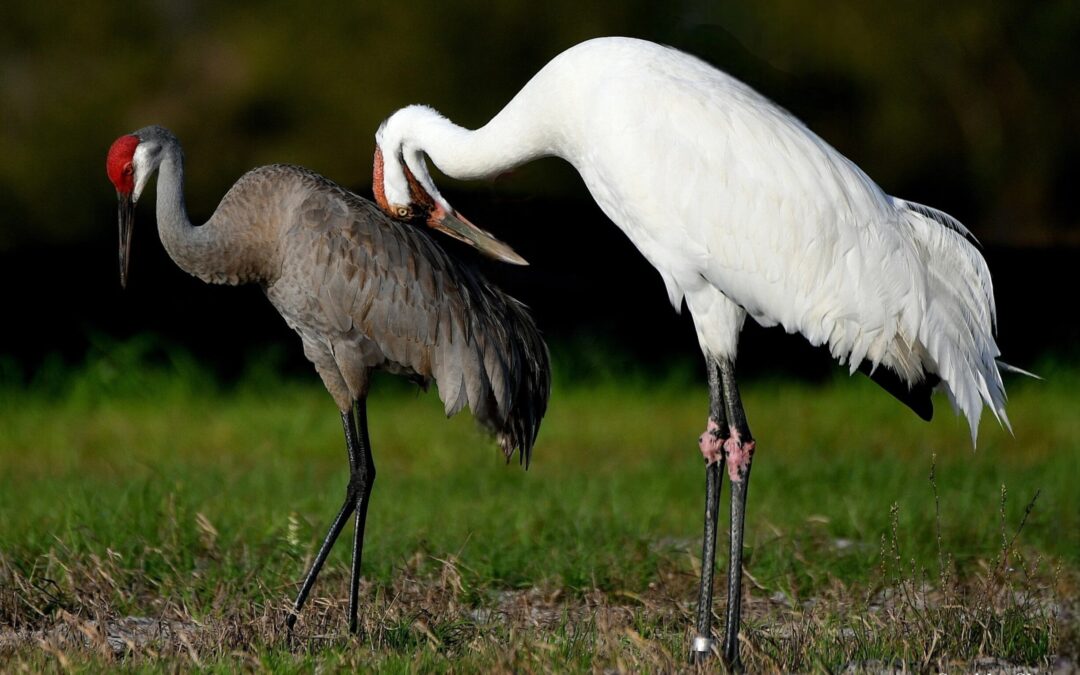

Sandhill crane and endangered whooping crane, whose home of an open meadow was turned into a subdivision/construction site. Despite the crane’s ability to fly, leaving a home you found safe to live and raise young is not easy. Photo©Staci-leeSherwood
When people think of wildlife in their town or city they usually think of squirrels, small birds, raccoons and skunks. Plenty of other wildlife also eke out a living near people, but we don’t always see them.
Some of those we know live nearby but rarely see are fox and coyote, but many birds of prey have had to adapt to an ever developing world where trees and food are more abundant in cities than outside of them. It’s not uncommon today to find owls, hawks, falcons and osprey sharing their home space next to yours. Even shorebirds and sea turtles have begun sharing their nesting habitats, as more beaches are built up and occupied by humans, leaving very few unspoiled islands left.
The habitat for ground nesting birds like cranes and quail often becomes a subdivision or shopping mall as sprawl moves further into rural areas. The photo above is of a sandhill crane and endangered whooping crane, whose home of an open meadow was turned into a subdivision/construction site. Despite the crane’s ability to fly, leaving a home you found safe to live and raise young is not easy.
The Need To Co-Exist
Long before humans appeared on Earth, life had been surviving and thriving here for hundreds of millions of years. While it’s true there have been five mass extinctions, about every 50 million years or so, this sixth mass extinction currently underway is almost entirely caused by humans. It’s not just mammals, but all species — from trees and wildflowers to insects and reptiles — that we are losing at alarming rates.
Many scientists call this the Anthropocene Period, meaning man-made extinctions.
“As scientists, we have to be careful not to be alarmist,” Ceballos acknowledged — but the gravity of the findings in this case, he explained, called for more powerful language than usual. “We would be unethical not to explain the magnitude of the problem, since we and other scientists are alarmed,” from this 2023 Stanford University report “Study finds human-driven mass extinction is eliminating entire branches of the tree of life”
Most non-human species are decreasing in population as we squeeze them out of their natural habitat for development, contaminate their air and water (also our water and air), kill them outright for sport, and leave them with nowhere to go and little to eat. We have forever damaged the planet’s protective ozone layer and have caused the continual warming, and in some places cooling, of places unequipped for such drastic changes. If we don’t start to co-exist with other species now, we will be the only species left on an unstable and dying planet.
Why So Many Wild Animals Choose City Life Over Wilderness
Urban life for many species is not a choice but a necessity. The uninhabited space they had for millions of years has vanished. For them, living near people is based on survival and the drive to find food. As their habitat becomes more fragmented through development, their food sources vanish. Starvation can lead any animal to desperation. Some species have learned to adapt to living in close proximity to us — even thrive — but others have not fared so well. Foxes and coyotes, for instance, have learned to navigate around us even in a noisy crowded habitat.
Many city dwellers describe living in such close quarters akin to being a sardine in a can. One can imagine how wild animals view this living arrangement. In the wild, the gray fox territory ranges from one to six miles of woodland, while a coyote typically has a range up to 15 miles. Urban areas could be half that or less.
Finding steady food sources and safe places to den during breeding season is a challenge not all wild canines succeed at. The need to find mates, shelter and food for pups can cause these wild canines to venture too close to high traffic roads or homeowners that prefer to call animal control than share. No one knows how many fox and coyote die this way, but you can imagine the stress if you had to live under these circumstances.
For birds, especially birds of prey, city life is tough and deadly. Owls are nocturnal, but urban life is brightly lit 24/7. This leads to window strikes, and makes hunting more difficult. Skyglow disrupts their natural behavior, can cause eye damage, and hinder their ability to navigate. Mother nature designed owls, hawks and falcons to live in a dark quiet wilderness not a busy city.
Foxes And Coyotes Are Ecosystem Allies, Not Villains
This gray fox makes his home on the grounds of a casino surrounded by cars and trains. Over the years this pair has raised several healthy young. but are now landlocked. The forests and meadows that used to be here have been replaced by subdivisions. Though foxes are smart animals many end up killed by cars or poisoned by those that see them as pests. If foxes are living in your neighborhood it’s because we took their home not the other way around. Clever animals, they can survive in urban areas but only out of necessity not choice.

This gray fox makes his home on the grounds of a casino surrounded by cars and trains. Over the years this pair has raised several healthy young, but are now landlocked. Photo©Staci-leeSherwood
Fox are an important part of a healthy ecosystem by helping to keep down the rodent population. Instead of using poison for a rodent problem, a family of foxes can keep them in check naturally and free of charge. Nocturnal by nature, they are a rare sight to see during the day. Despite living near people, foxes remain wary and more afraid of you then you need to be of them. While some populations are stable or increasing, their populations in the Midwest have declined so much that fox hunting has been cancelled in Illinois.
Like their fellow canine the fox, coyote can survive in crowded urban areas, mostly because they are most active at night when few people are out. Life around humans is not their first choice but a necessity as wilderness is destroyed for development, mining and logging.
We’ve all heard about coyotes killing cats or small dogs. While unfortunately that can happen, it’s not as common as the rumors make it sound. If you live in coyote territory, keep your cat indoors; after all, they’re domestic cats, not lions. Cats being killed by a car or poisoned by pesticides are far greater than killed by a coyote. As for dogs, they too should be kept on a leash, and not walked late at night.
Unlike wolves, coyotes tend to hunt alone, but form loose family communities. Urban living means they are used to being around humans, and usually move away once your presence is known, because coyotes don’t look for confrontation with people. Healthy animals do not attack people, especially unprovoked. The media makes them out to a villain to us, when truth is we are more a villain to them.
Protections We Can Choose For Wildlife Bird Populations
Birds love trees, to nest, sleep and observe. As we log what’s left of our forests more birds are forced to move to urban areas. Living in close proximity to us brings many dangers, which we can help mitigate if we choose. One of the most insidious dangers birds face is pesticide poisoning (herbicides in the garden and rodenticide). It is estimated that 67 million wild birds are killed every year by pesticides in the US, according to the American Bird Conservancy, with the US Fish & Wildlife estimating as high as 72 million birds every year.
The second biggest cause of death and injury for both migratory birds and local residents are window strikes. A staggering one billion birds die every year this way. Read more about window strikes and the need for bird-safe window treatments, as well as decreasing artificial light at night (which is also damaging to us humans).
By far, the biggest threat to North American birds is predation by outdoor cats (feral and pets), estimated to over 2 billion birds every year. As we cut down our forests, more birds are forced into the urban areas where dangers they never encounter in the wilderness hide. These numbers are not sustainable. ‘
Rachel Carson was right when she wrote Silent Spring in 1962. The book was a blatant warning we have ignored to our own peril and to the extreme population decline in other species. It’s never too late to read the warning and change our ways.

This group of royal terns is trying to cross the beach that allows trucks to drive on it during nesting season in Hugenout County Park in Jacksonville, FL. Despite the caution tape, chicks are run over and killed every year. Photo©Staci-leeSherwood
Many shorebird species like these royal terns, nest on public beaches. Unfortunately, these beaches do not close for nesting season, and caution tape with signs offer little protection from walkers, joggers and dogs. During nesting season many chicks are trampled or are fed plastic and cigarette butts by parents desperate to find food where there is very little. Scarce shade from developed dunes means hotter sand, and boiled eggs and chicks. Even on many nesting beaches, few structures are placed nearby for shade and weather protection. Hot sun and windy storms can devastate an entire colony of nesting shorebirds with nowhere to shelter. Learn why driving on the beach should be banned during nesting season.
As terrible as beach driving is, it’s not the only problem shorebirds face. Beach walkers and joggers that get too close to nesting birds or run into the group on purpose can cause nesting birds to abandon their eggs and chicks. Loose dogs can kill the birds. Beach trash often finds its way into the mouth of a chick when parents can’t find any real food. Dogs on beaches should always be on a leash.
Artificial Light Is A Global Crisis Unacknowledged
Sea turtles have been around for tens of millions of years and nested on quiet, dark beaches for many millennia. Now, most of those beaches are developed with houses and hotels and constant bright lights. Nesting females must navigate around the litter and lights if they want to nest. The dark beaches that gave them cover from predators no longer exist except for a few remote islands.
Artificial light, both individual and collective skyglow, causes millions of hatchlings to crawl toward the street following what they think are bright stars leading to the ocean. This is a global crisis. In Florida, depending on the beach, anywhere from half to 100% of hatchlings die this way, never making it to the ocean. Only a few beaches are still dark enough for most to avoid this man-made tragedy. The bulk of beaches that sea turtles nested on are mostly developed and brightly light all night long. Living on the beach means you are to be respectful of those wild animals that depend on a trash-free, dark environment, the same kind we would want.

Artificial light, both individual and collective skyglow, causes millions of hatchlings to crawl toward the street following what they think are bright stars leading to the ocean. Photo©Staci-leeSherwood
How To Help Wildlife Stay Wild And Away From Animal Control
• To help save birds from window strikes, look into bird-safe window treatments
• Save birds and all wildlife from a painful death by not using pesticides or rodenticides. This also prevents your exposure to cancer causing chemicals
• If you have cats, please keep them indoors. If that’s not possible, have them wear a collar with a bell.
• If you live in a cold climate, put out bird houses and feeders that you keep stocked. They will be much appreciated.
• For those living in coastal areas with sea turtles, turn off exterior lights after dark and close drapes. At the very least, change the bulbs to red “turtle-friendly” ones, which also make it easier and safer for you to see in the dark.
• If you have a fox or coyote that visits your property, let it be. At the very least, don’t call animal control to have it killed. Look for legitimate people who trap and transport wildlife to safer habitat. Think how you would feel in their place.
• When open space is proposed for development, especially in rural areas, get involved by attending meetings, and voicing concern for the wildlife that live there. Try to shrink the size of the development or ensure the animals there are moved to a safe wild area with similar habitat. It’s the very least developers and government officials can do for them when taking their land.
Reprinted with permission from realitycheckswithstacilee.com.
Staci-lee Sherwood is a lifelong preservationist, environmentalist and animal advocate. She is a published writer, blogger and poet, who writes poetry for fun and investigative articles to educate and motivate people into action at www.realitycheckswithstacilee.com. Staci-lee is an avid photographer and hiker who calls the East Coast home with her rescue kitties.
Find holistic Reiki practitioners in the Spirit of Change online directory.
RELATED ARTICLES:
The Rewards Of Living With Wildlife In Your Backyard
To Feed Or Not To Feed? The Dilemma Of Interacting With Birds And Other Wildlife
Recent Comments