
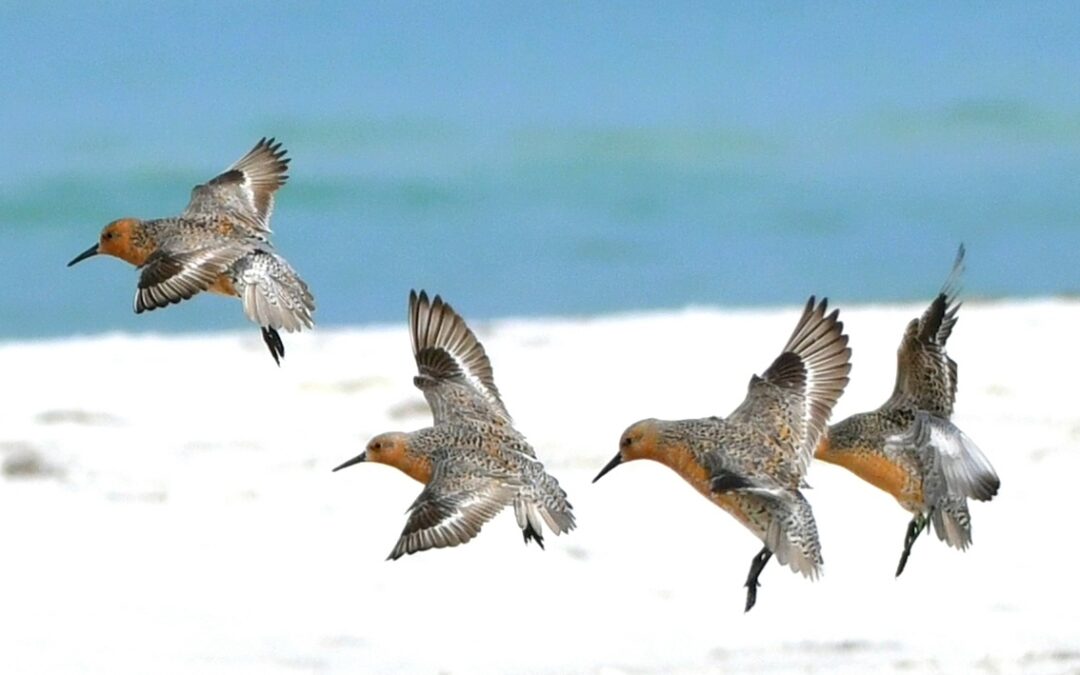

Red Knots have the longest migration of well over 9000 miles each trip. They can travel from as far as southern Argentina to breeding grounds in the Arctic tundra. Photo courtesy Staci-lee Sherwood.
Every spring, billions of birds migrate from their winter home to their nesting grounds, and then reverse the journey in the late summer or fall. For anyone who’s traveled long distances, you know how exhausting and sometimes tedious the journey can be.
When we travel to the same place, we often use markers so we know we’re on the correct path. Birds do the same thing using a variety of navigational tools. However, their flight paths might have been formed thousands, sometimes millions of years ago by their ancestors using their own internal clock and cues.
Modern life with its tall buildings and reflecting glass windows has altered what used to be a long but relatively safe journey for migrating birds to one that is extremely dangerous.
The Mystery Of Migration
Why do some birds migrate while others don’t? Some species travel just a few hundred miles while others travel several thousand miles over mountains and oceans. These are amazing feats of nature no human would want to do twice a year. It’s exhausting and dangerous with no guarantee a bird arrives alive.
For mated pairs, it’s even more uncertain that both will arrive safely and able to breed and raise young. After breeding season the newly hatched chicks, just learning to fly, have the task of following in their parents’ footsteps. Unlike humans, birds don’t have a choice; they have to follow flock.
Migration through New York City is called the Atlantic Flyway, up from wintering areas in the southern U.S., and even as far as South America. These species travel to the northern U.S. or even the Arctic to breed, then back down after breeding season. The Mississippi Flyway connects birds traveling between South America and Canada through the U.S. Midwest. Tens of millions of birds travel these two routes, so it’s easy to see how many die hitting windows and buildings that didn’t exist a century ago.
Migratory birds have an internal clock that signals when and where to travel. While they inherit which routes to take from their parents, they also use other natural cues to guide them. At the start of their journey, birds use the sun, the stars and Earth’s magnetic field to steer them in the right direction. When they encounter storms, they can be blown off course. Some will eventually get back on track when the storm passes, others seem to choose to stay where they landed (in south Florida we have had a yellow-headed caracara living here for three years), and others die from exhaustion from an extended trip or landing where there is no food for them.
Scientists still don’t really know how birds learn to migrate or how the ever changing climate and landscape will impact them, however this Scientific American article discusses how migrating birds may use quantum effects to navigate.
What Causes Window Strikes?
What scientists refer to as the ancestor of modern birds has been around since the Cretaceous period, for about 85+ million years. Human-made obstacles like buildings and artificial light are very new but deadly obstacles birds have had to learn to adapt to.
Artificial light comes in two forms: direct and indirect, also known as skyglow. Direct light can be light from inside or outside a building that draws a bird to it. Skyglow is the cumulative effect of all light — from street lights and car lights to cell phones, store signs and building lights. This type of light brightens the entire horizon. Nocturnal birds, like owls, are disorientated by this because it interferes with their night vision, making it harder to navigate and see prey. When your eyes are designed to see in darkness, a bright sky is deadly.

It’s estimated over a billion birds die from window strikes, the second most deadly cause of death after outdoor cats. The NYC Bird Alliance research shows between 90,000 and 230,000 birds are killed in the city each year in these tragic, often preventable collisions. As if that wasn’t bad enough, millions more die from the use of pesticides, which kill them directly via aerial spraying and indirectly by killing or poisoning their food sources. It’s little wonder birds in general are in serious decline.
How You Can Help Save Birds
There are many ways to help migrating birds, or any bird, stay safe while in flight. The following are things for both residential and commercial buildings. Some are very easy and inexpensive, but the lives saved are priceless.
1. In 2020 a landmark piece of legislation was passed by the NYC Council called the ‘Bird Safe Bill’, and in 2021 became NYC Local Law 15, making it the largest city to enact such a law. This requires all new construction to be bird-friendly to reduce death by collision. However, it left a loophole of the millions of windows already in place, so there is a lot of work still to be done. On the national level, contact your Congressional Representative at https://www.house.gov/representatives and ask they support and bring to a vote H.R.3268 Federal Bird Safe Buildings Act of 2025 .

Canada’s anti-collision buildings use wind-activated holographic feathers to deter glass collisions.
2. Some companies have created innovative, new products that could be options if you are looking to make your windows safer. Bird safe window film has proven to be 100% successful at the Philadelphia Zoo and Bronx Zoo with no reported fatalities since the bird safety film installation. The film patterns are specially designed to break reflections on the glass, allowing the birds to see there is an obstruction without blurring visibility for humans. Canada’s anti-collision buildings use wind-activated holographic feathers to deter glass collisions.
3. Keep bird feeders and baths away from windows. Remove indoor plants from windows where birds are fooled into thinking it’s a safe place to land. Keep outdoor plants trimmed below window level. The American Bird Conservancy provides guidelines and tips for preventing bird to glass collisions at your home.
4. Get a group together to ask a large building owner if they could reduce nighttime light or put a treatment on the windows. Education is key to changing people’s minds and behavior.
5. Project Safe Flight began in 1997 by founder Rebekah Creshkoff, who noticed a huge crisis of birds dying from building collisions. This program is all volunteer and run by the NYC Bird Alliance. There is also a project safe flight/bird strike rescue groups run in Atlanta, Georgia by Birds Georgia; and in Minnesota by the Minnesota Bird Coalition; and in Chicago run by Chicago Bird Collision Monitors. These three states have millions of birds migrating every year and always need help. 
6. Volunteer with a local bird group to record and recover injured/dead birds, or help where injured birds might be rehabbed and released. If you find a stunned bird, time is everything; however, be very gentle but swift. It’s best to take any stunned or injured bird immediately to a rehab. If you are not near one, the “black box” protocol is the next best thing to do.
Staci-lee Sherwood is a lifelong preservationist, environmentalist and animal advocate. She is a published writer, blogger and poet, who writes poetry for fun and investigative articles to educate and motivate people into action at www.realitycheckswithstacilee.com. Staci-lee is an avid photographer and hiker who calls the East Coast home with her rescue kitties.
Find holistic Animal Services in the Spirit of Change online Alternative Health Directory.
RELATED ARTICLES:
Loving Hummingbirds To Death: Thousands Die Annually From Commercial Nectar
The Birds
Recent Comments